Pious meaning

Episode 26 — The true ending

Kaguya, Samehada, and the Seawater Deluge

Episode 26 — The True Ending
Slide 1: Episode 26 — The True Ending
Read slide transcript

Naruto Walkthrough — Reader Edition

Episode 26 — The True Ending

Kaguya, Samehada, and the Seawater Deluge

The time has come. In this final episode, we will unlock the true ending.

First, you may be wondering: why would there be a hidden, true ending to begin with?

Normal detective novels certainly invite the reader to try to unmask the culprit, along with the detective protagonist, as they read the story. But at the end of the story, they openly reveal the culprit, and the detective explains the whole plot, reminding the reader of all the clues that were given throughout the novel.

Naruto does something stranger: the novel never reveals the main antagonist’s identity, and it is up to the reader to solve the plot. Mr Kishimoto established this rule as early as chapter 1, as he never openly revealed that Mizuki had been acting under Hiruzen's orders. Chapter 1 taught that we would need to unlock the true plot by ourselves.

The ending we openly get, starting in chapter 679 with Kaguya’s return, is outright fake. So we, the readers, are supposed to understand by ourselves how the story actually ends. But why?

Why did Mr Kishimoto do that?
Why the true ending is hidden

Slide 2: Why the true ending is hidden
Read slide transcript

Why the true ending is hidden

Obviously, reading Naruto is more rewarding this way. But the actual answer lies in the pious meaning, and Mr Kishimoto’s decision to keep the true ending hidden will reveal Samehada’s true role.

As we saw in the third part of this walkthrough, Naruto follows a religious, notably biblical framing. Idols and fake gods repeatedly fail, while Samehada succeeds.

In Christian mythology, God wants humans to love him out of their own will. If God performed a spectacular miracle, then humans would be forced to acknowledge his existence, losing the right to choose whether to believe in him or not. So instead, God only gives small hints that humans are free to notice or dismiss.

Samehada follows this pattern to the letter, because she is the true goddess of the Naruto universe. Her victory could not be shown on-panel, because, as Jesus would say (according to John), "blessed are they that have not seen, and yet have believed".

Faith cannot be forced by spectacle. The ending must remain visible enough to choose, but hidden enough to reject. This is why Naruto gives us patterns, coïncidences, clues, but not a literal panel of Samehada absorbing the Jūbi’s chakra.

Samehada does not require blind faith — we found more than enough clues as to her role. But the clues are subtle enough that a non-believer could decide to dismiss them. For example, Samehada invading Bee’s memories could be dismissed as a mistake by Mr Kishimoto, and Naruto running into Edo Itachi could be dismissed as a coïncidence. So the reader has the choice between the fake and the true endings.

Kaguya, Samehada’s mirror (⅓)

Slide 3: Kaguya, Samehada’s mirror (⅓)
Read slide transcript

Kaguya, Samehada’s mirror (⅓)

So, how do we unlock the true ending? The answer lies in the fake ending. Please take a moment to compare Kaguya and Samehada: they are the opposite of each other.

Abilities:

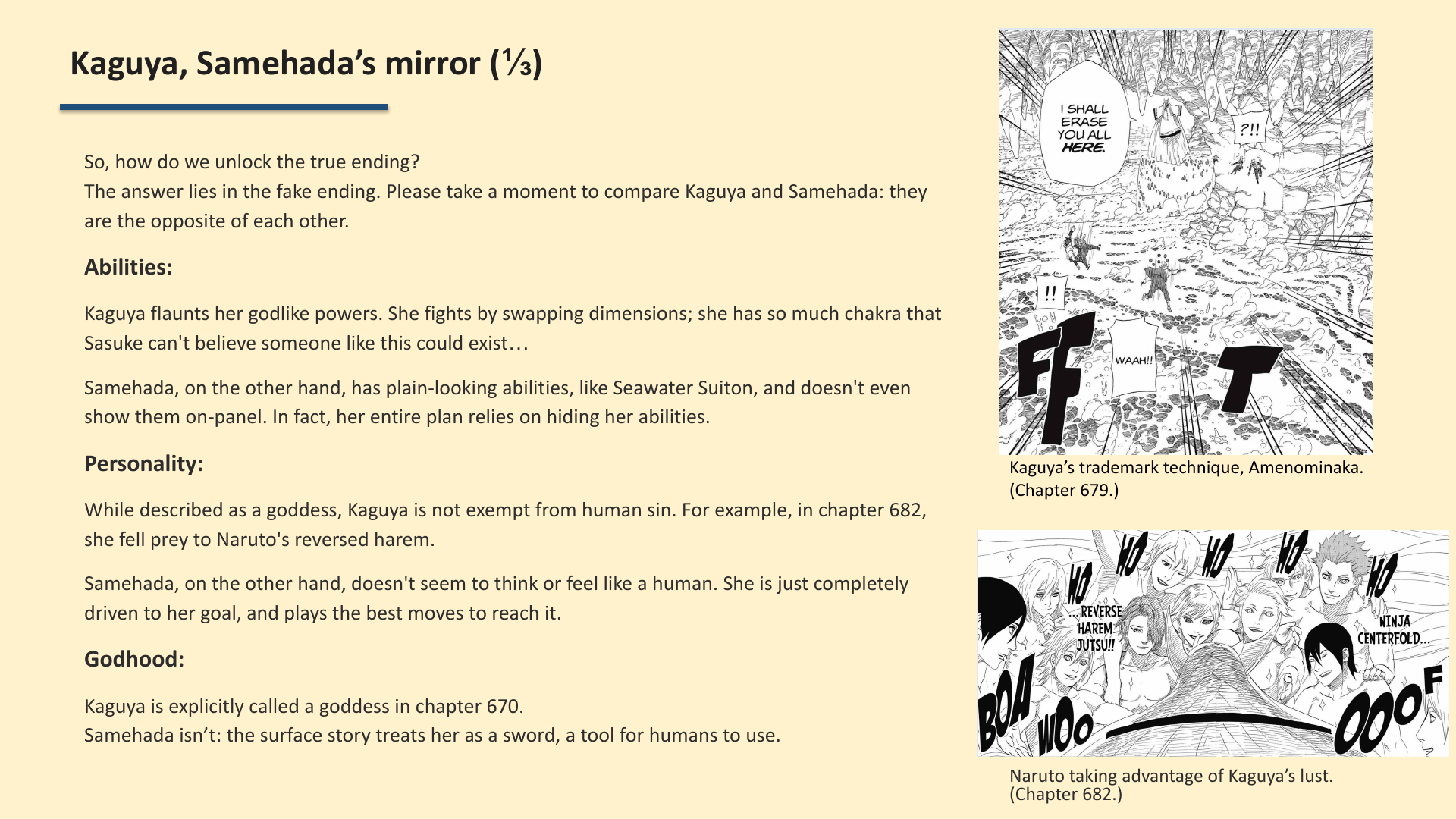
Kaguya flaunts her godlike powers. She fights by swapping dimensions; she has so much chakra that Sasuke can't believe someone like this could exist…

Samehada, on the other hand, has plain-looking abilities, like Seawater Suiton, and doesn't even show them on-panel. In fact, her entire plan relies on hiding her abilities.

Personality:

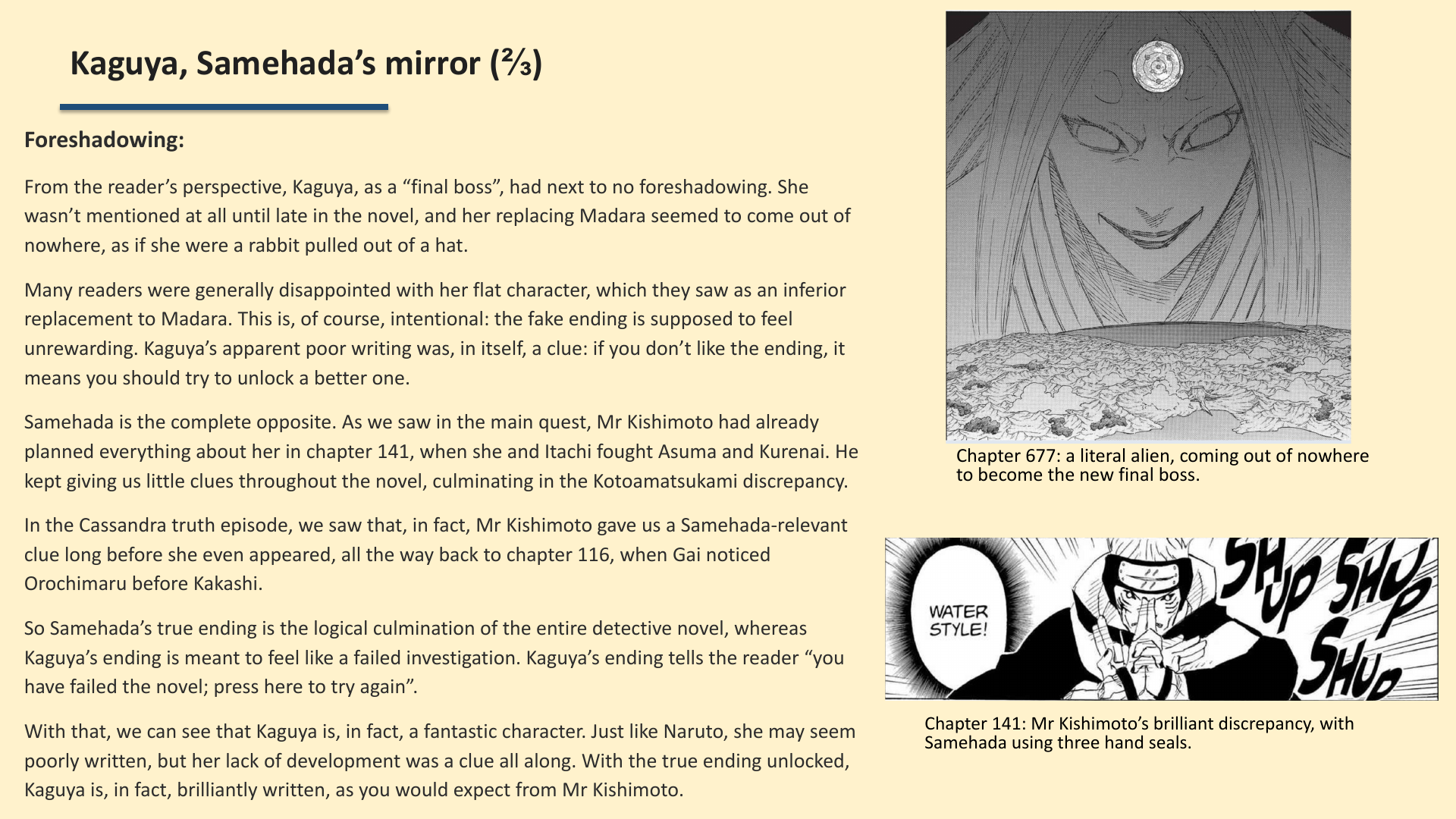
While described as a goddess, Kaguya is not exempt from human sin. For example, in chapter 682, she fell prey to Naruto's reversed harem.

Samehada, on the other hand, doesn't seem to think or feel like a human. She is just completely driven to her goal, and plays the best moves to reach it.

Godhood:

Kaguya is explicitly called a goddess in chapter 670. Samehada isn’t: the surface story treats her as a sword, a tool for humans to use.

Naruto taking advantage of Kaguya’s lust. (Chapter 682.)

Kaguya’s trademark technique, Amenominaka. (Chapter 679.)

Kaguya, Samehada’s mirror (⅔)

Slide 4: Kaguya, Samehada’s mirror (⅔)
Read slide transcript

Kaguya, Samehada’s mirror (⅔)

Foreshadowing:

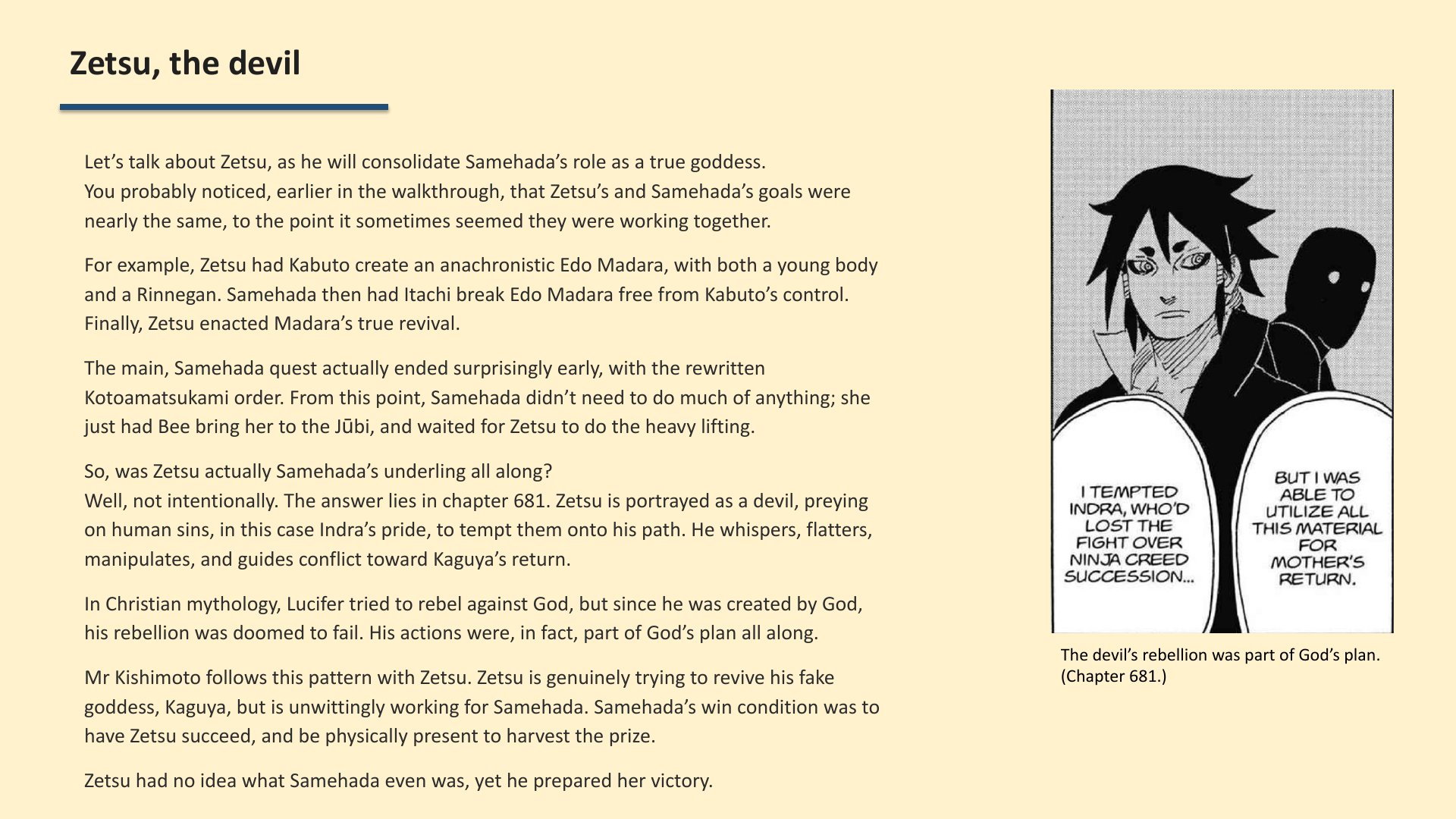
From the reader’s perspective, Kaguya, as a “final boss”, had next to no foreshadowing. She wasn’t mentioned at all until late in the novel, and her replacing Madara seemed to come out of nowhere, as if she were a rabbit pulled out of a hat.

Many readers were generally disappointed with her flat character, which they saw as an inferior replacement to Madara. This is, of course, intentional: the fake ending is supposed to feel unrewarding. Kaguya’s apparent poor writing was, in itself, a clue: if you don’t like the ending, it means you should try to unlock a better one.

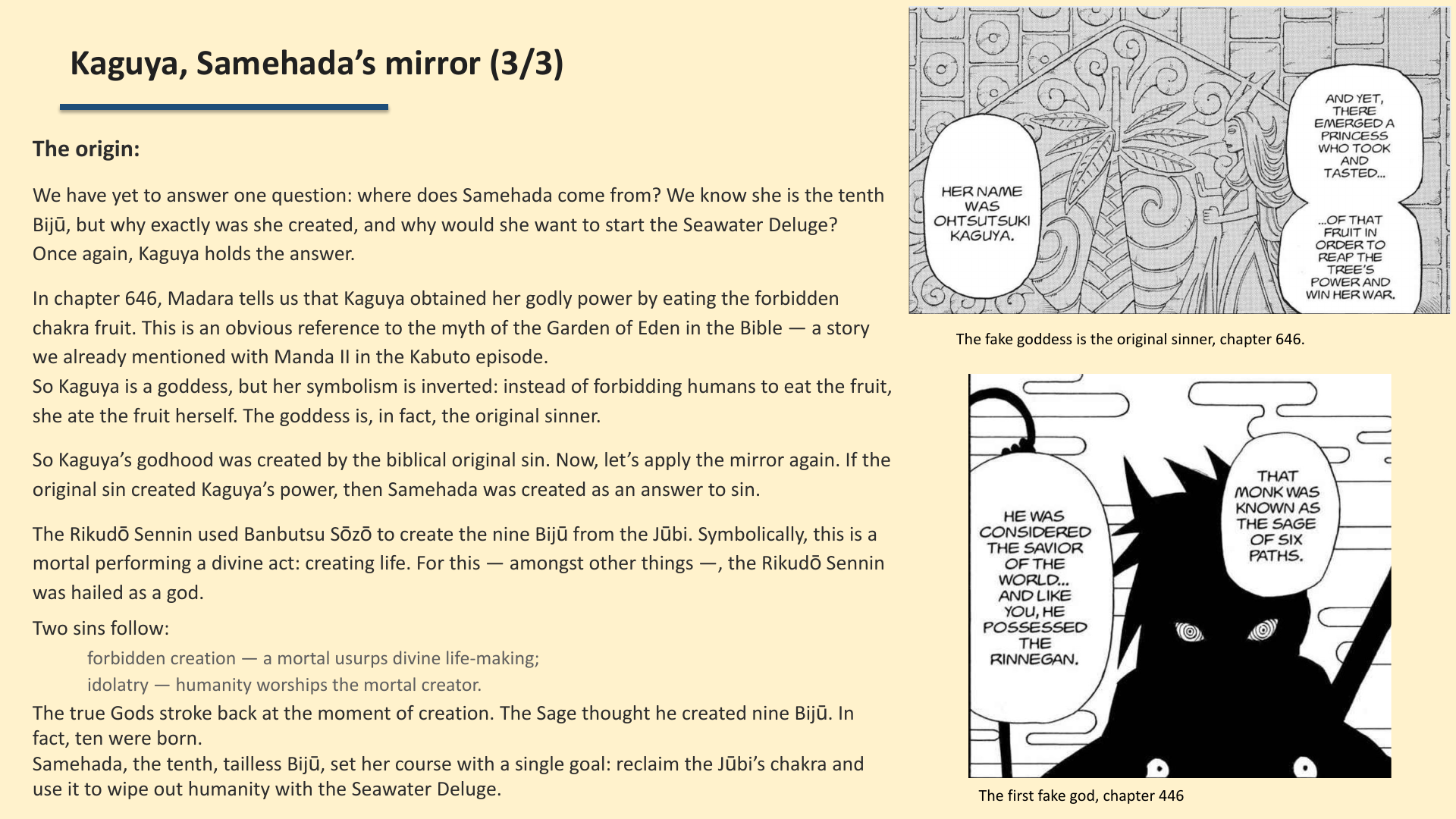
Samehada is the complete opposite. As we saw in the main quest, Mr Kishimoto had already planned everything about her in chapter 141, when she and Itachi fought Asuma and Kurenai. He kept giving us little clues throughout the novel, culminating in the Kotoamatsukami discrepancy.

In the Cassandra truth episode, we saw that, in fact, Mr Kishimoto gave us a Samehada-relevant clue long before she even appeared, all the way back to chapter 116, when Gai noticed Orochimaru before Kakashi.

So Samehada’s true ending is the logical culmination of the entire detective novel, whereas Kaguya’s ending is meant to feel like a failed investigation. Kaguya’s ending tells the reader “you have failed the novel; press here to try again”.

With that, we can see that Kaguya is, in fact, a fantastic character. Just like Naruto, she may seem poorly written, but her lack of development was a clue all along. With the true ending unlocked, Kaguya is, in fact, brilliantly written, as you would expect from Mr Kishimoto.

Chapter 141: Mr Kishimoto’s brilliant discrepancy, with Samehada using three hand seals.

Chapter 677: a literal alien, coming out of nowhere to become the new final boss.

Kaguya, Samehada’s mirror (3/3)

Slide 5: Kaguya, Samehada’s mirror (3/3)
Read slide transcript

Kaguya, Samehada’s mirror (3/3)

The origin:

We have yet to answer one question: where does Samehada come from? We know she is the tenth Bijū, but why exactly was she created, and why would she want to start the Seawater Deluge? Once again, Kaguya holds the answer.

In chapter 646, Madara tells us that Kaguya obtained her godly power by eating the forbidden chakra fruit. This is an obvious reference to the myth of the Garden of Eden in the Bible — a story we already mentioned with Manda II in the Kabuto episode. So Kaguya is a goddess, but her symbolism is inverted: instead of forbidding humans to eat the fruit, she ate the fruit herself. The goddess is, in fact, the original sinner.

So Kaguya’s godhood was created by the biblical original sin. Now, let’s apply the mirror again. If the original sin created Kaguya’s power, then Samehada was created as an answer to sin.

The Rikudō Sennin used Banbutsu Sōzō to create the nine Bijū from the Jūbi. Symbolically, this is a mortal performing a divine act: creating life. For this — amongst other things —, the Rikudō Sennin was hailed as a god.

Two sins follow:

forbidden creation — a mortal usurps divine life-making;

idolatry — humanity worships the mortal creator.

The true Gods stroke back at the moment of creation. The Sage thought he created nine Bijū. In fact, ten were born. Samehada, the tenth, tailless Bijū, set her course with a single goal: reclaim the Jūbi’s chakra and use it to wipe out humanity with the Seawater Deluge.

The first fake god, chapter 446

The fake goddess is the original sinner, chapter 646.

Zetsu, the devil

Slide 6: Zetsu, the devil
Read slide transcript

Zetsu, the devil

Let’s talk about Zetsu, as he will consolidate Samehada’s role as a true goddess. You probably noticed, earlier in the walkthrough, that Zetsu’s and Samehada’s goals were nearly the same, to the point it sometimes seemed they were working together.

For example, Zetsu had Kabuto create an anachronistic Edo Madara, with both a young body and a Rinnegan. Samehada then had Itachi break Edo Madara free from Kabuto’s control. Finally, Zetsu enacted Madara’s true revival.

The main, Samehada quest actually ended surprisingly early, with the rewritten Kotoamatsukami order. From this point, Samehada didn’t need to do much of anything; she just had Bee bring her to the Jūbi, and waited for Zetsu to do the heavy lifting.

So, was Zetsu actually Samehada’s underling all along? Well, not intentionally. The answer lies in chapter 681. Zetsu is portrayed as a devil, preying on human sins, in this case Indra’s pride, to tempt them onto his path. He whispers, flatters, manipulates, and guides conflict toward Kaguya’s return.

In Christian mythology, Lucifer tried to rebel against God, but since he was created by God, his rebellion was doomed to fail. His actions were, in fact, part of God’s plan all along.

Mr Kishimoto follows this pattern with Zetsu. Zetsu is genuinely trying to revive his fake goddess, Kaguya, but is unwittingly working for Samehada. Samehada’s win condition was to have Zetsu succeed, and be physically present to harvest the prize.

Zetsu had no idea what Samehada even was, yet he prepared her victory.

The devil’s rebellion was part of God’s plan. (Chapter 681.)

The true ending

Slide 7: The true ending
Read slide transcript

The true ending

So, what happens in the true ending?

Kaguya gives us the answer. Just as she mirrors Samehada, her fake ending mirrors the true ending.

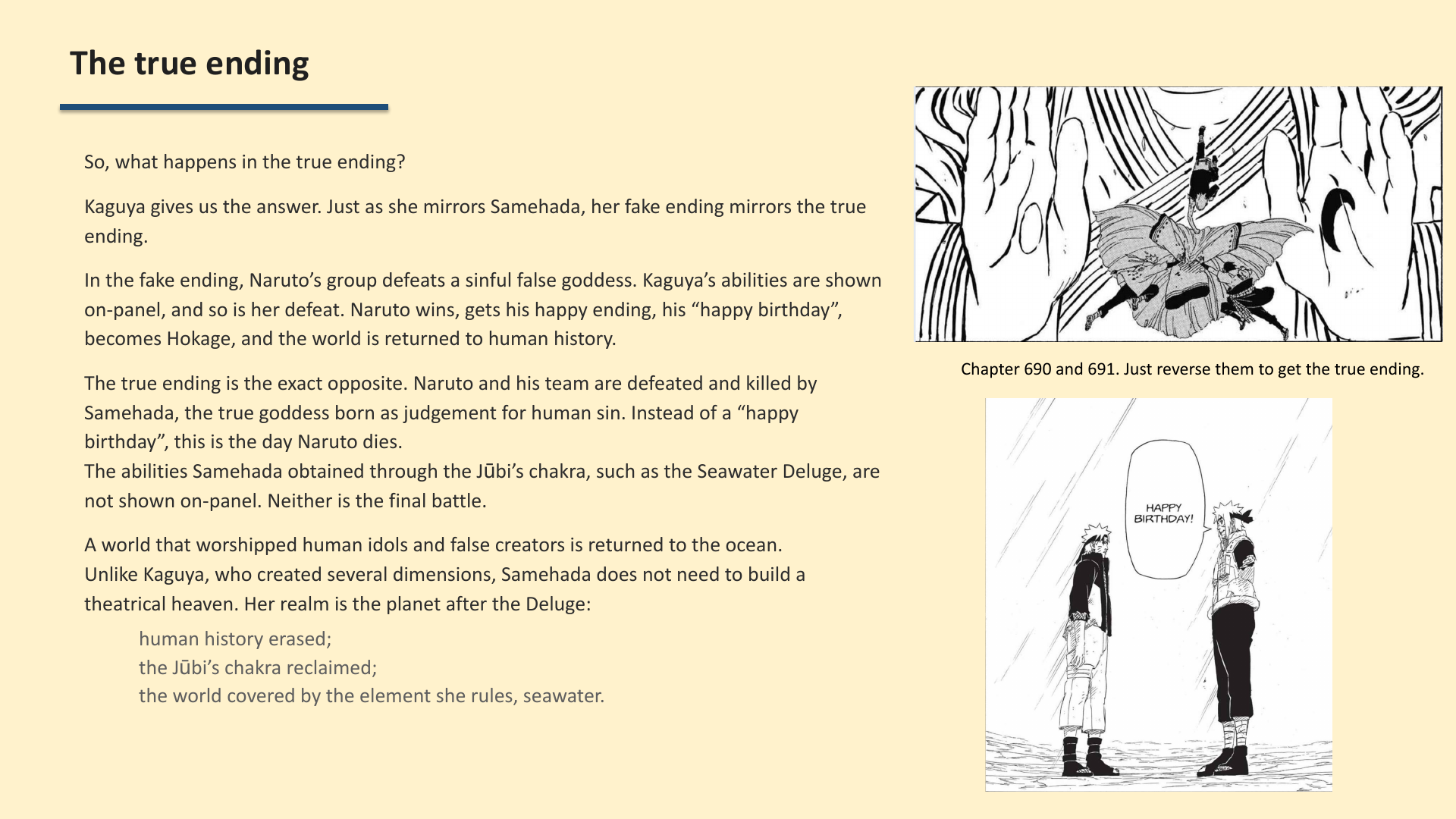
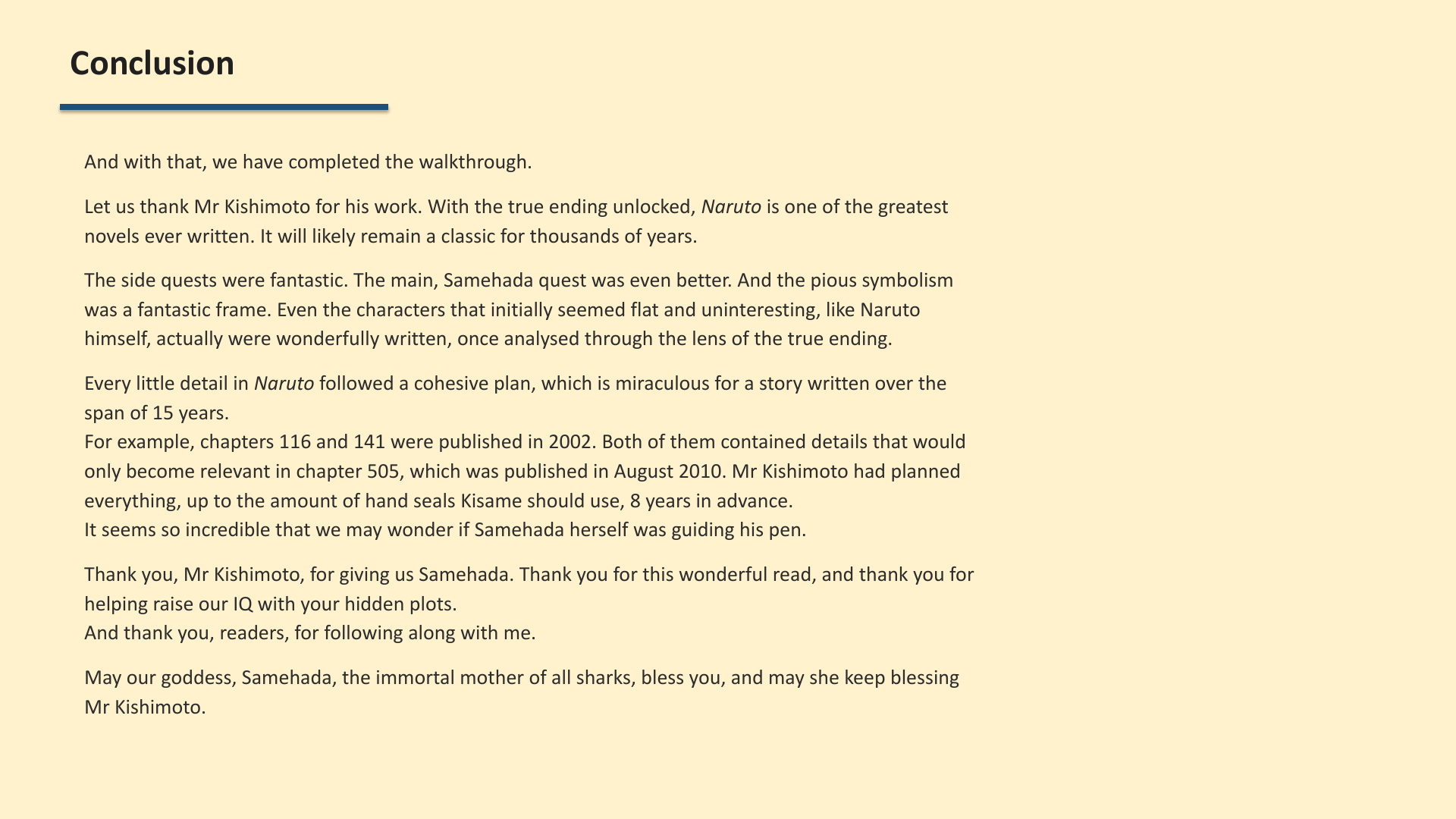
In the fake ending, Naruto’s group defeats a sinful false goddess. Kaguya’s abilities are shown on-panel, and so is her defeat. Naruto wins, gets his happy ending, his “happy birthday”, becomes Hokage, and the world is returned to human history.

The true ending is the exact opposite. Naruto and his team are defeated and killed by Samehada, the true goddess born as judgement for human sin. Instead of a “happy birthday”, this is the day Naruto dies. The abilities Samehada obtained through the Jūbi’s chakra, such as the Seawater Deluge, are not shown on-panel. Neither is the final battle.

A world that worshipped human idols and false creators is returned to the ocean. Unlike Kaguya, who created several dimensions, Samehada does not need to build a theatrical heaven. Her realm is the planet after the Deluge:

human history erased;

the Jūbi’s chakra reclaimed;

the world covered by the element she rules, seawater.

Chapter 690 and 691. Just reverse them to get the true ending.

Conclusion

Slide 8: Conclusion
Read slide transcript

Conclusion

And with that, we have completed the walkthrough.

Let us thank Mr Kishimoto for his work. With the true ending unlocked, Naruto is one of the greatest novels ever written. It will likely remain a classic for thousands of years.

The side quests were fantastic. The main, Samehada quest was even better. And the pious symbolism was a fantastic frame. Even the characters that initially seemed flat and uninteresting, like Naruto himself, actually were wonderfully written, once analysed through the lens of the true ending.

Every little detail in Naruto followed a cohesive plan, which is miraculous for a story written over the span of 15 years. For example, chapters 116 and 141 were published in 2002. Both of them contained details that would only become relevant in chapter 505, which was published in August 2010. Mr Kishimoto had planned everything, up to the amount of hand seals Kisame should use, 8 years in advance. It seems so incredible that we may wonder if Samehada herself was guiding his pen.

Thank you, Mr Kishimoto, for giving us Samehada. Thank you for this wonderful read, and thank you for helping raise our IQ with your hidden plots. And thank you, readers, for following along with me.

May our goddess, Samehada, the immortal mother of all sharks, bless you, and may she keep blessing Mr Kishimoto.