Pious meaning

Episode 23 — Fate wins

Naruto and predestination

Episode 23 — Fate Wins
Slide 1: Episode 23 — Fate Wins
Read slide transcript

Naruto Walkthrough — Reader Edition

Episode 23 — Fate Wins

Many tragedies and mythologies treat fate as a power that kings and heroes cannot escape. A classical example would be Oedipus: he flees the prophecy that he will kill his father and marry his mother, and fulfills it by fleeing. Every attempt by Laius, Jocasta, and Oedipus to evade the fate instead facilitated its fulfillment.

Fate seems more powerful than even gods. In Greek mythology, Kronos, fearing a prophecy that one of his children would overthrow him, swallowed them at birth, with only Zeus escaping. Eventually, Zeus did overthrow Kronos in order to free his siblings. Zeus was helped by the Cyclopes and the Hecatoncheires, who turned against Kronos because he, fearing their power, had imprisoned them.

In Norse mythology, Baldr’s death was foreseen, guarded against, and still happens anyway.

In these stories, fate does not necessarily win by overpowering resistance. Sometimes, it wins by using resistance as its path.
Fate in Japanese fiction

Slide 2: Fate in Japanese fiction
Read slide transcript

Fate in Japanese fiction

Fate is a common narrative device in Japanese fiction as well. Just like in Greek strategies, it is often treated as inescapable. A typical example would be Frieza, from Dragon Ball.

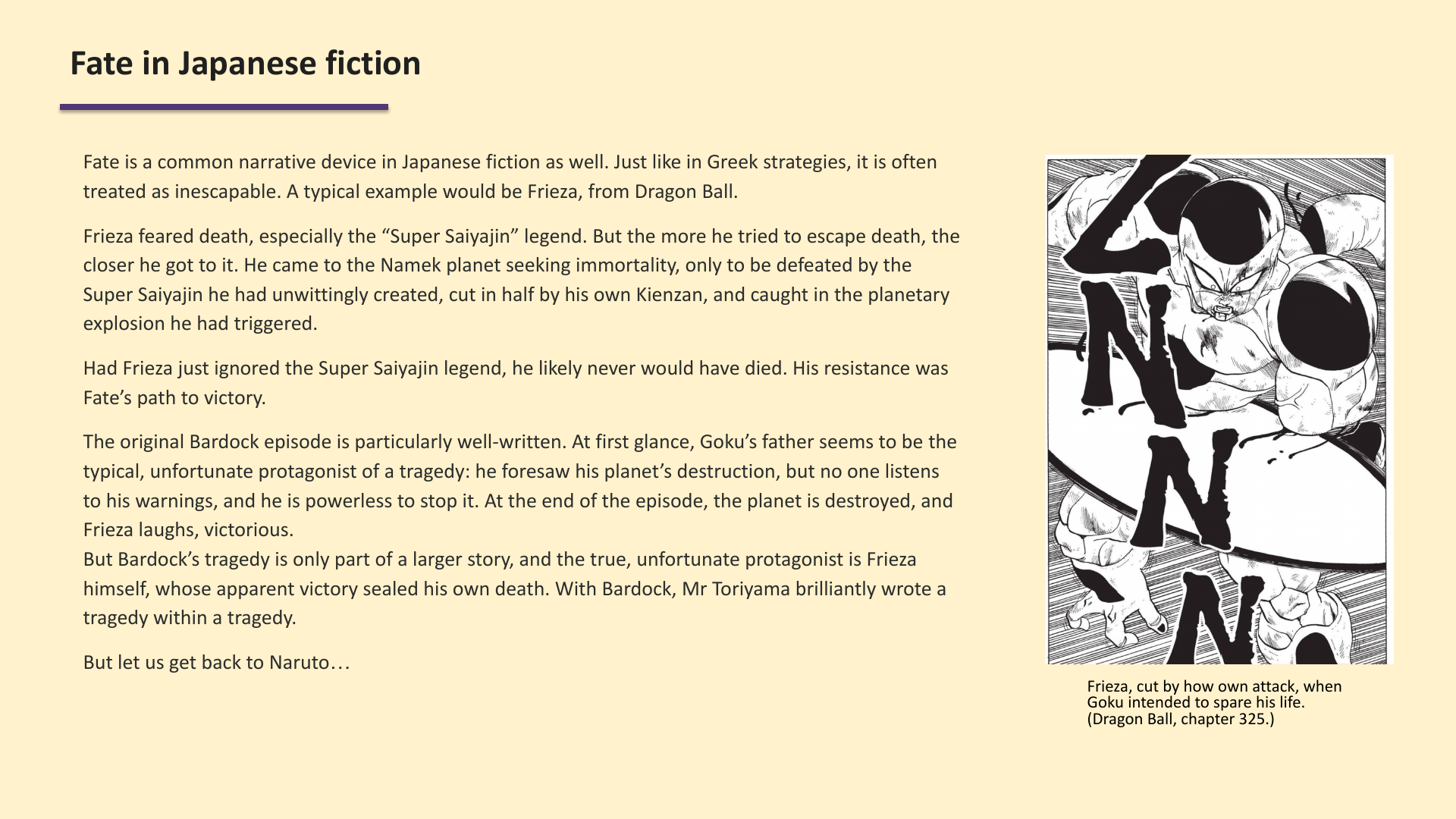
Frieza feared death, especially the “Super Saiyajin” legend. But the more he tried to escape death, the closer he got to it. He came to the Namek planet seeking immortality, only to be defeated by the Super Saiyajin he had unwittingly created, cut in half by his own Kienzan, and caught in the planetary explosion he had triggered.

Had Frieza just ignored the Super Saiyajin legend, he likely never would have died. His resistance was Fate’s path to victory.

The original Bardock episode is particularly well-written. At first glance, Goku’s father seems to be the typical, unfortunate protagonist of a tragedy: he foresaw his planet’s destruction, but no one listens to his warnings, and he is powerless to stop it. At the end of the episode, the planet is destroyed, and Frieza laughs, victorious. But Bardock’s tragedy is only part of a larger story, and the true, unfortunate protagonist is Frieza himself, whose apparent victory sealed his own death. With Bardock, Mr Toriyama brilliantly wrote a tragedy within a tragedy.

But let us get back to Naruto…

Frieza, cut by how own attack, when Goku intended to spare his life. (Dragon Ball, chapter 325.)

Creating the enemy you feared

Slide 3: Creating the enemy you feared
Read slide transcript

Creating the enemy you feared

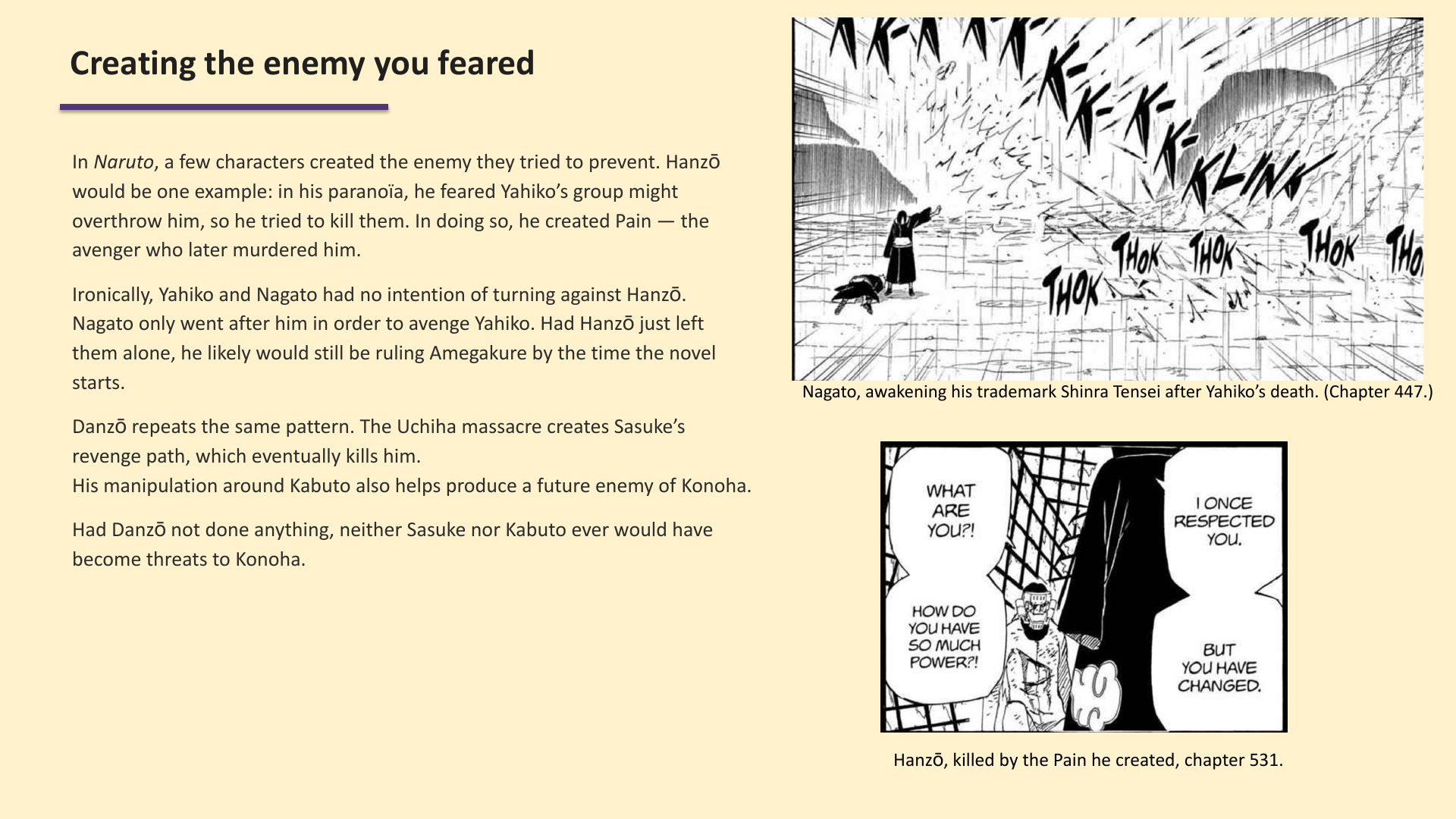
In Naruto, a few characters created the enemy they tried to prevent. Hanzō would be one example: in his paranoïa, he feared Yahiko’s group might overthrow him, so he tried to kill them. In doing so, he created Pain — the avenger who later murdered him.

Ironically, Yahiko and Nagato had no intention of turning against Hanzō. Nagato only went after him in order to avenge Yahiko. Had Hanzō just left them alone, he likely would still be ruling Amegakure by the time the novel starts.

Danzō repeats the same pattern. The Uchiha massacre creates Sasuke’s revenge path, which eventually kills him. His manipulation around Kabuto also helps produce a future enemy of Konoha.

Had Danzō not done anything, neither Sasuke nor Kabuto ever would have become threats to Konoha.

Nagato, awakening his trademark Shinra Tensei after Yahiko’s death. (Chapter 447.)

Hanzō, killed by the Pain he created, chapter 531.

Choosing the fate you hated

Slide 4: Choosing the fate you hated
Read slide transcript

Choosing the fate you hated

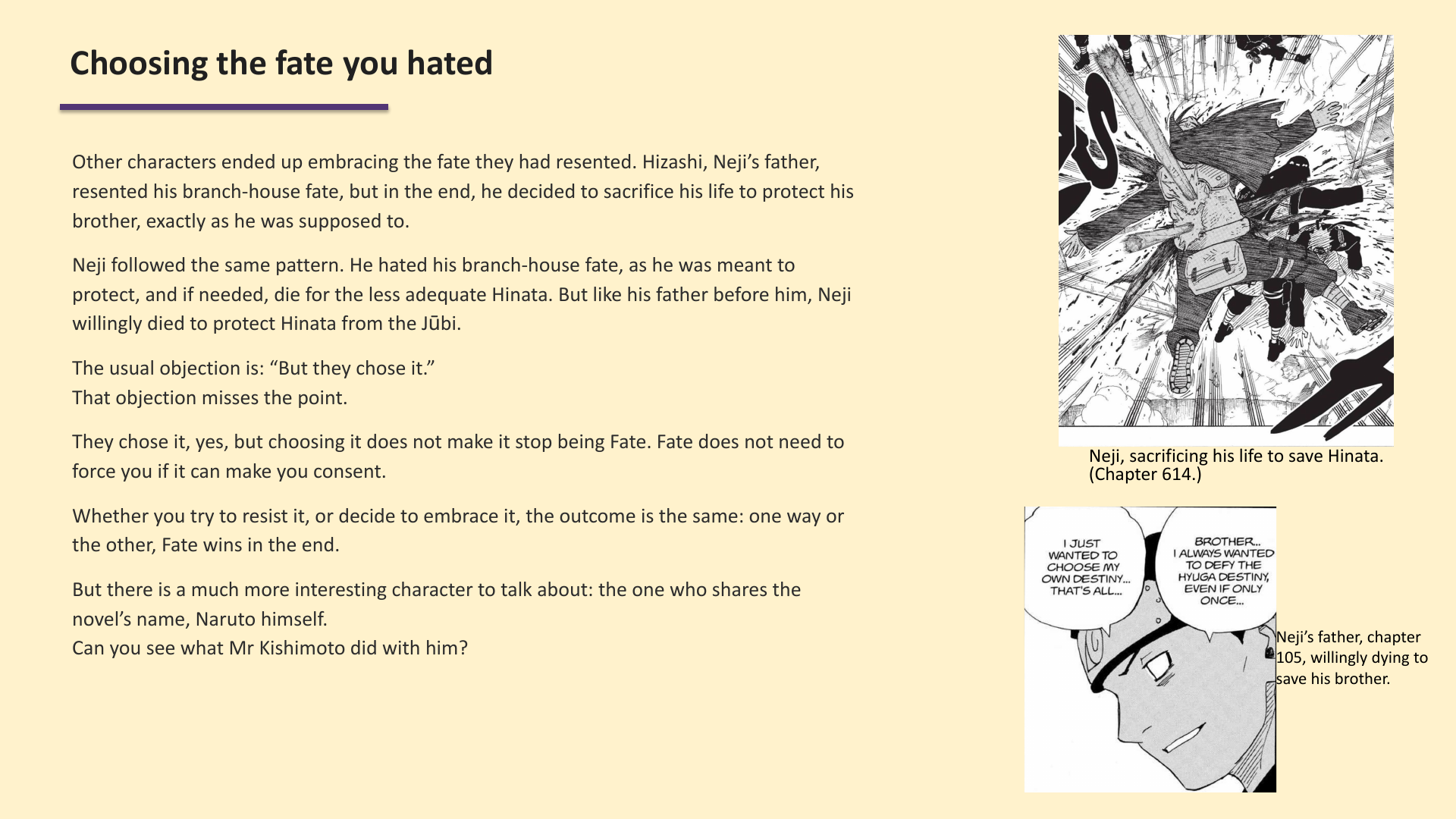
Other characters ended up embracing the fate they had resented. Hizashi, Neji’s father, resented his branch-house fate, but in the end, he decided to sacrifice his life to protect his brother, exactly as he was supposed to.

Neji followed the same pattern. He hated his branch-house fate, as he was meant to protect, and if needed, die for the less adequate Hinata. But like his father before him, Neji willingly died to protect Hinata from the Jūbi.

The usual objection is: “But they chose it.” That objection misses the point.

They chose it, yes, but choosing it does not make it stop being Fate. Fate does not need to force you if it can make you consent.

Whether you try to resist it, or decide to embrace it, the outcome is the same: one way or the other, Fate wins in the end.

But there is a much more interesting character to talk about: the one who shares the novel’s name, Naruto himself. Can you see what Mr Kishimoto did with him?

Neji, sacrificing his life to save Hinata. (Chapter 614.)

Neji’s father, chapter 105, willingly dying to save his brother.

Naruto declares war on destiny

Slide 5: Naruto declares war on destiny
Read slide transcript

Naruto declares war on destiny

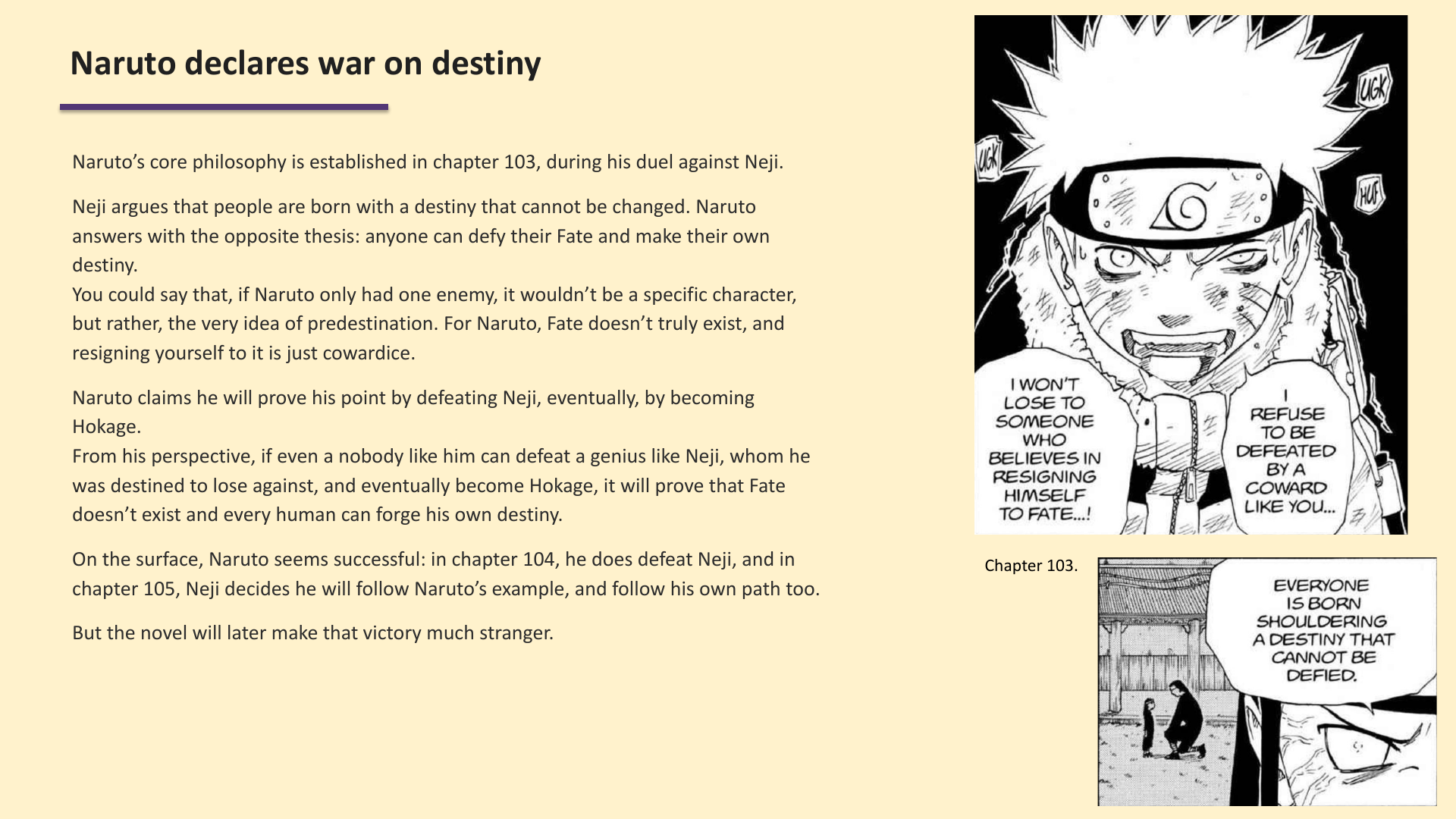
Naruto’s core philosophy is established in chapter 103, during his duel against Neji.

Neji argues that people are born with a destiny that cannot be changed. Naruto answers with the opposite thesis: anyone can defy their Fate and make their own destiny. You could say that, if Naruto only had one enemy, it wouldn’t be a specific character, but rather, the very idea of predestination. For Naruto, Fate doesn’t truly exist, and resigning yourself to it is just cowardice.

Naruto claims he will prove his point by defeating Neji, eventually, by becoming Hokage. From his perspective, if even a nobody like him can defeat a genius like Neji, whom he was destined to lose against, and eventually become Hokage, it will prove that Fate doesn’t exist and every human can forge his own destiny.

On the surface, Naruto seems successful: in chapter 104, he does defeat Neji, and in chapter 105, Neji decides he will follow Naruto’s example, and follow his own path too.

But the novel will later make that victory much stranger.

Chapter 103.

The hidden inheritance

Slide 6: The hidden inheritance
Read slide transcript

The hidden inheritance

Late in the novel, it seems Naruto has reached his goal. He is hailed as a hero in Konoha, has become the most powerful ninja in the alliance, and the entire ninja world rallied around him. So, did Naruto succeed in proving that Fate doesn't exist and even a nobody can succeed?

At first glance, it seems so, but in the meantime, we found out that:

Naruto is the fourth Hokage’s son.

He is an Uzumaki, a clan known for their extraordinary vitality and chakra.

Being the Kyūbi Jinchūriki is actually a huge asset, as the Kyūbi is by far the strongest bijū.

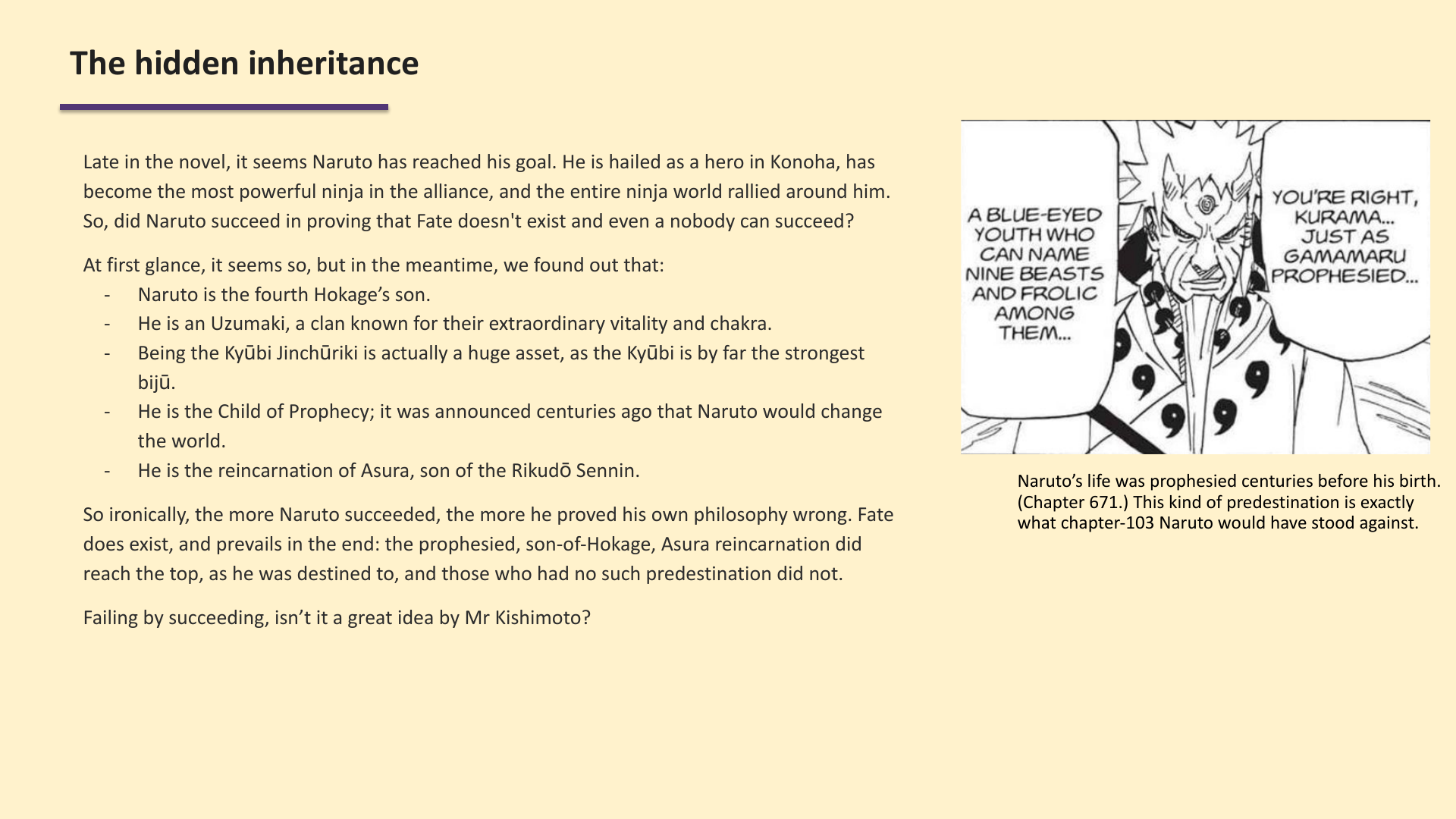
He is the Child of Prophecy; it was announced centuries ago that Naruto would change the world.

He is the reincarnation of Asura, son of the Rikudō Sennin.

So ironically, the more Naruto succeeded, the more he proved his own philosophy wrong. Fate does exist, and prevails in the end: the prophesied, son-of-Hokage, Asura reincarnation did reach the top, as he was destined to, and those who had no such predestination did not.

Failing by succeeding, isn’t it a great idea by Mr Kishimoto?

Naruto’s life was prophesied centuries before his birth. (Chapter 671.) This kind of predestination is exactly what chapter-103 Naruto would have stood against.

Madara’s Tengai Shinsei

Slide 7: Madara’s Tengai Shinsei
Read slide transcript

Madara’s Tengai Shinsei

So Naruto unwittingly became the antithesis of what he was trying to prove.

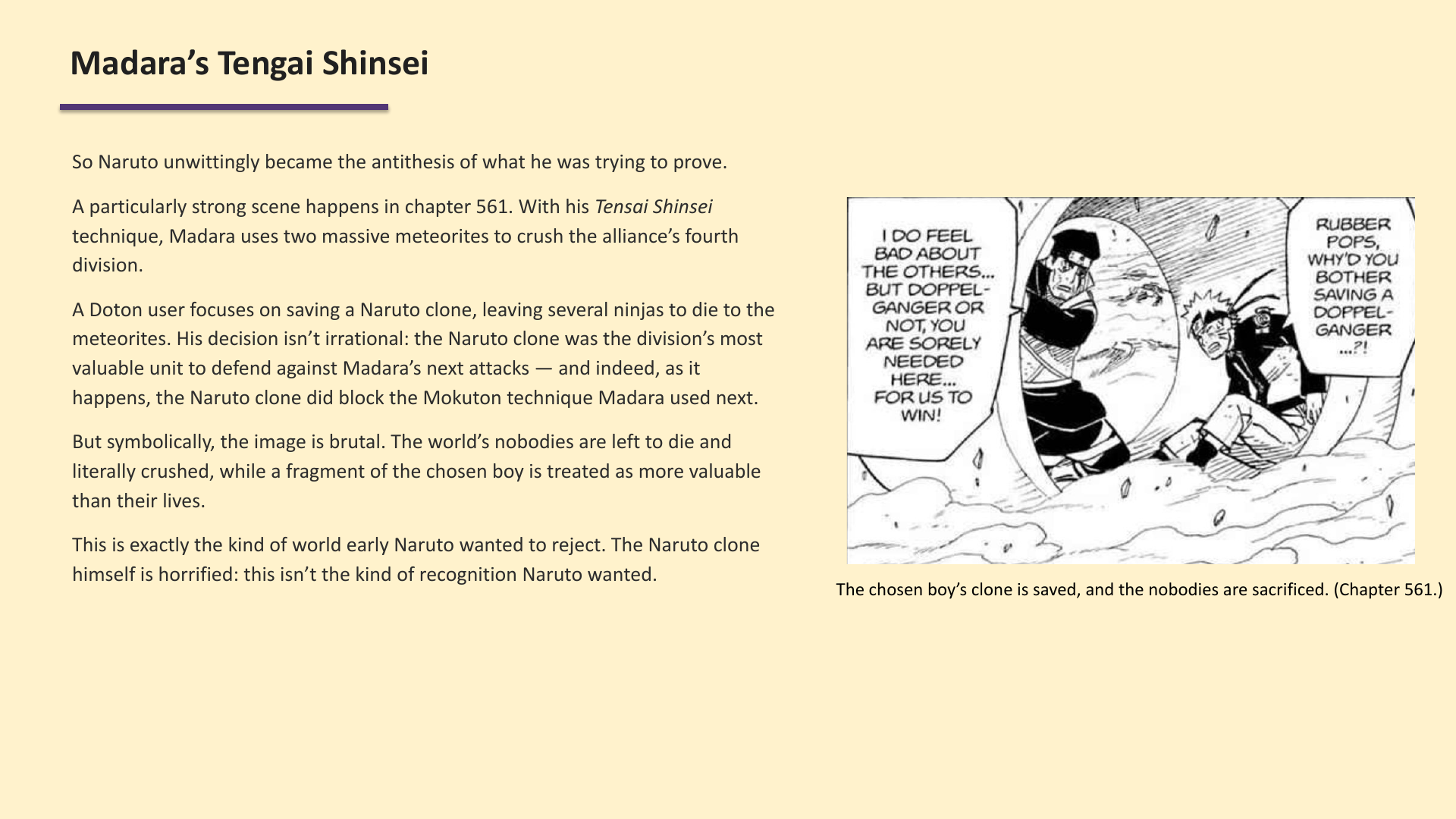
A particularly strong scene happens in chapter 561. With his Tensai Shinsei technique, Madara uses two massive meteorites to crush the alliance’s fourth division.

A Doton user focuses on saving a Naruto clone, leaving several ninjas to die to the meteorites. His decision isn’t irrational: the Naruto clone was the division’s most valuable unit to defend against Madara’s next attacks — and indeed, as it happens, the Naruto clone did block the Mokuton technique Madara used next.

But symbolically, the image is brutal. The world’s nobodies are left to die and literally crushed, while a fragment of the chosen boy is treated as more valuable than their lives.

This is exactly the kind of world early Naruto wanted to reject. The Naruto clone himself is horrified: this isn’t the kind of recognition Naruto wanted.

The chosen boy’s clone is saved, and the nobodies are sacrificed. (Chapter 561.)

Retrospective irony: Neji was the underdog

Slide 8: Retrospective irony: Neji was the underdog
Read slide transcript

Retrospective irony: Neji was the underdog

So, as the novel progressed, Naruto kept proving his own philosophy wrong. But we, in fact, do not need to wait for the climax of the war to see that.

Let’s get back to the Neji fight. When we first read it, with the information we had back then, we were given the impression that Naruto was the underdog in his battle against a gifted Byakugan user. But if we read that fight again, with the information from later in the novel in mind, our interpretation will be different.

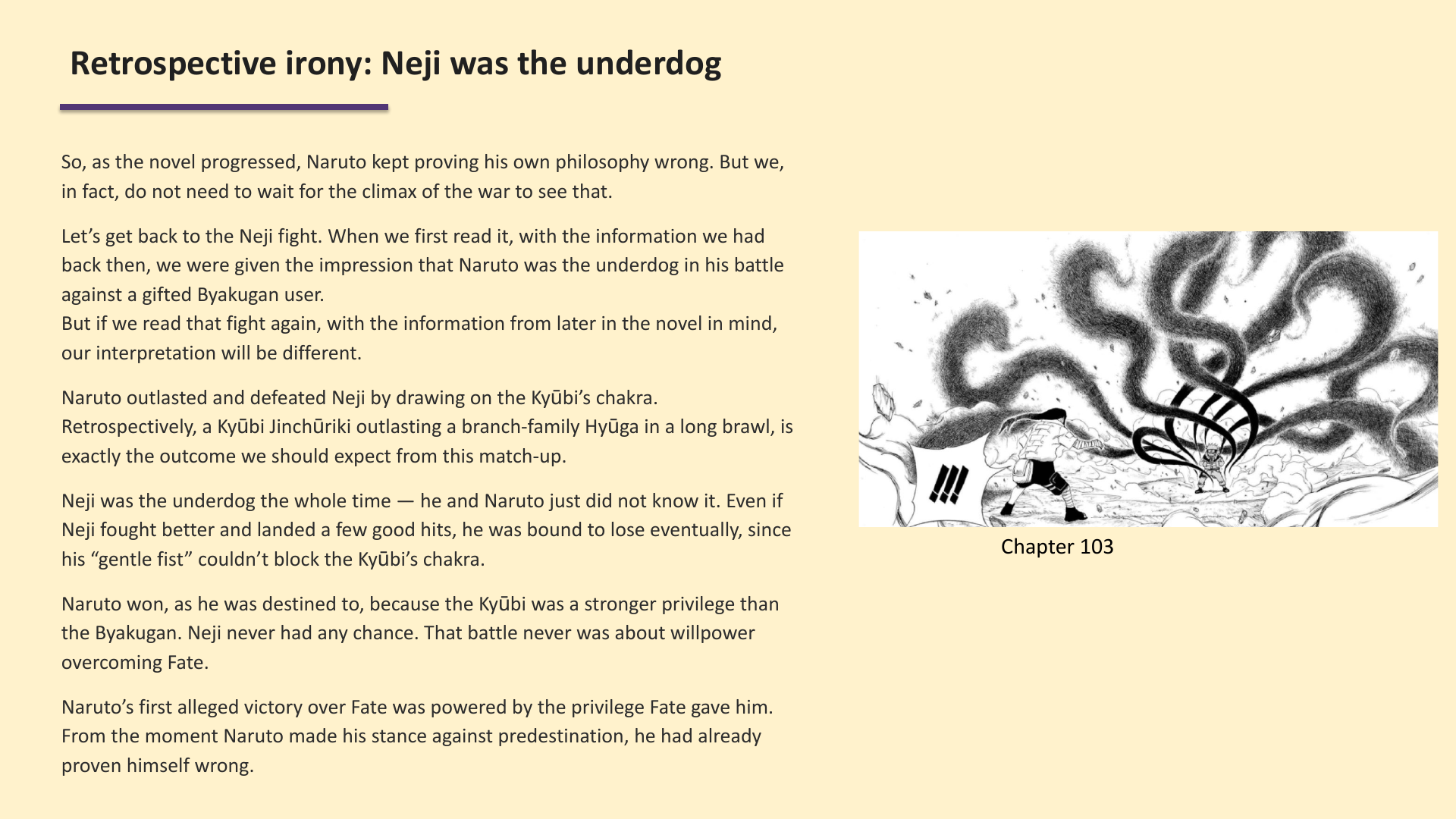
Naruto outlasted and defeated Neji by drawing on the Kyūbi’s chakra. Retrospectively, a Kyūbi Jinchūriki outlasting a branch-family Hyūga in a long brawl, is exactly the outcome we should expect from this match-up.

Neji was the underdog the whole time — he and Naruto just did not know it. Even if Neji fought better and landed a few good hits, he was bound to lose eventually, since his “gentle fist” couldn’t block the Kyūbi’s chakra.

Naruto won, as he was destined to, because the Kyūbi was a stronger privilege than the Byakugan. Neji never had any chance. That battle never was about willpower overcoming Fate.

Naruto’s first alleged victory over Fate was powered by the privilege Fate gave him. From the moment Naruto made his stance against predestination, he had already proven himself wrong.

Chapter 103

Episode conclusion

Slide 9: Episode conclusion
Read slide transcript

Episode conclusion

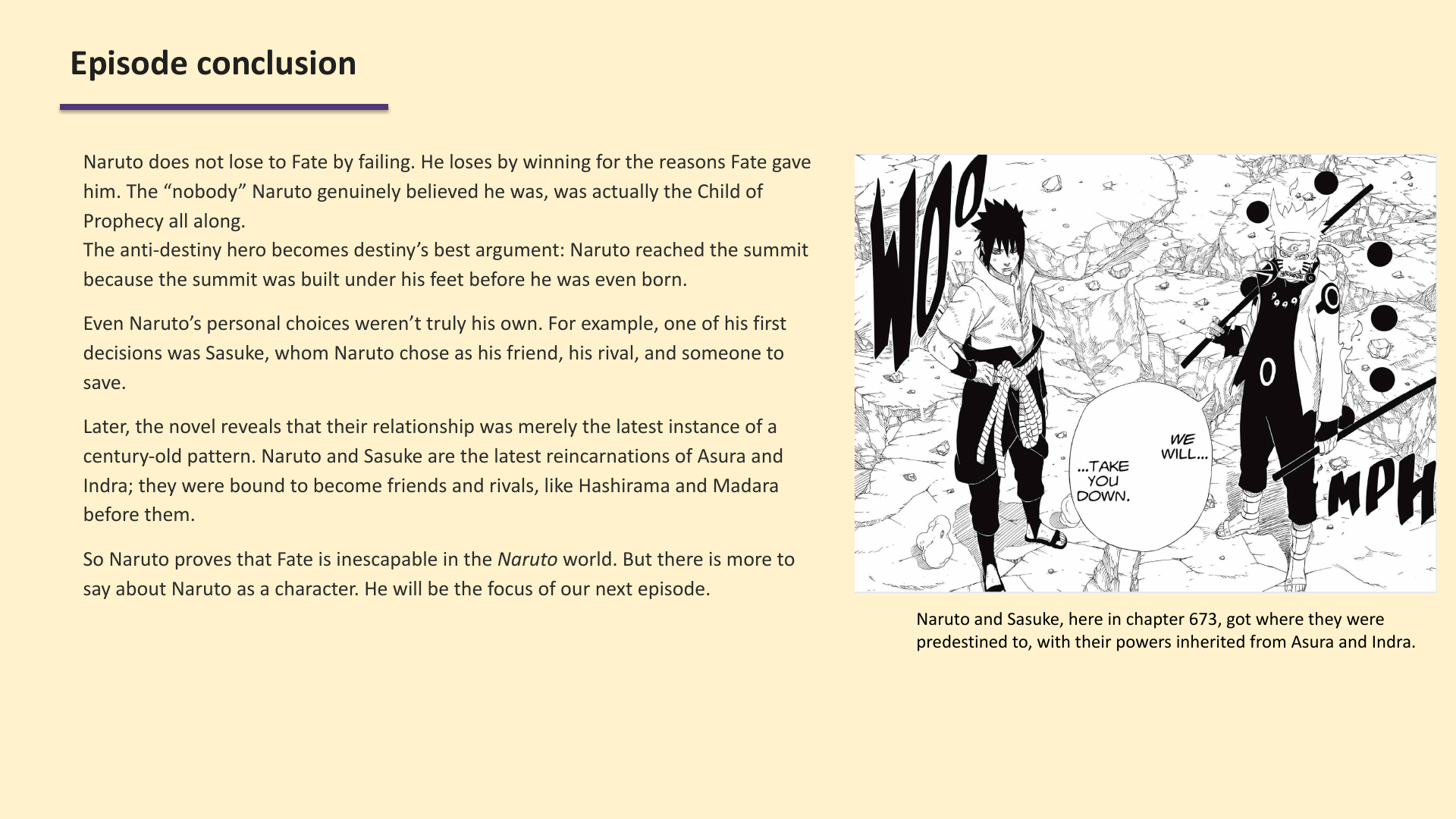
Naruto does not lose to Fate by failing. He loses by winning for the reasons Fate gave him. The “nobody” Naruto genuinely believed he was, was actually the Child of Prophecy all along. The anti-destiny hero becomes destiny’s best argument: Naruto reached the summit because the summit was built under his feet before he was even born.

Even Naruto’s personal choices weren’t truly his own. For example, one of his first decisions was Sasuke, whom Naruto chose as his friend, his rival, and someone to save.

Later, the novel reveals that their relationship was merely the latest instance of a century-old pattern. Naruto and Sasuke are the latest reincarnations of Asura and Indra; they were bound to become friends and rivals, like Hashirama and Madara before them.

So Naruto proves that Fate is inescapable in the Naruto world. But there is more to say about Naruto as a character. He will be the focus of our next episode.

Naruto and Sasuke, here in chapter 673, got where they were predestined to, with their powers inherited from Asura and Indra.