Pious meaning

Episode 21 — Kabuto’s little Eden

Manda II and the original sin

Episode 21 — Kabuto’s Little Eden
Slide 1: Episode 21 — Kabuto’s Little Eden
Read slide transcript

Naruto Walkthrough — Reader Edition

Episode 21 — Kabuto’s Little Eden

While, as we saw in the previous episode, Naruto characters do not worship true gods, many humans were hailed as gods. All of them follow the same pattern: they spectacularly fail.

We we will study a few of them in details, with this episode focusing on Kabuto. But before we get to Kabuto, let us quickly list a few fake gods who follow this pattern.
Human gods fail

Slide 2: Human gods fail
Read slide transcript

Human gods fail

Pain was worshipped as a god in Amegakure. It turns out “Pain” was just a squad of animated corpses. Nagato’s life ends in suicide, the Rinnegan eventually is returned to Madara, and Amegakure remains miserable after his rule.

Hashirama was hailed as the God of Shinobi. His goal was to bring peace between the Senju and the Uchiha, and to the world in general. Instead, the village he created participated in several world wars, and the Konoha government ordered the massacre of the Uchiha. Hashirama’s DNA becomes part of Madara’s path to the Rinnegan and the Jūbi, and when Edo Hashirama is summoned in the final war, his Sage chakra helps the blind Madara survive long enough to reclaim his Rinnegan.

Hiruzen, like the first Hokage, was hailed as a God of Shinobi. At first, he seemed worthy of his title: we saw in the tutorial what a great teacher he was. However, as the novel progresses, we keep discovering catastrophes that happened during his rule — the prime example being the Uchiha massacre. Some of the major threats Konoha faces can be traced back to Hiruzen’s government. Kabuto and Pain are two examples. Hiruzen didn’t personally order those disasters; the “God of Shinobi” just had no idea what his government was doing behind his back.

Madara saw himself as the world’s savior. He read old scriptures, heard voices, and believed he was on a Messianic mission. However, the voice he hears is not God’s, but the Jūbi’s, and Madara was merely a pawn in Zetsu’s and Samehada’s plans. Instead of saving the world, Madara’s Infinite Tsukuyomi doomed humanity.

In Naruto, every time a character is hailed as a god, disaster follows. Let us have a deeper look at Kabuto.

Kabuto’s war plan

Slide 3: Kabuto’s war plan
Read slide transcript

Kabuto’s war plan

Let’s take a step back. Before analysing the meaning of Kabuto’s character, let us quickly sum up his war plan. At first glance, the readers could be disappointed by Kabuto’s Edo Tensei army. Most of the Edo ninjas underperformed, and seemed underwhelming compared to their living selves.

This was intentional. Kabuto never intended to win the war. If the Zetsu / Edo Tensei army prevails too early, while Obito has a Rinnegan and Kabuto does not, then Obito gets the Jūbi, and Kabuto loses. Kabuto actually needed “Akatsuki” to barely lose. The state he was trying to reach is:

Obito dead.

the alliance devastated.

the Zetsu army wiped out.

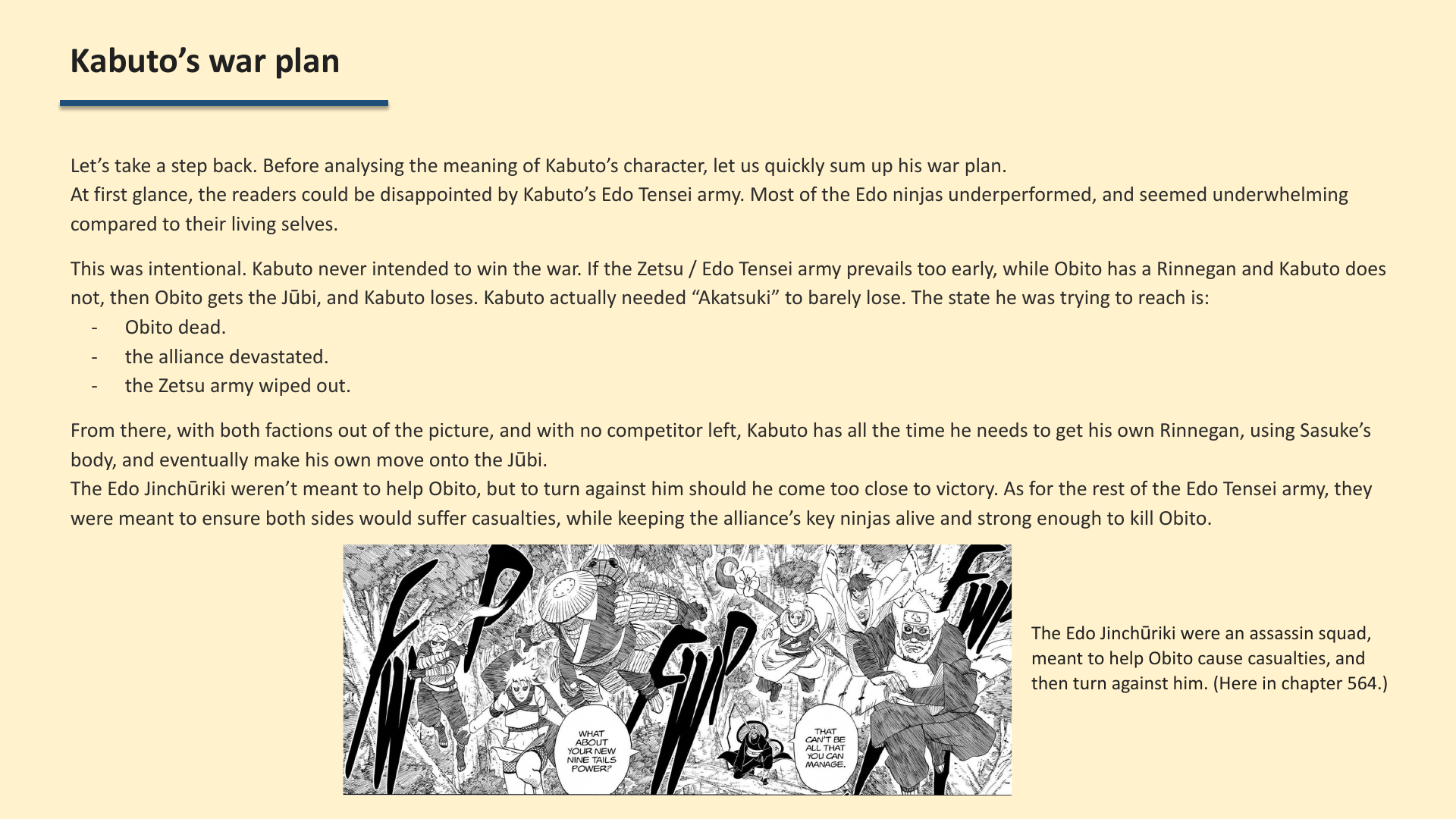
From there, with both factions out of the picture, and with no competitor left, Kabuto has all the time he needs to get his own Rinnegan, using Sasuke’s body, and eventually make his own move onto the Jūbi. The Edo Jinchūriki weren’t meant to help Obito, but to turn against him should he come too close to victory. As for the rest of the Edo Tensei army, they were meant to ensure both sides would suffer casualties, while keeping the alliance’s key ninjas alive and strong enough to kill Obito.

The Edo Jinchūriki were an assassin squad, meant to help Obito cause casualties, and then turn against him. (Here in chapter 564.)

Kabuto’s delusions

Slide 4: Kabuto’s delusions
Read slide transcript

Kabuto’s delusions

So Kabuto bolstered Obito’s forces in order to ensure that both sides would suffer as many casualties as possible. The plan was not stupid. Kabuto wasn’t losing his Edo ninjas without a good reason: he had a cohesive strategy to keep Akatsuki barely losing. The problem isn’t strategy, but scale. Kabuto had no idea what he was dealing with:

Madara cannot be controlled as easily as Kabuto believed.

Neither can Itachi.

Neither can the Jūbi itself.

Capturing Sasuke and awakening the Rinnegan isn’t as simple as it sounds.

Obito isn’t Kabuto’s main competitor: Zetsu and Samehada are far more dangerous.

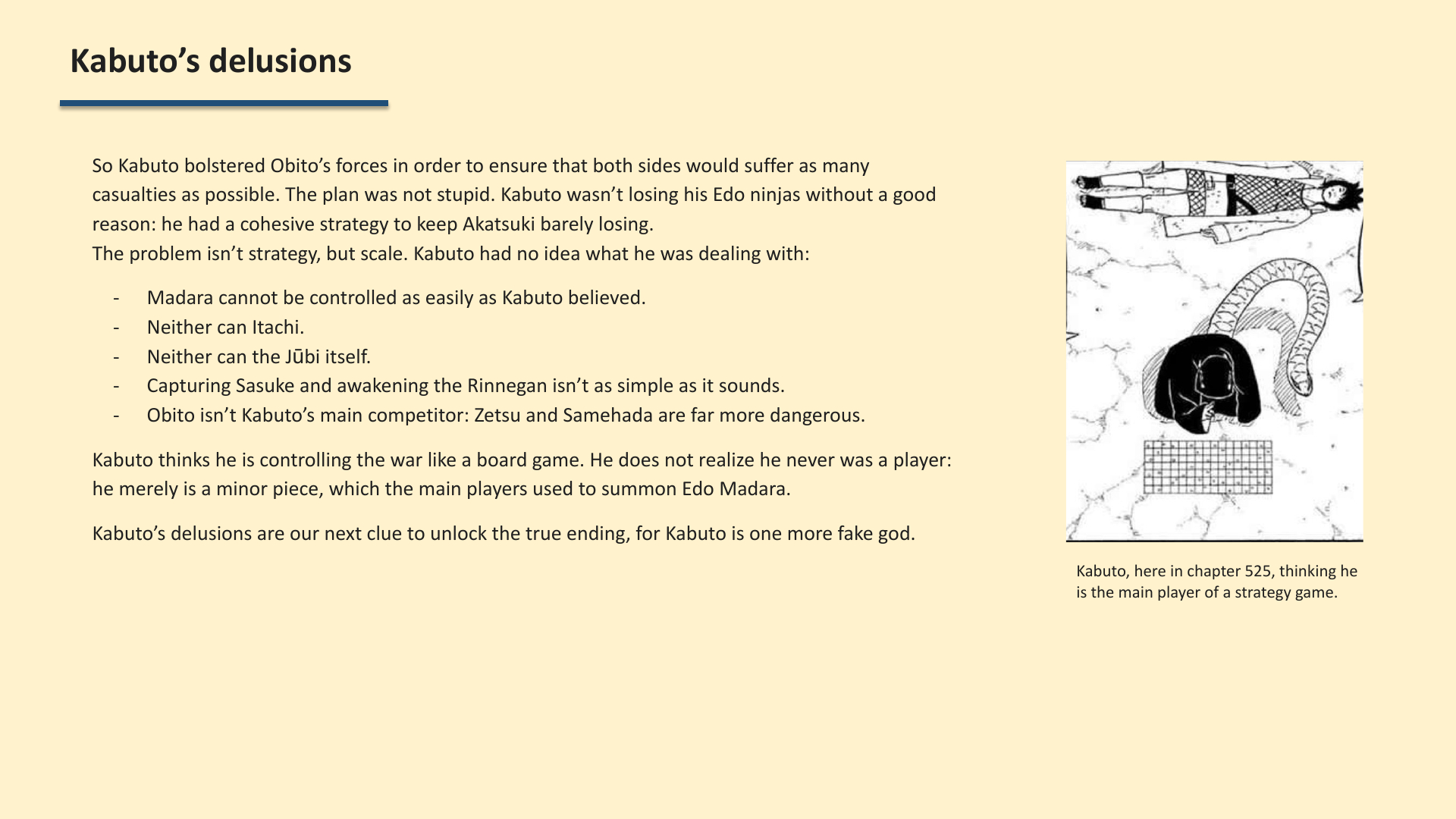
Kabuto thinks he is controlling the war like a board game. He does not realize he never was a player: he merely is a minor piece, which the main players used to summon Edo Madara.

Kabuto’s delusions are our next clue to unlock the true ending, for Kabuto is one more fake god.

Kabuto, here in chapter 525, thinking he is the main player of a strategy game.

Counterfeit resurrection

Slide 5: Counterfeit resurrection
Read slide transcript

Counterfeit resurrection

Kabuto’s main miracle during the war is resurrection — but false resurrection.

Edo Tensei does not restore the dead to life: it binds souls into artificial bodies and uses them as weapons. Being a fake god, Kabuto cannot create life, so he recycles death.

This clue, however, is obvious; no one would need a walkthrough to find it.

Can you find a much more interesting clue regarding Kabuto’s god delusions?

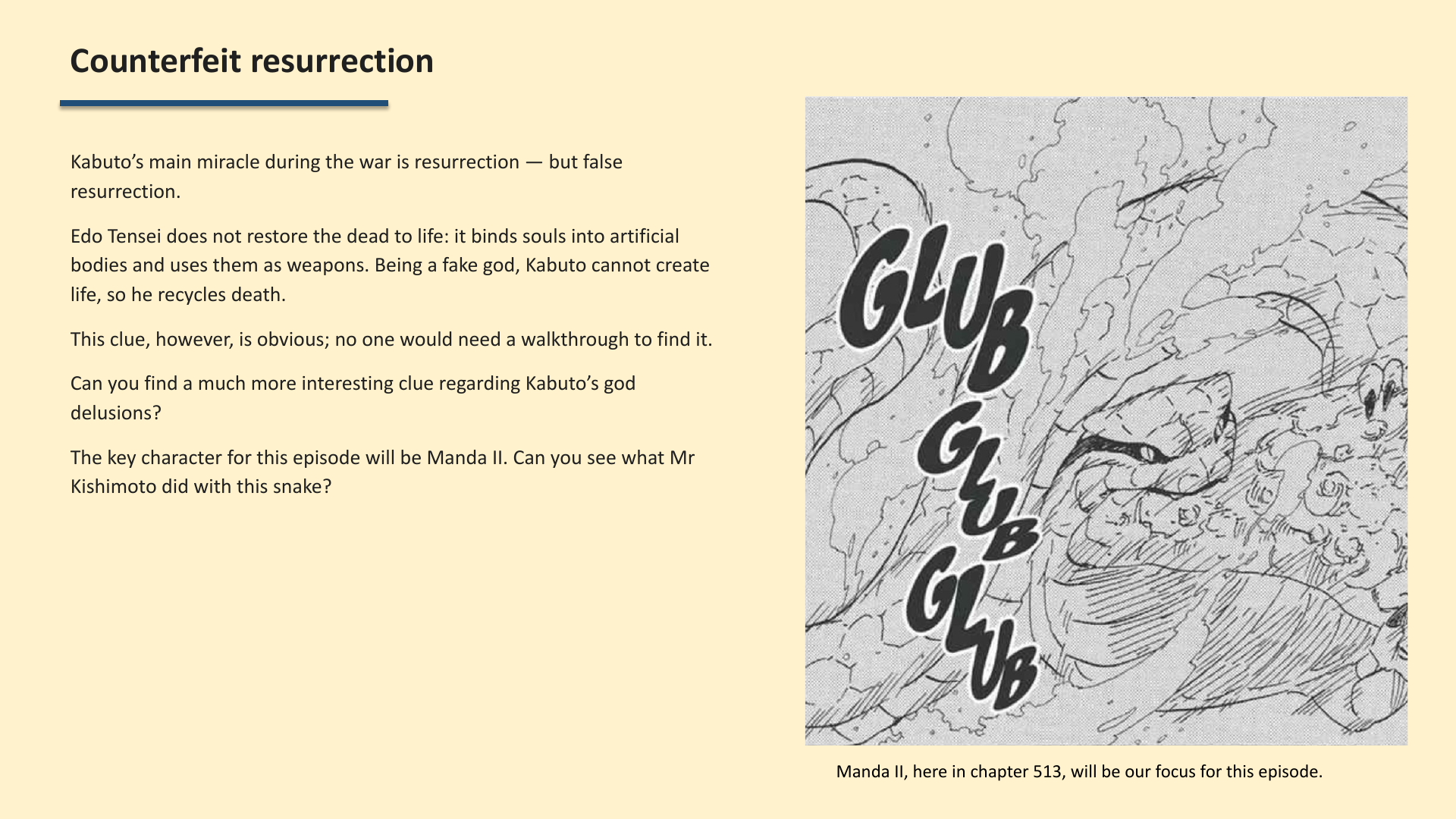
The key character for this episode will be Manda II. Can you see what Mr Kishimoto did with this snake?

Manda II, here in chapter 513, will be our focus for this episode.

The Garden of Eden

Slide 6: The Garden of Eden
Read slide transcript

The Garden of Eden

To understand the purpose of Manda II, we need to go back to the Bible, specifically, the myth of the Garden of Eden.

In Genesis, after the forbidden fruit is eaten, we are told that the serpent is cursed to crawl on its belly. However, if you compare the peaceful Eden to our current world, the curse goes beyond the human and the snake. Animals brutally kill and eat each other, not out of malice, but for survival. In nature, the fawn is hunted and killed by the bear, and yet neither of them had anything to do with Eve eating the forbidden fruit.

So what happened after the original sin is, chaos, death, and entropy were introduced into the world. Animals, and life in general, lost their perfection, with the snake merely being an extreme example.

In the snake’s case, if it was cursed to crawl on its belly, it implies that before the fall, it did not yet need to slither on the ground. Now, let’s look at Manda II again…

Can you see what Mr Kishimoto did here? Manda II has legs! This is once again a fantastic writing by Mr Kishimoto.

With Manda II, Kabuto wasn’t just trying to create a strong creature to aid him in battle. Symbolically, Kabuto was attempting to undo the original sin, recreate a perfect life-form from before the fruit was eaten, and become the God of his own Garden of Eden. He gave Manda II legs in order to recreate a pre-curse serpent that wouldn’t need to crawl on its belly.

Kabuto’s failure

Slide 7: Kabuto’s failure
Read slide transcript

Kabuto’s failure

Manda II should be a stunning symbol: an Edenic, perfect lifeform; the serpent restored before the curse.

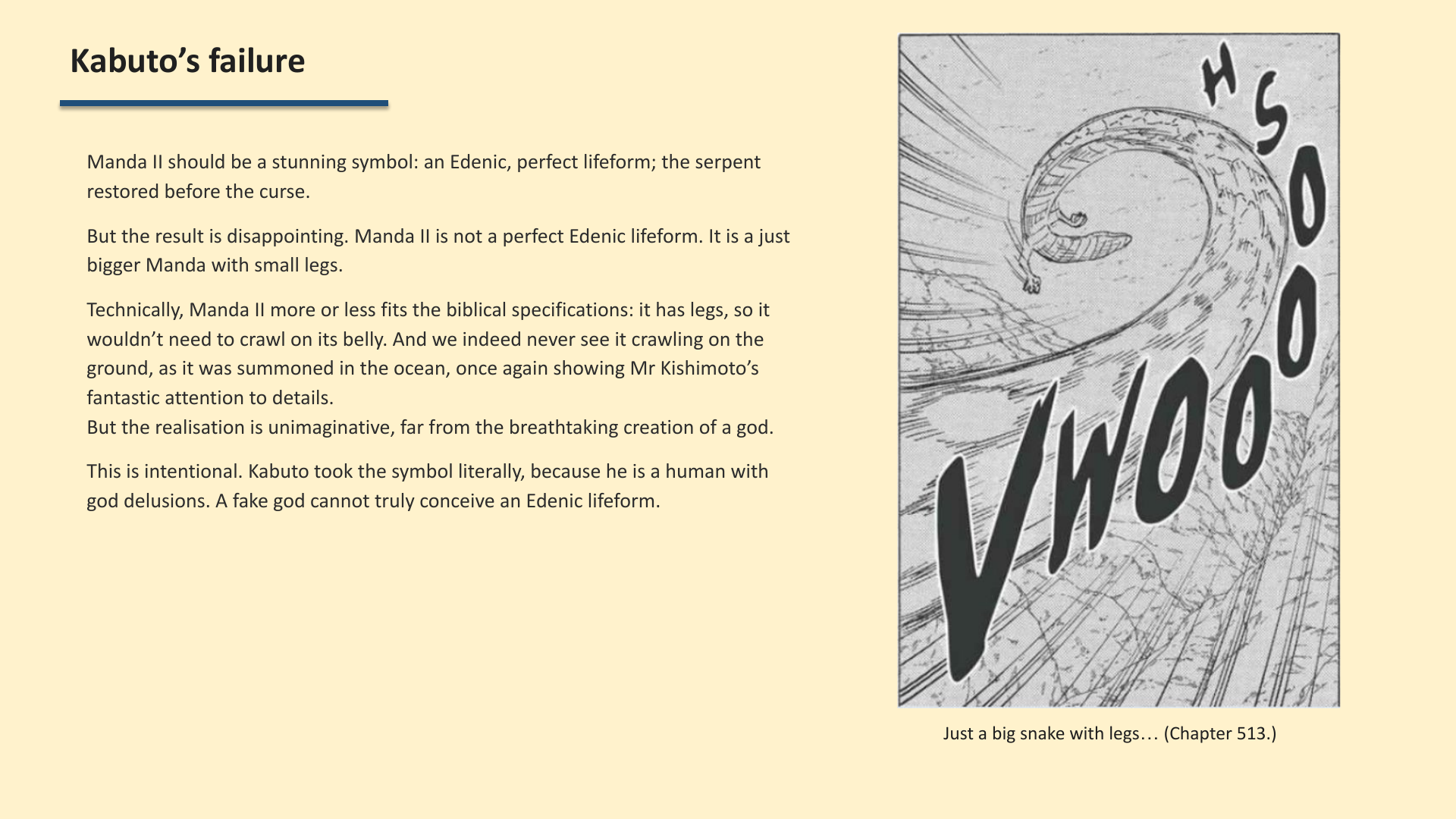
But the result is disappointing. Manda II is not a perfect Edenic lifeform. It is a just bigger Manda with small legs.

Technically, Manda II more or less fits the biblical specifications: it has legs, so it wouldn’t need to crawl on its belly. And we indeed never see it crawling on the ground, as it was summoned in the ocean, once again showing Mr Kishimoto’s fantastic attention to details. But the realisation is unimaginative, far from the breathtaking creation of a god.

This is intentional. Kabuto took the symbol literally, because he is a human with god delusions. A fake god cannot truly conceive an Edenic lifeform.

Just a big snake with legs… (Chapter 513.)

The Eden predator

Slide 8: The Eden predator
Read slide transcript

The Eden predator

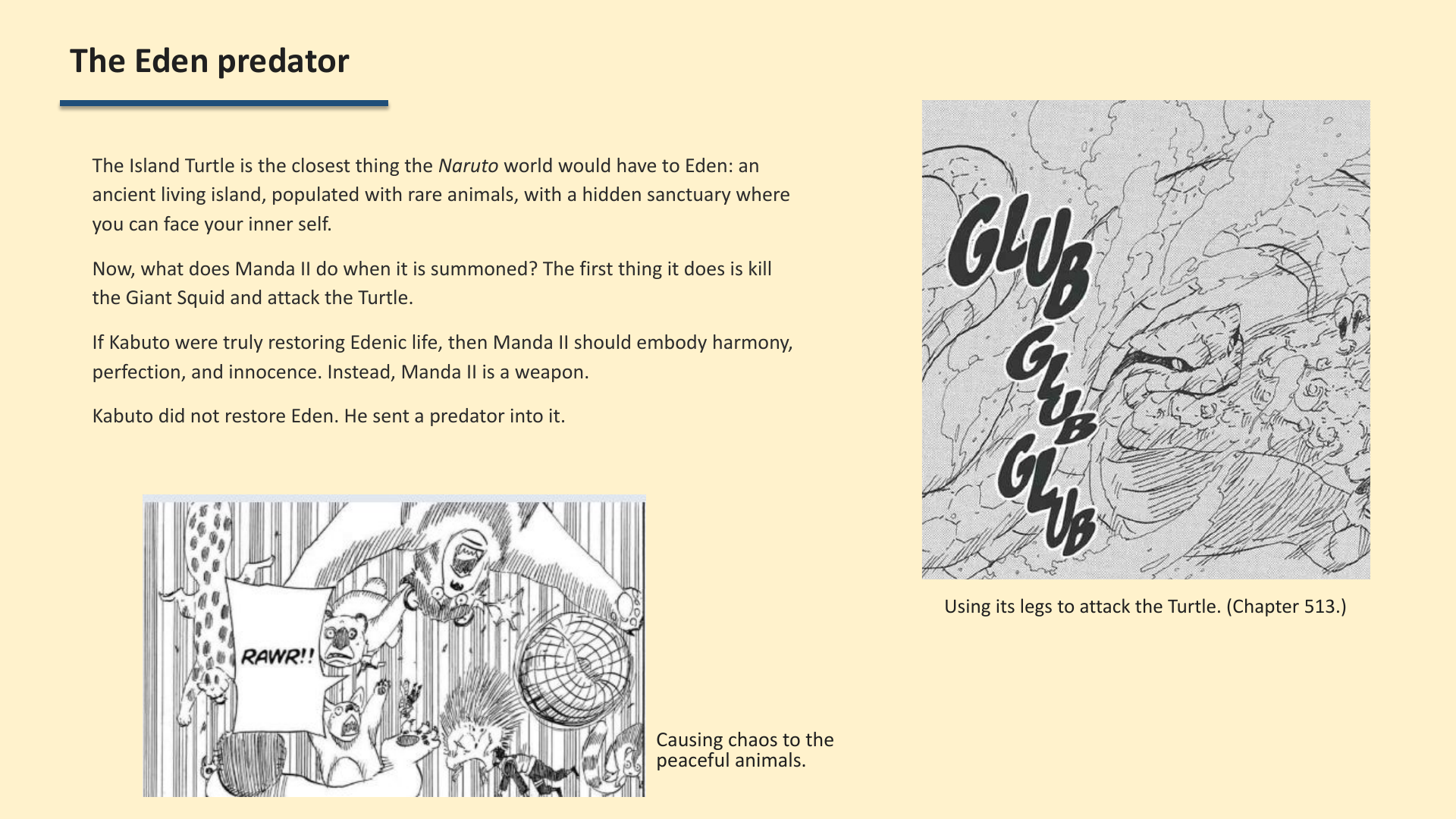
The Island Turtle is the closest thing the Naruto world would have to Eden: an ancient living island, populated with rare animals, with a hidden sanctuary where you can face your inner self.

Now, what does Manda II do when it is summoned? The first thing it does is kill the Giant Squid and attack the Turtle.

If Kabuto were truly restoring Edenic life, then Manda II should embody harmony, perfection, and innocence. Instead, Manda II is a weapon.

Kabuto did not restore Eden. He sent a predator into it.

Using its legs to attack the Turtle. (Chapter 513.)

Causing chaos to the peaceful animals.

The fake creation

Slide 9: The fake creation
Read slide transcript

The fake creation

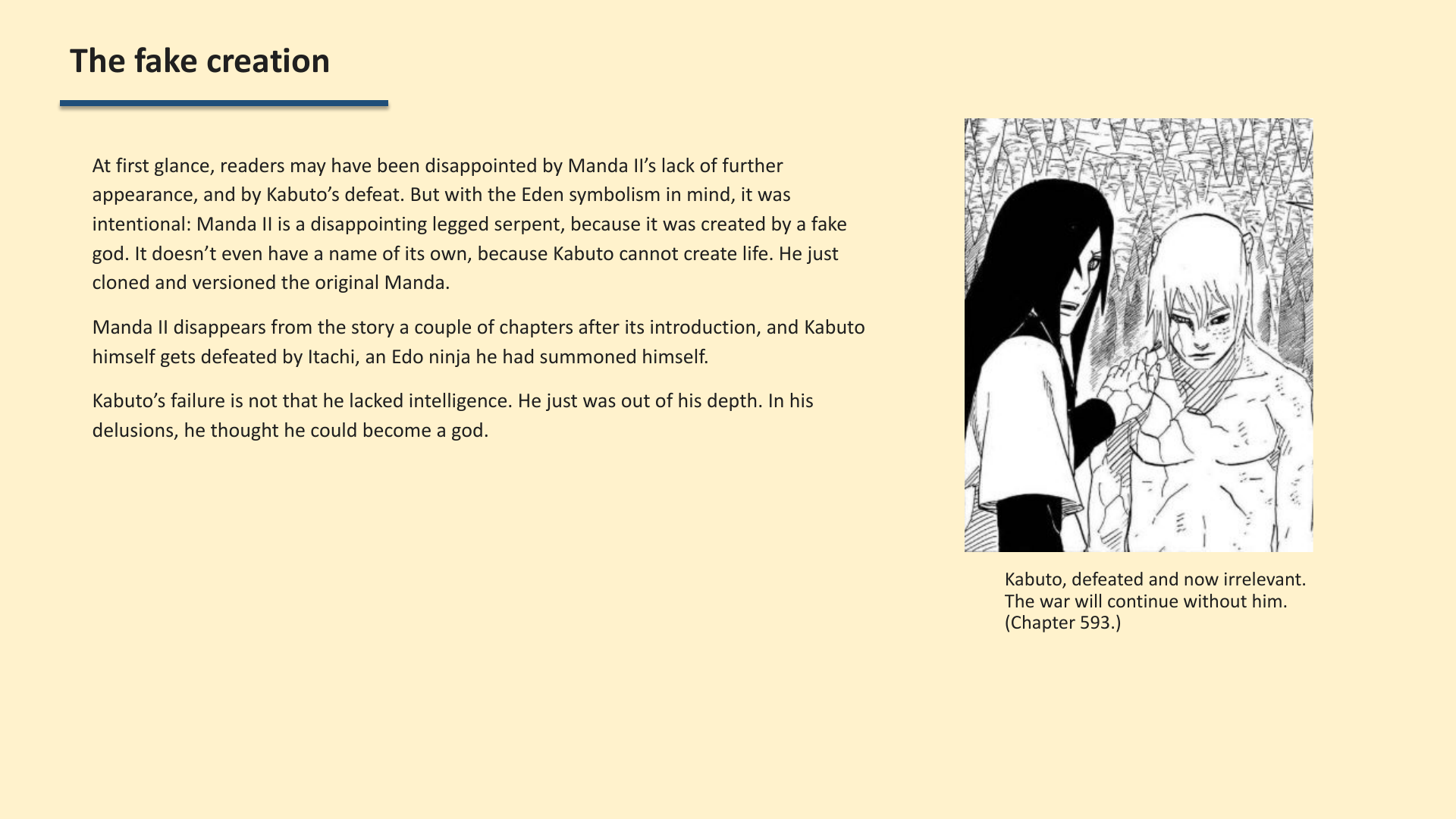
At first glance, readers may have been disappointed by Manda II’s lack of further appearance, and by Kabuto’s defeat. But with the Eden symbolism in mind, it was intentional: Manda II is a disappointing legged serpent, because it was created by a fake god. It doesn’t even have a name of its own, because Kabuto cannot create life. He just cloned and versioned the original Manda.

Manda II disappears from the story a couple of chapters after its introduction, and Kabuto himself gets defeated by Itachi, an Edo ninja he had summoned himself.

Kabuto’s failure is not that he lacked intelligence. He just was out of his depth. In his delusions, he thought he could become a god.

Kabuto, defeated and now irrelevant. The war will continue without him. (Chapter 593.)