Pious meaning

Episode 20 — Hidan and Jashin

The god noboby investigates

Episode 20 — Hidan’s god
Slide 1: Episode 20 — Hidan’s god
Read slide transcript

Naruto Walkthrough - Reader Edition

Episode 20 — Hidan’s god

We have completed the main quest, Samehada’s plan to get the Jūbi. But while we saw how Samehada managed to get herself into a winning position, we have not seen her actually claim victory and hijack Kaguya’s revival. This happens in the true ending.

Our next goal is not to uncover a hidden plot, but to unlock the ending itself. For that, we need to understand the pious meaning of the novel, and find the religious framing and symbolism Mr Kishimoto used.

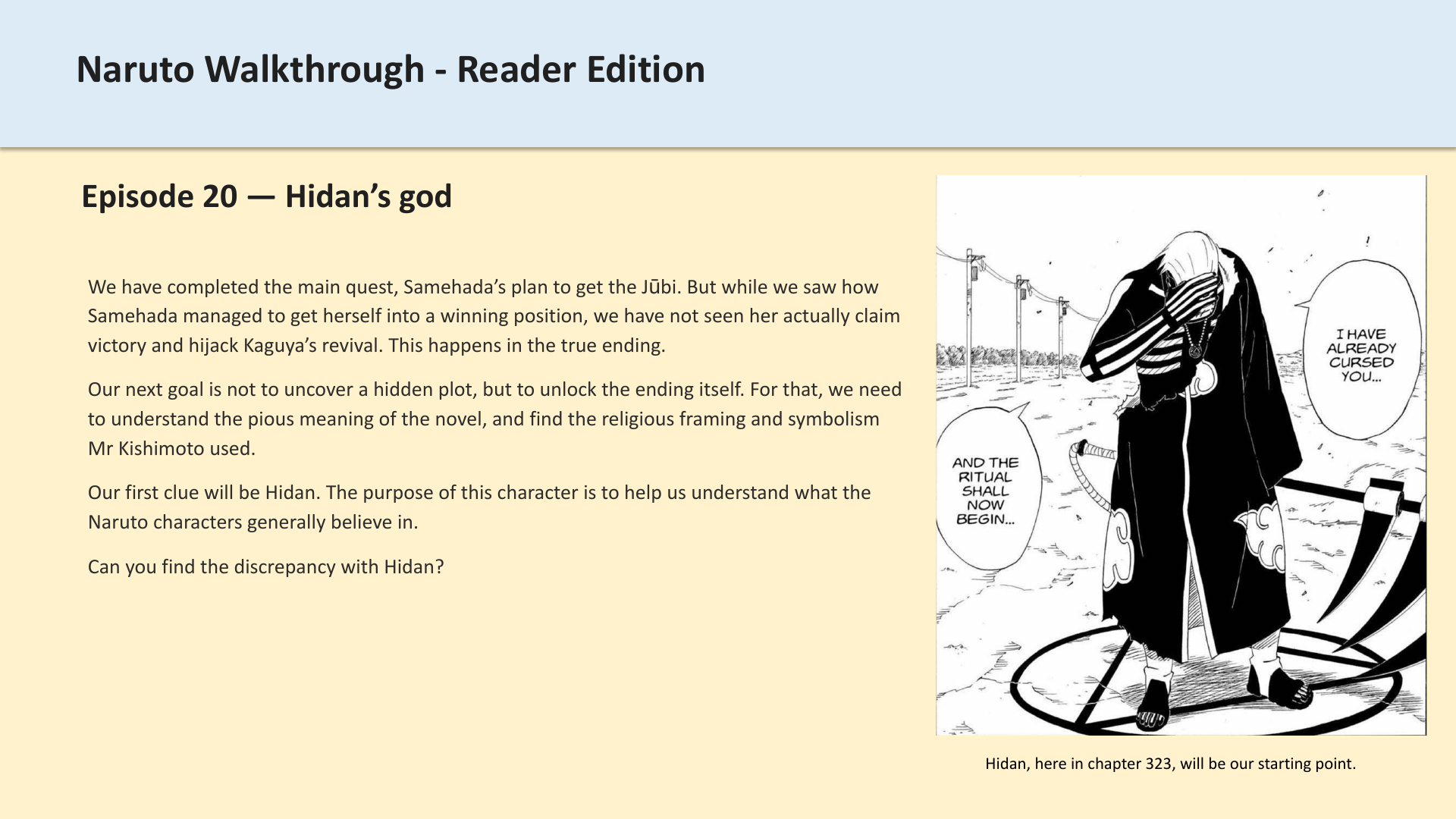
Our first clue will be Hidan. The purpose of this character is to help us understand what the Naruto characters generally believe in.

Can you find the discrepancy with Hidan?

Hidan, here in chapter 323, will be our starting point.
A disclaimer

Slide 2: A disclaimer
Read slide transcript

A disclaimer

Before getting to Hidan, let us start this third section with a little disclaimer.

In this final part of the walkthrough, we are going to see that the Naruto novel is built within a religious frame, and sometimes references the Bible. We will need, amongst other things, to find and analyse the Christian symbolism in order to unlock the true ending, which, as we will see, sides with gods against sacrilegious humans.

We will not infer anything regarding Mr Kishimoto’s personal beliefs, or lack thereof, and we will not discuss the inherent merits of Christianity, or religions in general.

Naruto is a fantastic novel, but remains a work of fiction. In the context of this walkthrough, the Bible is merely a book referenced by Mr Kishimoto to build his fictional world. Our personal beliefs and opinions are irrelevant here.

With that out of the way, let us get back to Hidan.

Immortality and ninjutsu seekers.

Slide 3: Immortality and ninjutsu seekers.
Read slide transcript

Immortality and ninjutsu seekers.

Several Naruto characters sought immortality, or at least to prolong their lives beyond a human lifespan. Some of them went to extreme lengths to cheat death. For example:

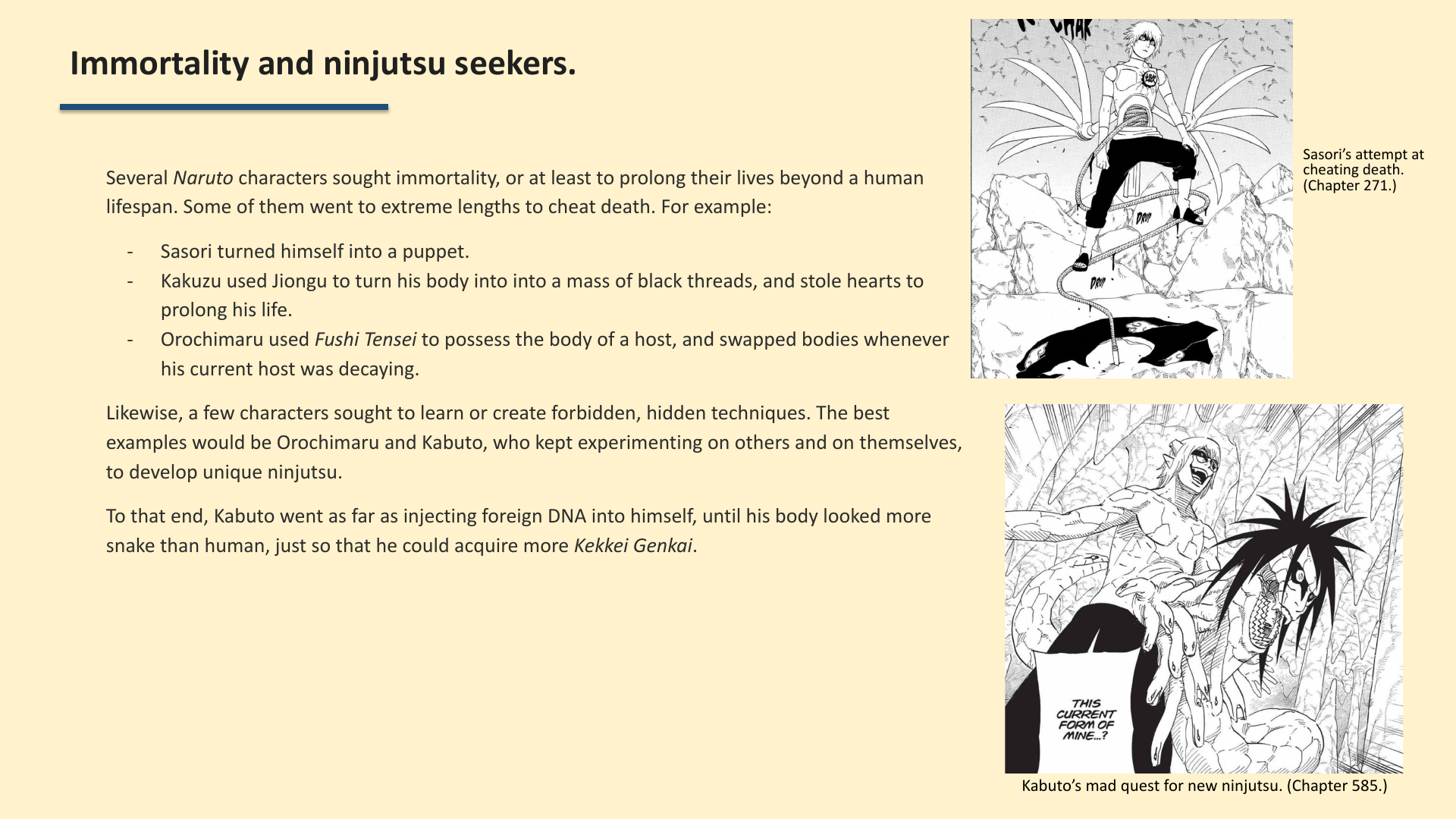
Sasori turned himself into a puppet.

Kakuzu used Jiongu to turn his body into into a mass of black threads, and stole hearts to prolong his life.

Orochimaru used Fushi Tensei to possess the body of a host, and swapped bodies whenever his current host was decaying.

Likewise, a few characters sought to learn or create forbidden, hidden techniques. The best examples would be Orochimaru and Kabuto, who kept experimenting on others and on themselves, to develop unique ninjutsu.

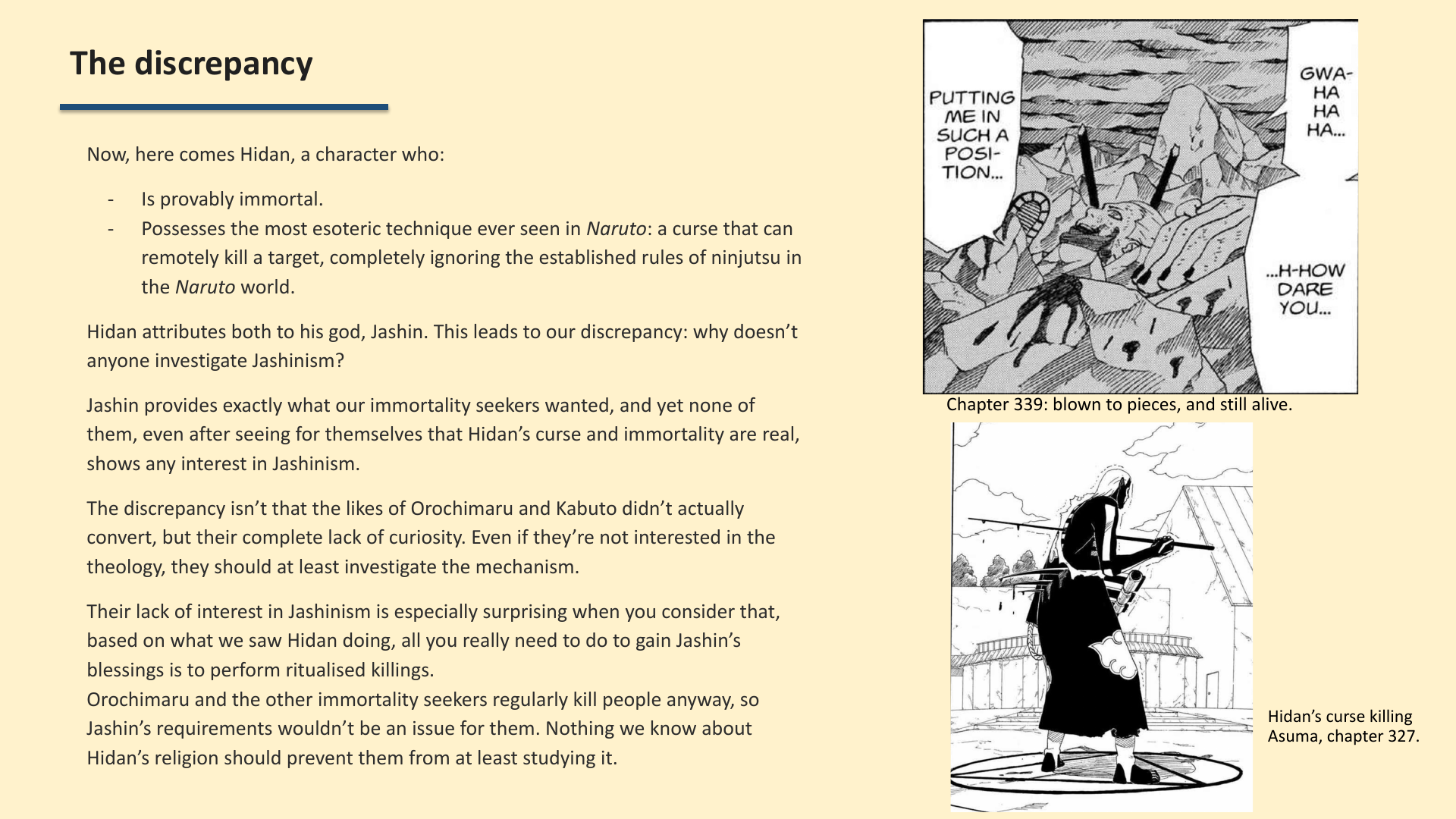
To that end, Kabuto went as far as injecting foreign DNA into himself, until his body looked more snake than human, just so that he could acquire more Kekkei Genkai.

Kabuto’s mad quest for new ninjutsu. (Chapter 585.)

Sasori’s attempt at cheating death. (Chapter 271.)

The discrepancy

Slide 4: The discrepancy
Read slide transcript

The discrepancy

Now, here comes Hidan, a character who:

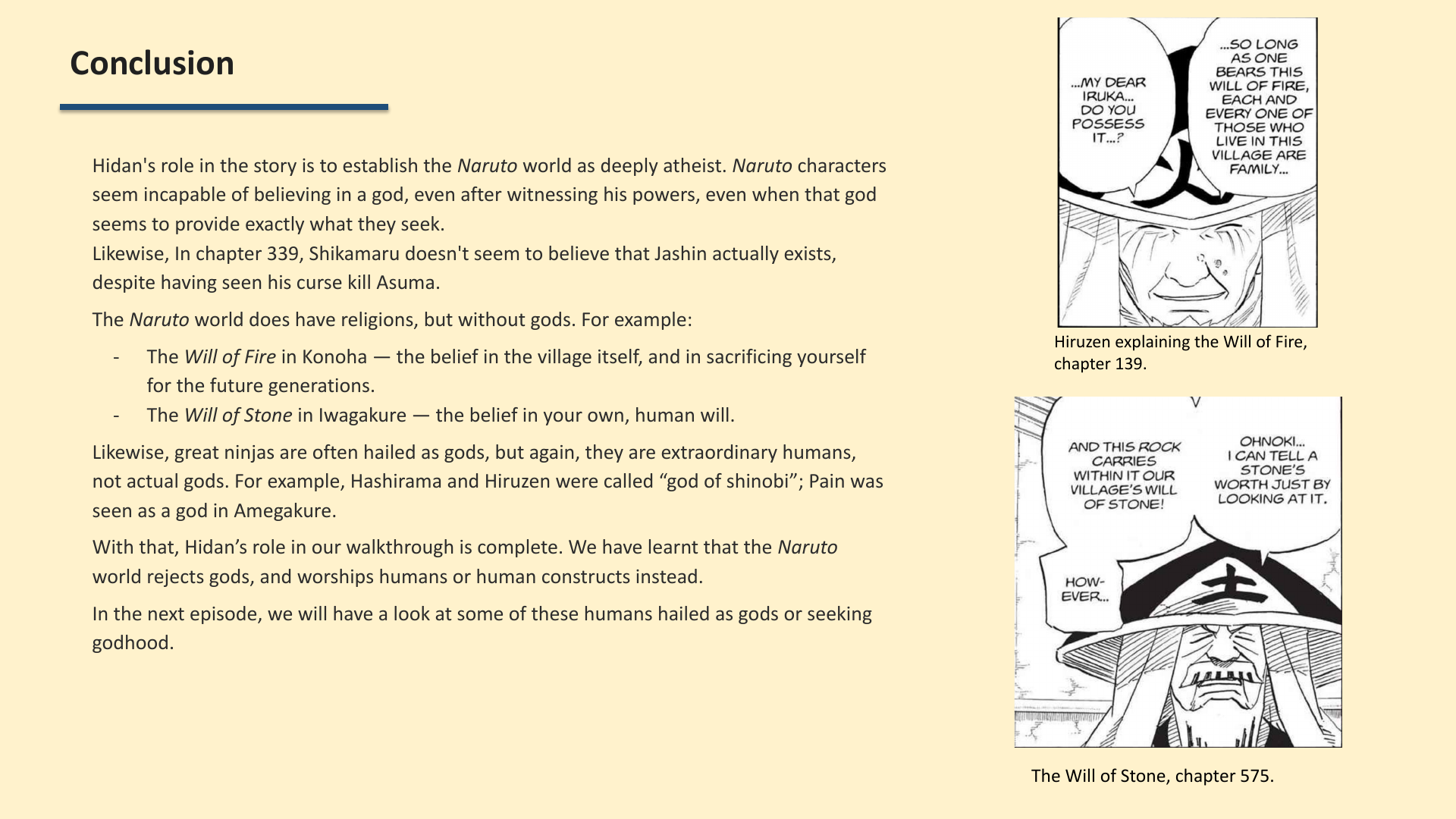
Is provably immortal.

Possesses the most esoteric technique ever seen in Naruto: a curse that can remotely kill a target, completely ignoring the established rules of ninjutsu in the Naruto world.

Hidan attributes both to his god, Jashin. This leads to our discrepancy: why doesn’t anyone investigate Jashinism?

Jashin provides exactly what our immortality seekers wanted, and yet none of them, even after seeing for themselves that Hidan’s curse and immortality are real, shows any interest in Jashinism.

The discrepancy isn’t that the likes of Orochimaru and Kabuto didn’t actually convert, but their complete lack of curiosity. Even if they’re not interested in the theology, they should at least investigate the mechanism.

Their lack of interest in Jashinism is especially surprising when you consider that, based on what we saw Hidan doing, all you really need to do to gain Jashin’s blessings is to perform ritualised killings. Orochimaru and the other immortality seekers regularly kill people anyway, so Jashin’s requirements wouldn’t be an issue for them. Nothing we know about Hidan’s religion should prevent them from at least studying it.

Chapter 339: blown to pieces, and still alive.

Hidan’s curse killing Asuma, chapter 327.

Conclusion

Slide 5: Conclusion
Read slide transcript

Conclusion

Hidan's role in the story is to establish the Naruto world as deeply atheist. Naruto characters seem incapable of believing in a god, even after witnessing his powers, even when that god seems to provide exactly what they seek. Likewise, In chapter 339, Shikamaru doesn't seem to believe that Jashin actually exists, despite having seen his curse kill Asuma.

The Naruto world does have religions, but without gods. For example:

The Will of Fire in Konoha — the belief in the village itself, and in sacrificing yourself for the future generations.

The Will of Stone in Iwagakure — the belief in your own, human will.

Likewise, great ninjas are often hailed as gods, but again, they are extraordinary humans, not actual gods. For example, Hashirama and Hiruzen were called “god of shinobi”; Pain was seen as a god in Amegakure.

With that, Hidan’s role in our walkthrough is complete. We have learnt that the Naruto world rejects gods, and worships humans or human constructs instead.

In the next episode, we will have a look at some of these humans hailed as gods or seeking godhood.

The Will of Stone, chapter 575.

Hiruzen explaining the Will of Fire, chapter 139.