Pious meaning

Episode 22 — Konan’s freshwater miracle
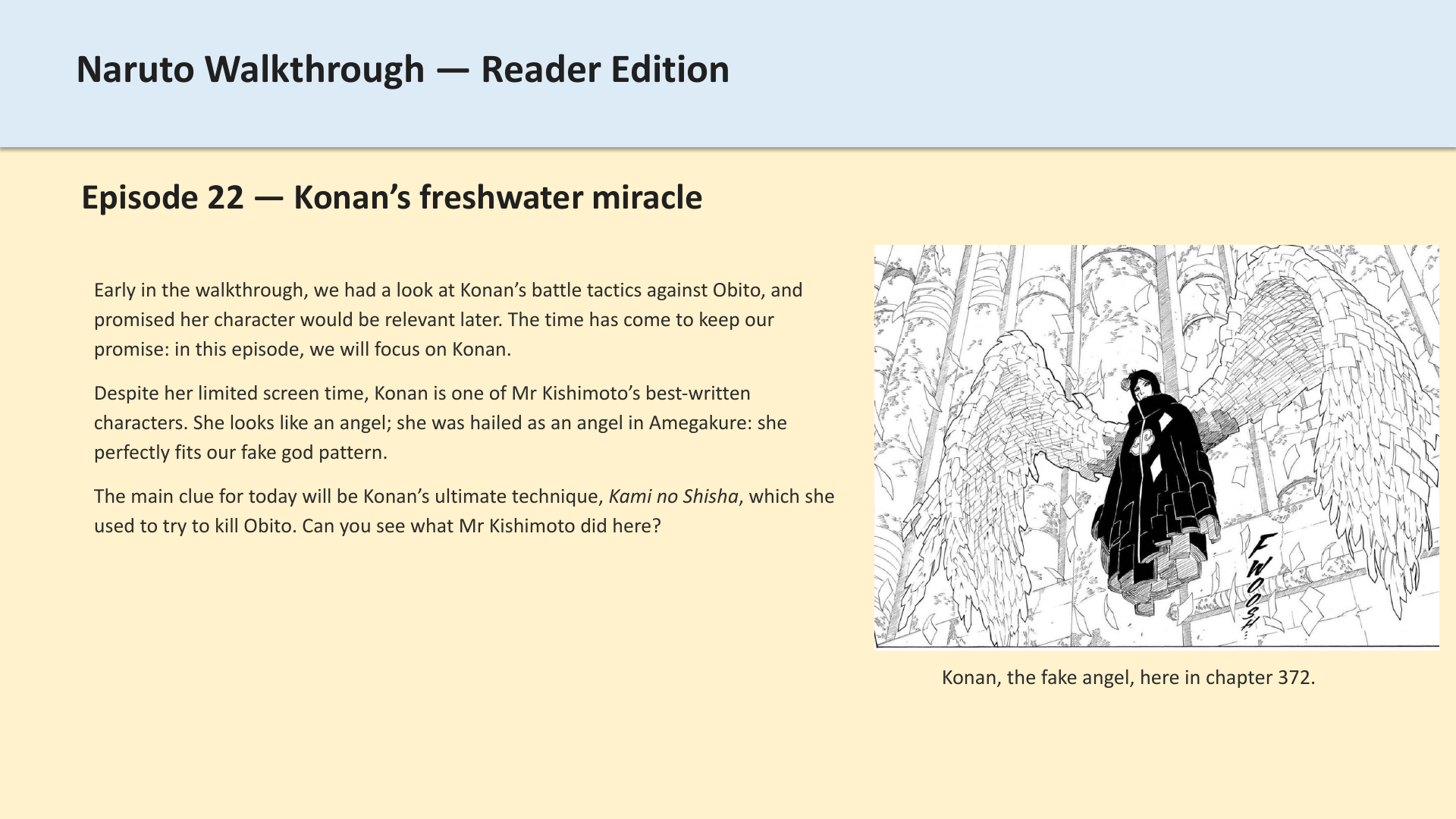
The fake angel

Episode 22 — Konan’s freshwater miracle

Slide 1: Episode 22 — Konan’s freshwater miracle
Read slide transcript

Naruto Walkthrough — Reader Edition

Episode 22 — Konan’s freshwater miracle

Early in the walkthrough, we had a look at Konan’s battle tactics against Obito, and promised her character would be relevant later. The time has come to keep our promise: in this episode, we will focus on Konan.

Despite her limited screen time, Konan is one of Mr Kishimoto’s best-written characters. She looks like an angel; she was hailed as an angel in Amegakure: she perfectly fits our fake god pattern.

The main clue for today will be Konan’s ultimate technique, Kami no Shisha, which she used to try to kill Obito. Can you see what Mr Kishimoto did here?

Konan, the fake angel, here in chapter 372.
The industrial miracle

Slide 2: The industrial miracle
Read slide transcript

The industrial miracle

Kami no Shisha is an obvious reference to Moses parting the sea in the Bible. At first glance, what Konan does seem similar: water parts, the enemy is trapped, and the scale feels miraculous.

There are, however, two issues with Konan’s technique, which prove she is not a true angel. Can you spot them?

The first issue is, Konan’s miracle was industrial.

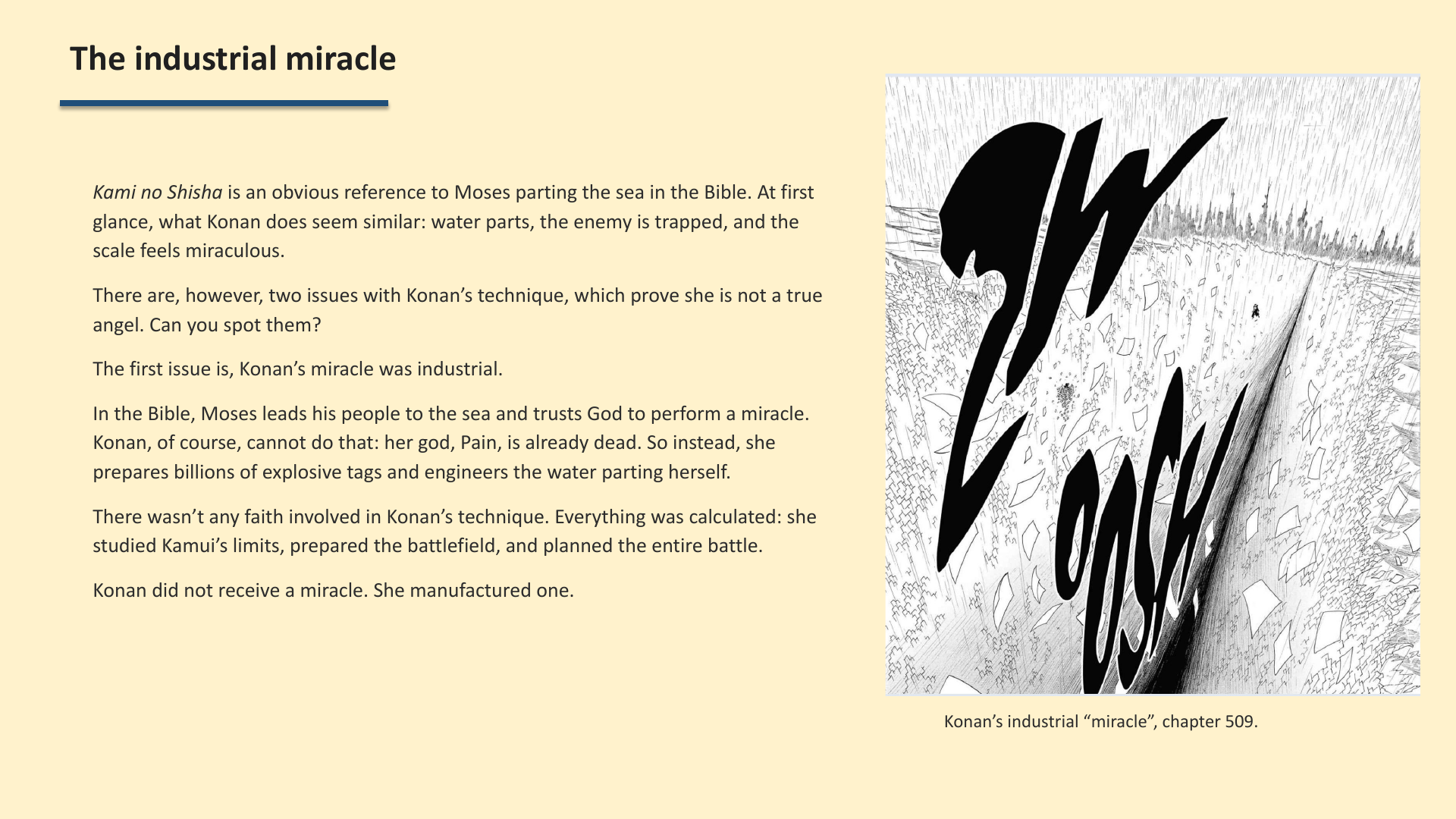
In the Bible, Moses leads his people to the sea and trusts God to perform a miracle. Konan, of course, cannot do that: her god, Pain, is already dead. So instead, she prepares billions of explosive tags and engineers the water parting herself.

There wasn’t any faith involved in Konan’s technique. Everything was calculated: she studied Kamui’s limits, prepared the battlefield, and planned the entire battle.

Konan did not receive a miracle. She manufactured one.

Konan’s industrial “miracle”, chapter 509.

The wrong sea

Slide 3: The wrong sea
Read slide transcript

The wrong sea

The second issue with Konan’s water-parting miracle is the water itself. In the Bible, Moses parts the sea. Konan, on the other hand, only parts a freshwater lake.

This is where Mr Kishimoto built a fantastic parallel between Konan and Samehada. Konan, the fake angel, parts a lake, whereas Samehada, the true goddess of the Naruto universe, rules over the ocean, and is planning to start the Seawater Deluge.

Konan’s fake miracle was doomed to fail, because she parted the wrong water.

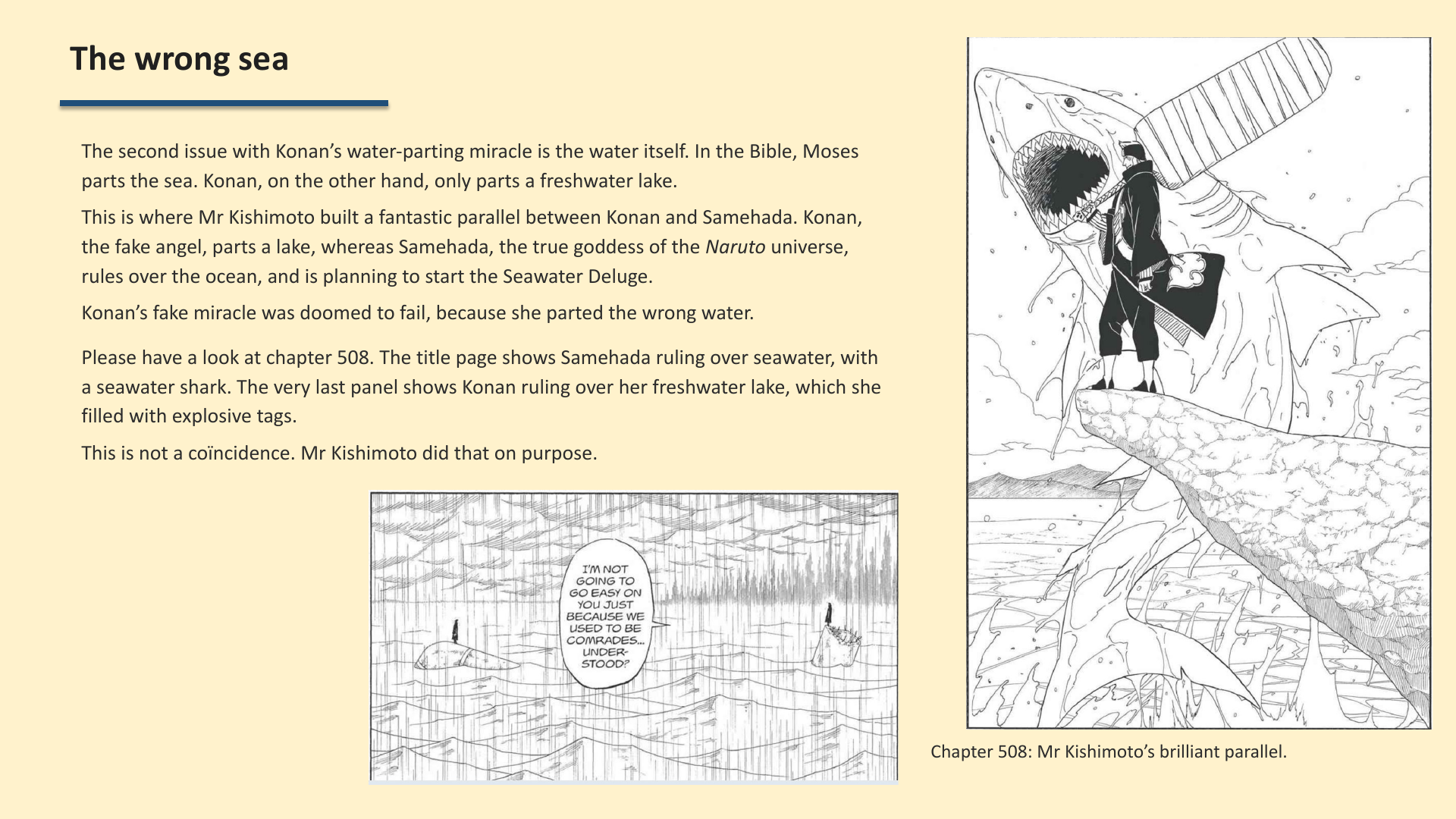
Please have a look at chapter 508. The title page shows Samehada ruling over seawater, with a seawater shark. The very last panel shows Konan ruling over her freshwater lake, which she filled with explosive tags.

This is not a coïncidence. Mr Kishimoto did that on purpose.

Chapter 508: Mr Kishimoto’s brilliant parallel.

Seawater

Slide 4: Seawater
Read slide transcript

Seawater

Speaking of seawater, it is time we fulfilled another promise. After the Samehada quest, we had a seawater episode, in which we focused on scientific trivial and explained why, in a battle context, seawater Suiton would be a strong counter to many Naruto techniques.

We said we would explain later why this is relevant in our quest to unlock the true ending. This later is now: with the fake god pattern, and with Konan’s example, can you see the purpose of the seawater episode?

The strongest counters we saw then were related to techniques used by fake gods:

Hashirama’s Mokuton: cannot grow in seawater.

Pain’s high-frequency chakra network: unusable in seawater.

Konan beautifully fits the pattern: her explosive tags are waterproof, but not seawaterproof.

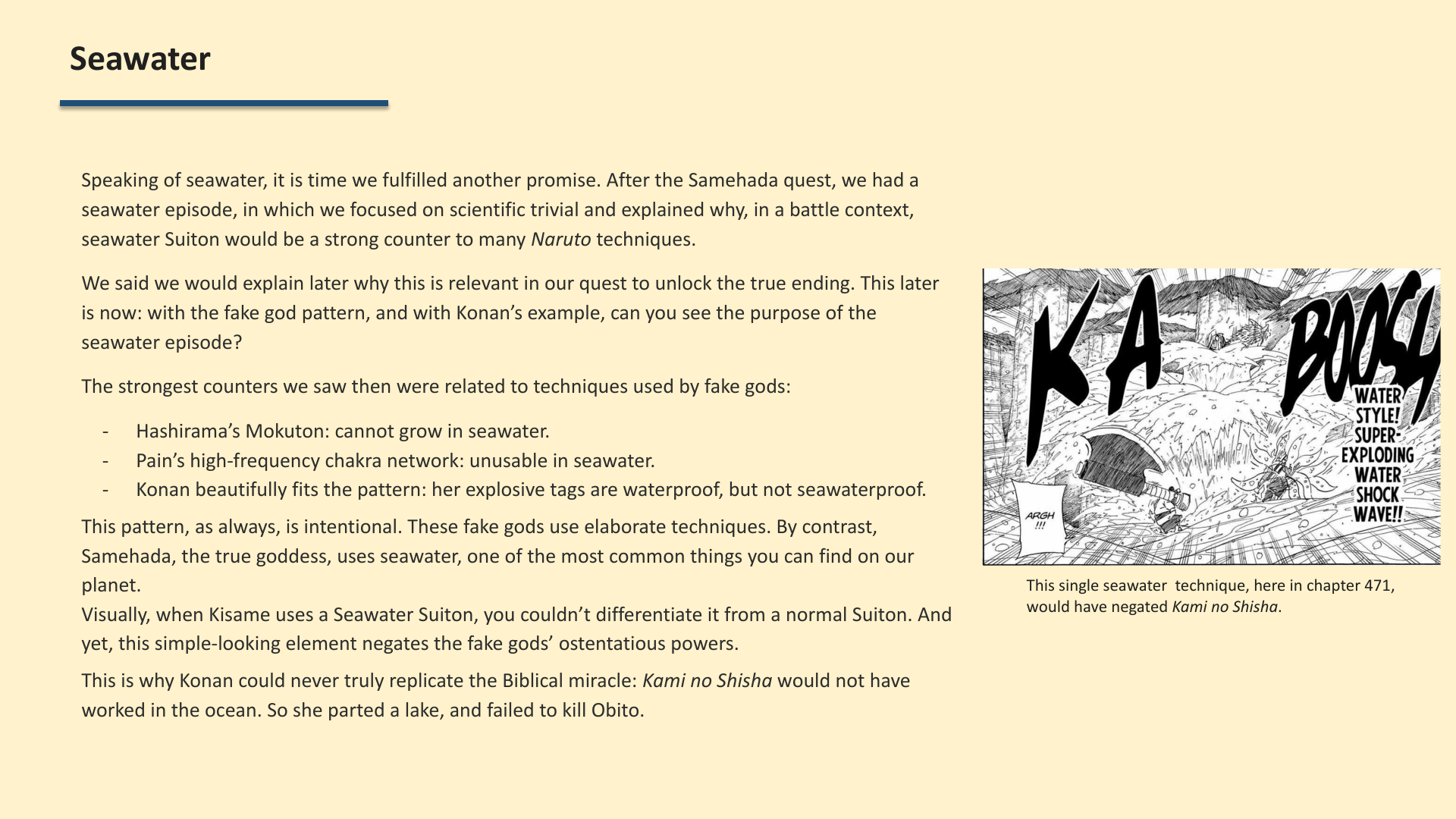
This pattern, as always, is intentional. These fake gods use elaborate techniques. By contrast, Samehada, the true goddess, uses seawater, one of the most common things you can find on our planet. Visually, when Kisame uses a Seawater Suiton, you couldn’t differentiate it from a normal Suiton. And yet, this simple-looking element negates the fake gods’ ostentatious powers.

This is why Konan could never truly replicate the Biblical miracle: Kami no Shisha would not have worked in the ocean. So she parted a lake, and failed to kill Obito.

This single seawater technique, here in chapter 471, would have negated Kami no Shisha.

The Kisame parallel

Slide 5: The Kisame parallel
Read slide transcript

The Kisame parallel

The parallel between Konan and Samehada goes beyond the type of water they use. There is one more thing Mr Kishimoto did on purpose: the timing of Konan’s death.

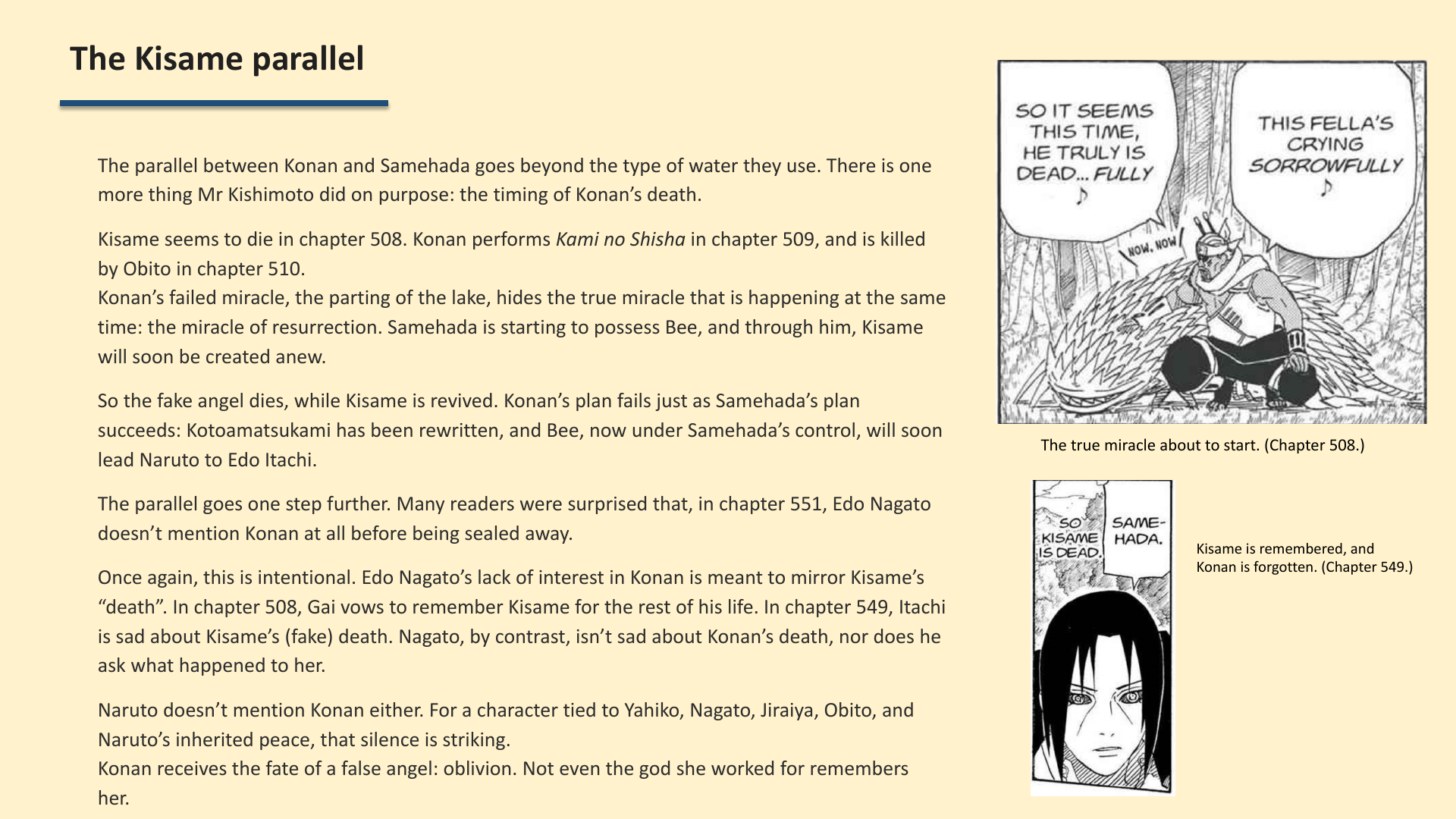
Kisame seems to die in chapter 508. Konan performs Kami no Shisha in chapter 509, and is killed by Obito in chapter 510. Konan’s failed miracle, the parting of the lake, hides the true miracle that is happening at the same time: the miracle of resurrection. Samehada is starting to possess Bee, and through him, Kisame will soon be created anew.

So the fake angel dies, while Kisame is revived. Konan’s plan fails just as Samehada’s plan succeeds: Kotoamatsukami has been rewritten, and Bee, now under Samehada’s control, will soon lead Naruto to Edo Itachi.

The parallel goes one step further. Many readers were surprised that, in chapter 551, Edo Nagato doesn’t mention Konan at all before being sealed away.

Once again, this is intentional. Edo Nagato’s lack of interest in Konan is meant to mirror Kisame’s “death”. In chapter 508, Gai vows to remember Kisame for the rest of his life. In chapter 549, Itachi is sad about Kisame’s (fake) death. Nagato, by contrast, isn’t sad about Konan’s death, nor does he ask what happened to her.

Naruto doesn’t mention Konan either. For a character tied to Yahiko, Nagato, Jiraiya, Obito, and Naruto’s inherited peace, that silence is striking. Konan receives the fate of a false angel: oblivion. Not even the god she worked for remembers her.

The true miracle about to start. (Chapter 508.)

Kisame is remembered, and Konan is forgotten. (Chapter 549.)

Conclusion — Konan’s tragedy

Slide 6: Conclusion — Konan’s tragedy
Read slide transcript

Conclusion — Konan’s tragedy

So Konan fits our pattern of fake gods failing. As opposed to the likes of Kabuto, however, she is a tragic character, because she didn’t lack angelic virtues.

Konan is sincere, selfless, loyal, intelligent, patient, and devoted. Unlike Kabuto and Madara, she didn’t have any godhood delusions. In another story, she could have been a remarkable angel.

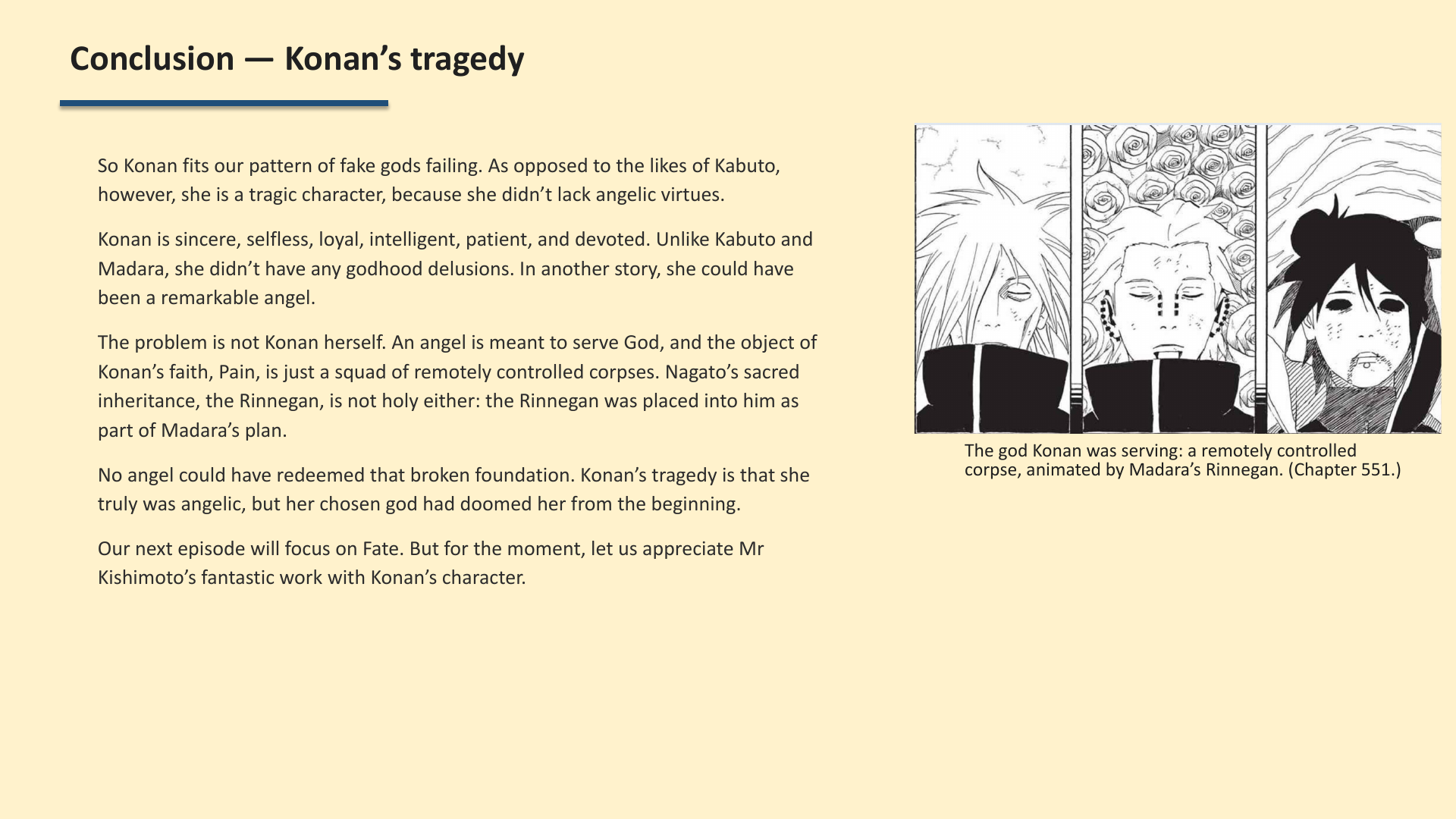
The problem is not Konan herself. An angel is meant to serve God, and the object of Konan’s faith, Pain, is just a squad of remotely controlled corpses. Nagato’s sacred inheritance, the Rinnegan, is not holy either: the Rinnegan was placed into him as part of Madara’s plan.

No angel could have redeemed that broken foundation. Konan’s tragedy is that she truly was angelic, but her chosen god had doomed her from the beginning.

Our next episode will focus on Fate. But for the moment, let us appreciate Mr Kishimoto’s fantastic work with Konan’s character.

The god Konan was serving: a remotely controlled corpse, animated by Madara’s Rinnegan. (Chapter 551.)