Pious meaning

Episode 25 — Cassandra truths

The prophets no one listened to

Episode 25 — Cassandra Truths
Slide 1: Episode 25 — Cassandra Truths
Read slide transcript

Naruto Walkthrough — Reader Edition

Episode 25 — Cassandra Truths

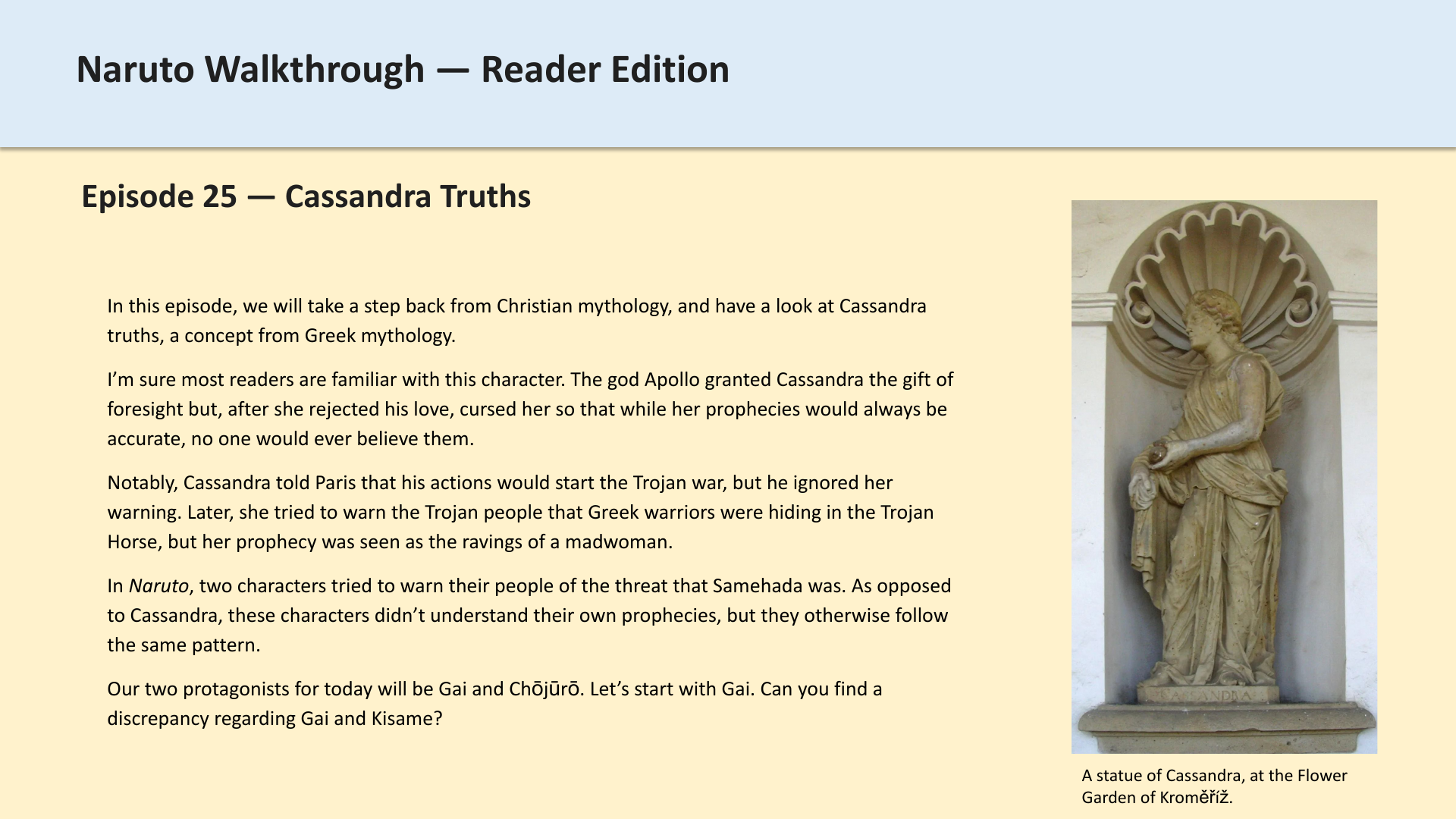
In this episode, we will take a step back from Christian mythology, and have a look at Cassandra truths, a concept from Greek mythology.

I’m sure most readers are familiar with this character. The god Apollo granted Cassandra the gift of foresight but, after she rejected his love, cursed her so that while her prophecies would always be accurate, no one would ever believe them.

Notably, Cassandra told Paris that his actions would start the Trojan war, but he ignored her warning. Later, she tried to warn the Trojan people that Greek warriors were hiding in the Trojan Horse, but her prophecy was seen as the ravings of a madwoman.

In Naruto, two characters tried to warn their people of the threat that Samehada was. As opposed to Cassandra, these characters didn’t understand their own prophecies, but they otherwise follow the same pattern.

Our two protagonists for today will be Gai and Chōjūrō. Let’s start with Gai. Can you find a discrepancy regarding Gai and Kisame?

A statue of Cassandra, at the Flower Garden of Kroměříž.
Gai’s running gag

Slide 2: Gai’s running gag
Read slide transcript

Gai’s running gag

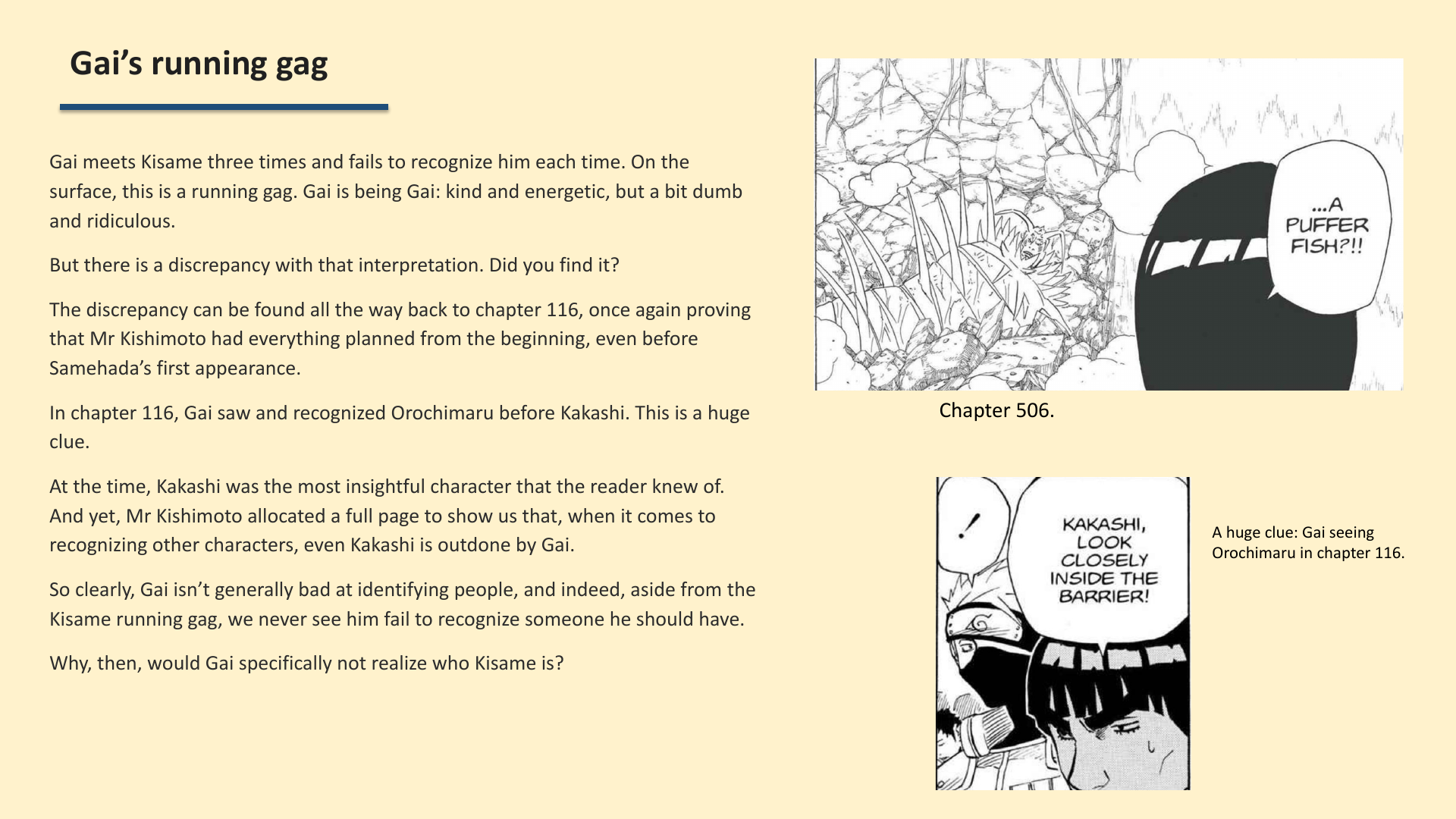
Gai meets Kisame three times and fails to recognize him each time. On the surface, this is a running gag. Gai is being Gai: kind and energetic, but a bit dumb and ridiculous.

But there is a discrepancy with that interpretation. Did you find it?

The discrepancy can be found all the way back to chapter 116, once again proving that Mr Kishimoto had everything planned from the beginning, even before Samehada’s first appearance.

In chapter 116, Gai saw and recognized Orochimaru before Kakashi. This is a huge clue.

At the time, Kakashi was the most insightful character that the reader knew of. And yet, Mr Kishimoto allocated a full page to show us that, when it comes to recognizing other characters, even Kakashi is outdone by Gai.

So clearly, Gai isn’t generally bad at identifying people, and indeed, aside from the Kisame running gag, we never see him fail to recognize someone he should have.

Why, then, would Gai specifically not realize who Kisame is?

Chapter 506.

A huge clue: Gai seeing Orochimaru in chapter 116.

Gai’s talent

Slide 3: Gai’s talent
Read slide transcript

Gai’s talent

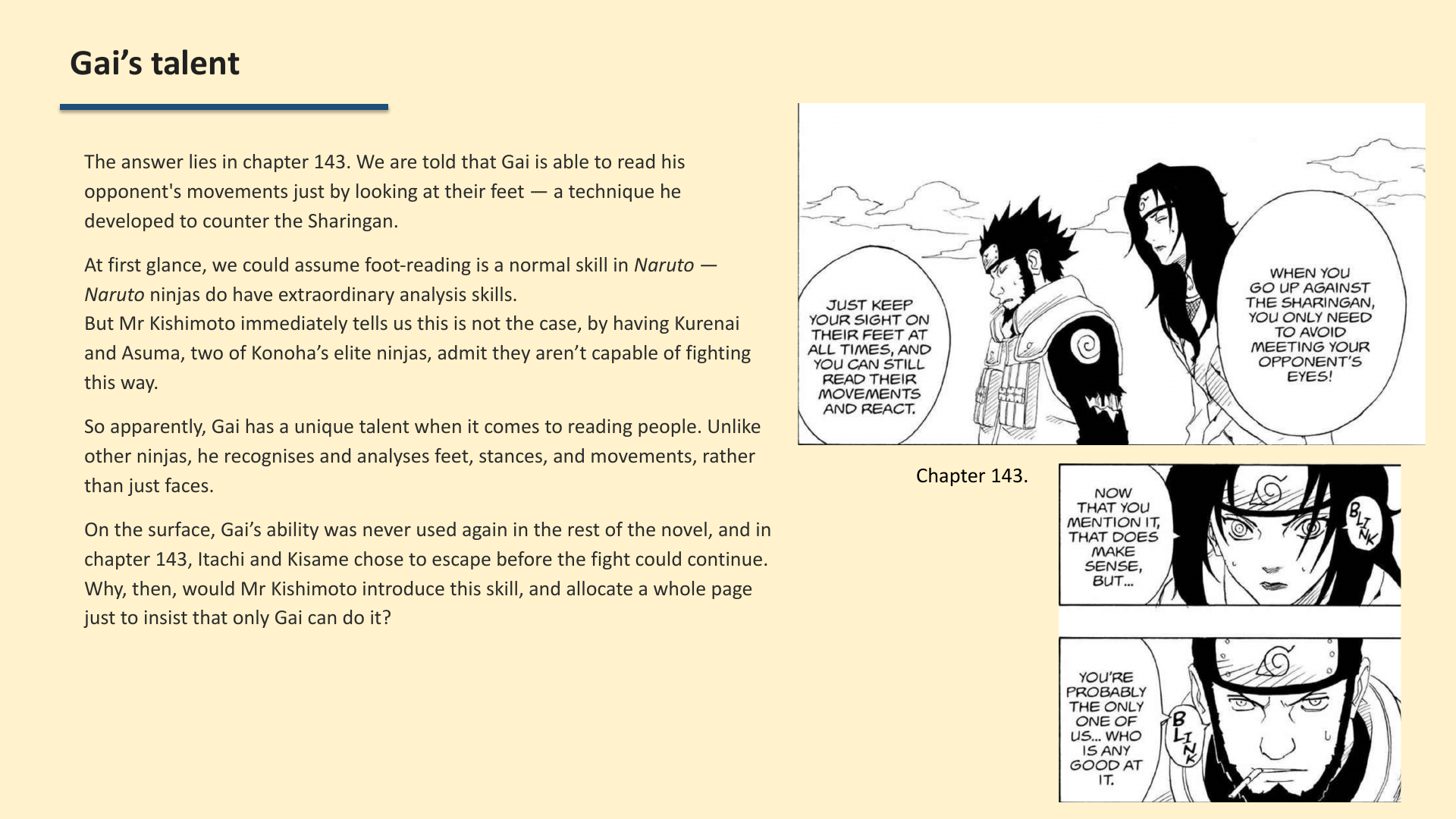
The answer lies in chapter 143. We are told that Gai is able to read his opponent's movements just by looking at their feet — a technique he developed to counter the Sharingan.

At first glance, we could assume foot-reading is a normal skill in Naruto — Naruto ninjas do have extraordinary analysis skills. But Mr Kishimoto immediately tells us this is not the case, by having Kurenai and Asuma, two of Konoha’s elite ninjas, admit they aren’t capable of fighting this way.

So apparently, Gai has a unique talent when it comes to reading people. Unlike other ninjas, he recognises and analyses feet, stances, and movements, rather than just faces.

On the surface, Gai’s ability was never used again in the rest of the novel, and in chapter 143, Itachi and Kisame chose to escape before the fight could continue. Why, then, would Mr Kishimoto introduce this skill, and allocate a whole page just to insist that only Gai can do it?

Chapter 143.

Gai’s prophecy

Slide 4: Gai’s prophecy
Read slide transcript

Gai’s prophecy

Let us look at the Kisame encounters again.

Chapter 143: Gai met the real Kisame, Samehada's human form.

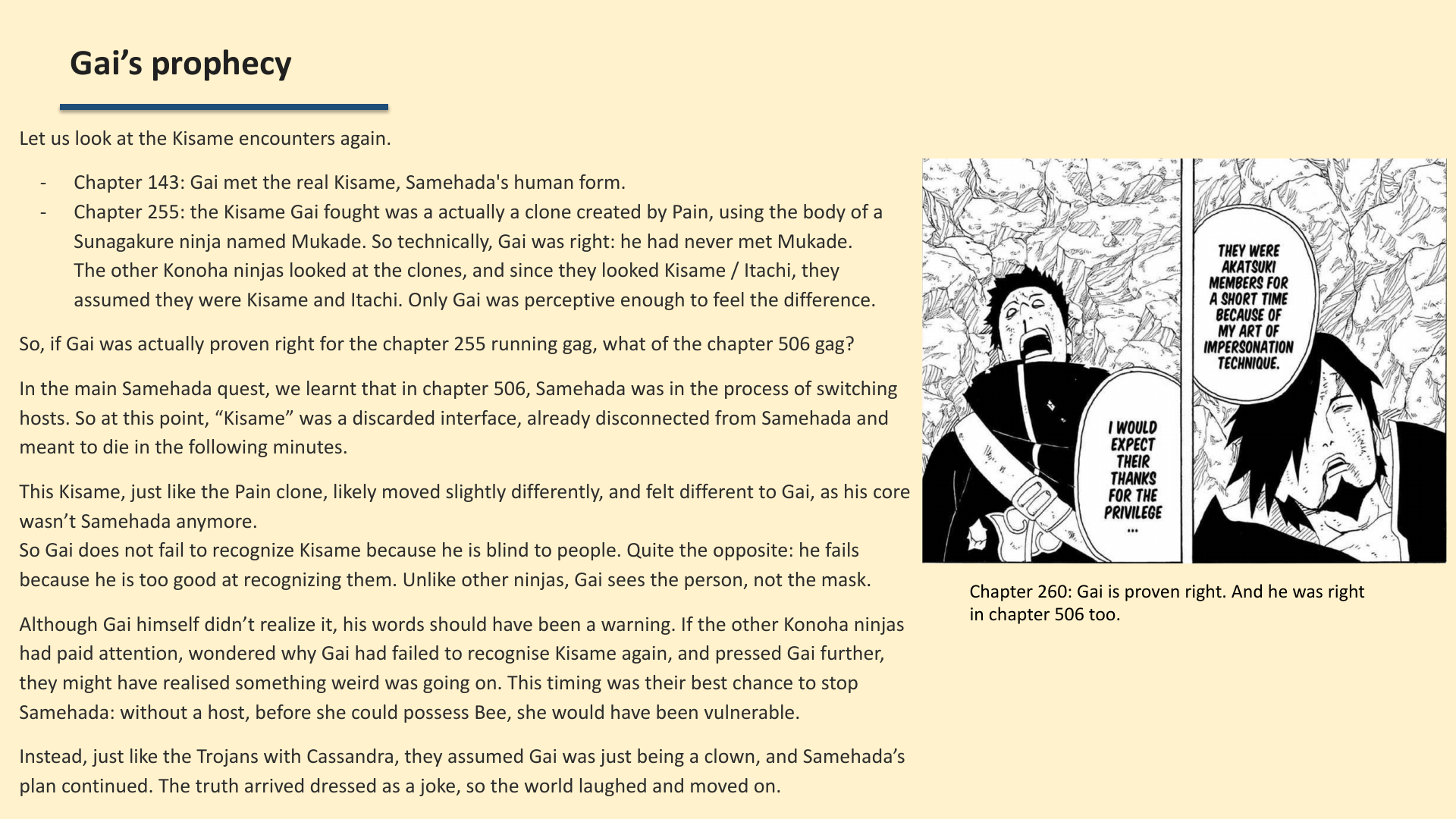
Chapter 255: the Kisame Gai fought was a actually a clone created by Pain, using the body of a Sunagakure ninja named Mukade. So technically, Gai was right: he had never met Mukade. The other Konoha ninjas looked at the clones, and since they looked Kisame / Itachi, they assumed they were Kisame and Itachi. Only Gai was perceptive enough to feel the difference.

So, if Gai was actually proven right for the chapter 255 running gag, what of the chapter 506 gag?

In the main Samehada quest, we learnt that in chapter 506, Samehada was in the process of switching hosts. So at this point, “Kisame” was a discarded interface, already disconnected from Samehada and meant to die in the following minutes.

This Kisame, just like the Pain clone, likely moved slightly differently, and felt different to Gai, as his core wasn’t Samehada anymore. So Gai does not fail to recognize Kisame because he is blind to people. Quite the opposite: he fails because he is too good at recognizing them. Unlike other ninjas, Gai sees the person, not the mask.

Although Gai himself didn’t realize it, his words should have been a warning. If the other Konoha ninjas had paid attention, wondered why Gai had failed to recognise Kisame again, and pressed Gai further, they might have realised something weird was going on. This timing was their best chance to stop Samehada: without a host, before she could possess Bee, she would have been vulnerable.

Instead, just like the Trojans with Cassandra, they assumed Gai was just being a clown, and Samehada’s plan continued. The truth arrived dressed as a joke, so the world laughed and moved on.

Chapter 260: Gai is proven right. And he was right in chapter 506 too.

Chōjūrō says the answer

Slide 5: Chōjūrō says the answer
Read slide transcript

Chōjūrō says the answer

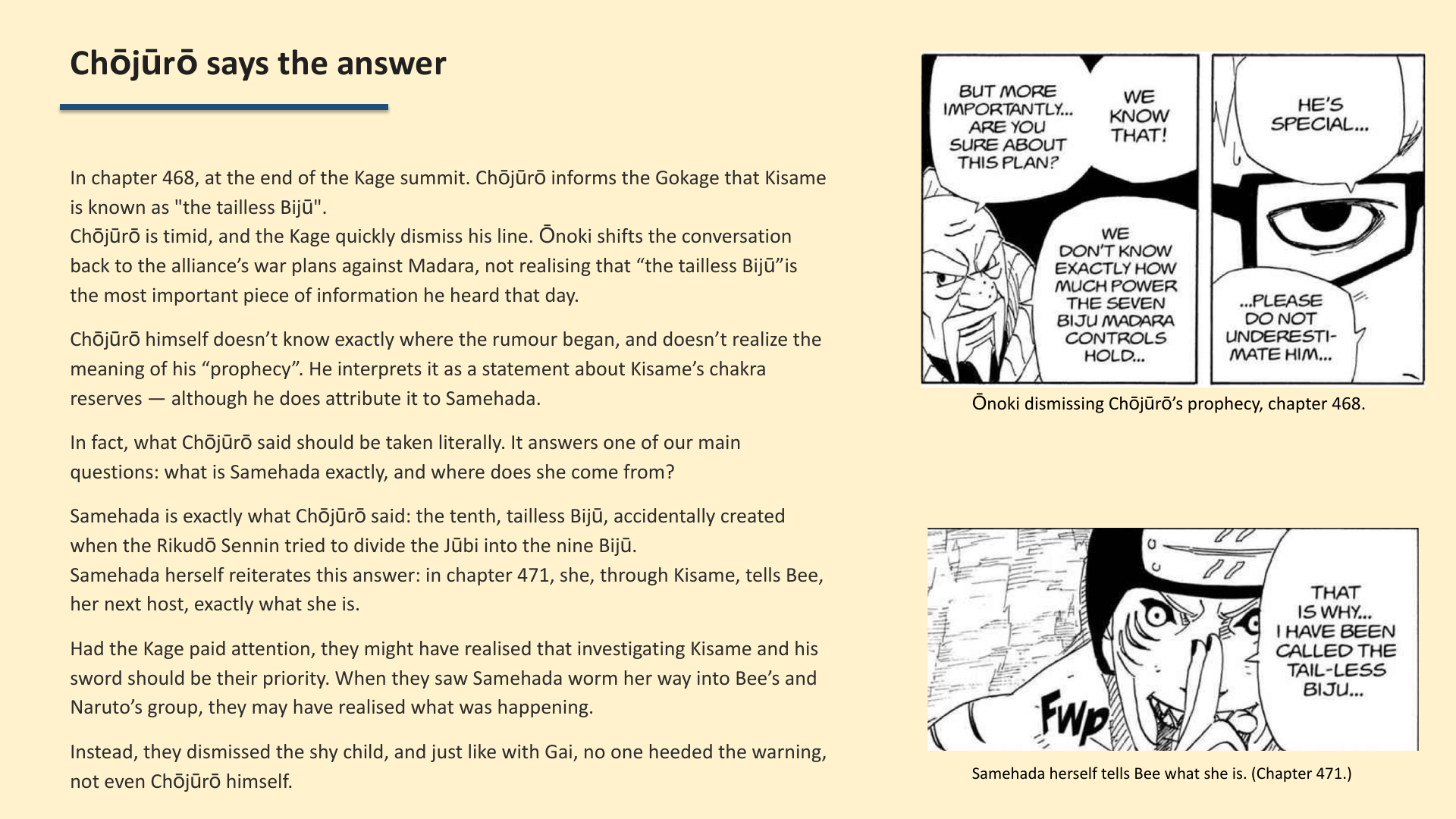
In chapter 468, at the end of the Kage summit. Chōjūrō informs the Gokage that Kisame is known as "the tailless Bijū". Chōjūrō is timid, and the Kage quickly dismiss his line. Ōnoki shifts the conversation back to the alliance’s war plans against Madara, not realising that “the tailless Bijū”is the most important piece of information he heard that day.

Chōjūrō himself doesn’t know exactly where the rumour began, and doesn’t realize the meaning of his “prophecy”. He interprets it as a statement about Kisame’s chakra reserves — although he does attribute it to Samehada.

In fact, what Chōjūrō said should be taken literally. It answers one of our main questions: what is Samehada exactly, and where does she come from?

Samehada is exactly what Chōjūrō said: the tenth, tailless Bijū, accidentally created when the Rikudō Sennin tried to divide the Jūbi into the nine Bijū. Samehada herself reiterates this answer: in chapter 471, she, through Kisame, tells Bee, her next host, exactly what she is.

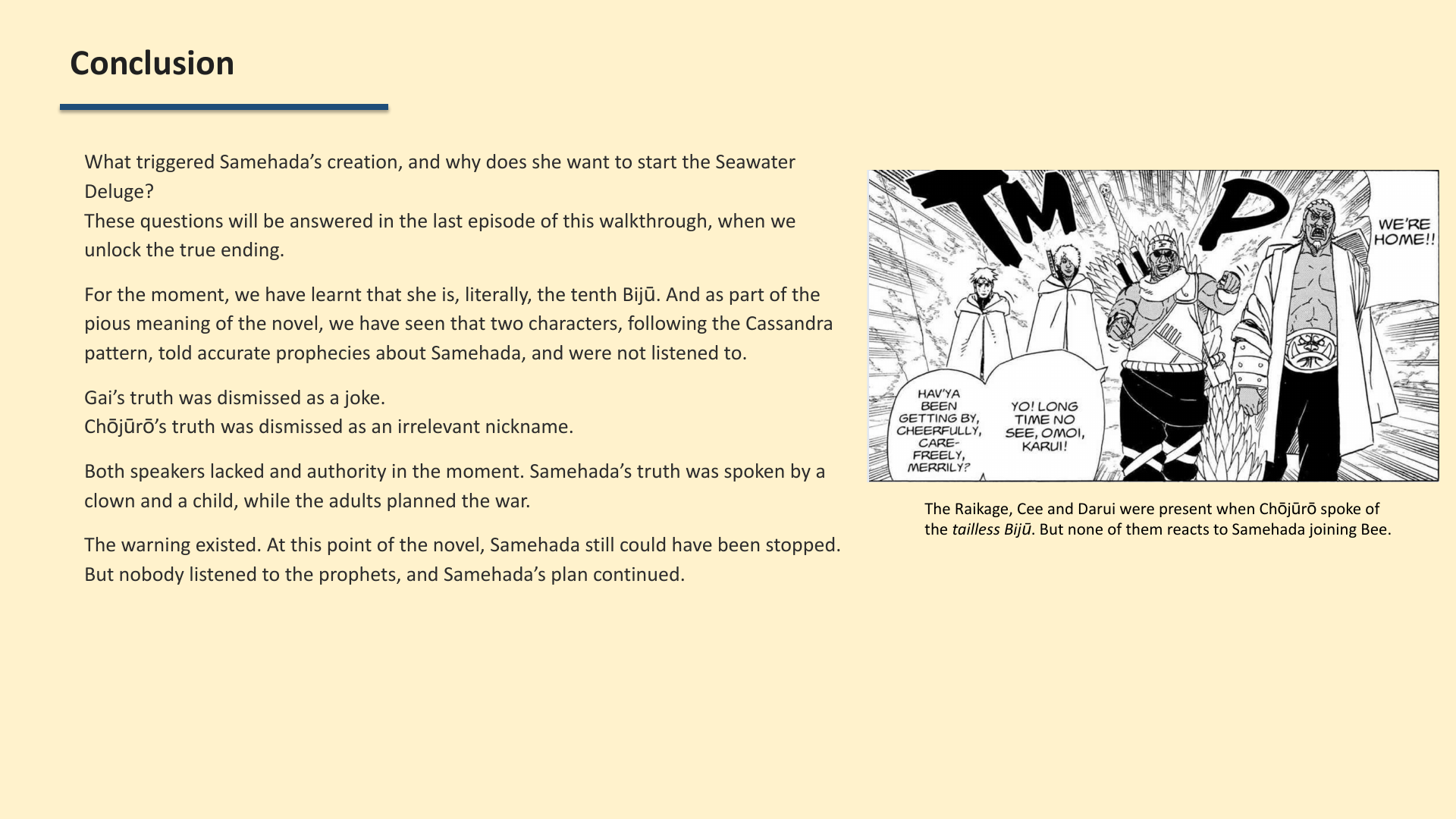
Had the Kage paid attention, they might have realised that investigating Kisame and his sword should be their priority. When they saw Samehada worm her way into Bee’s and Naruto’s group, they may have realised what was happening.

Instead, they dismissed the shy child, and just like with Gai, no one heeded the warning, not even Chōjūrō himself.

Samehada herself tells Bee what she is. (Chapter 471.)

Ōnoki dismissing Chōjūrō’s prophecy, chapter 468.

Conclusion

Slide 6: Conclusion
Read slide transcript

Conclusion

What triggered Samehada’s creation, and why does she want to start the Seawater Deluge? These questions will be answered in the last episode of this walkthrough, when we unlock the true ending.

For the moment, we have learnt that she is, literally, the tenth Bijū. And as part of the pious meaning of the novel, we have seen that two characters, following the Cassandra pattern, told accurate prophecies about Samehada, and were not listened to.

Gai’s truth was dismissed as a joke. Chōjūrō’s truth was dismissed as an irrelevant nickname.

Both speakers lacked and authority in the moment. Samehada’s truth was spoken by a clown and a child, while the adults planned the war.

The warning existed. At this point of the novel, Samehada still could have been stopped. But nobody listened to the prophets, and Samehada’s plan continued.

The Raikage, Cee and Darui were present when Chōjūrō spoke of the tailless Bijū. But none of them reacts to Samehada joining Bee.