Main quest

Episode 19 — Seawater
Kisame's Seawater Suiton

Episode 19 — Seawater

Slide 1: Episode 19 — Seawater
Read slide transcript

Naruto Walkthrough — Reader Edition

Episode 19 — Seawater

Before we can move on to the pious ending, we need to have a look at Kisame’s elemental ninjutsu, seawater Suiton.

In this episode, we will study some scientific trivia and see how, in the context of a Naruto battle, seawater would differ from the freshwater that is created by ordinary Suiton users. As we are about to find out, Seawater Suiton counter most of the ninjutsu seen in Naruto.

This episode may seem strange at first, as it might look like a power-scaling detour in an otherwise plot-focused walkthrough. But power-scaling is not the point.

Seawater will be one of the keys to unlock the pious meaning. This episode will make sense a bit later in the walkthrough.
The basic difference: dissolved ions

Slide 2: The basic difference: dissolved ions
Read slide transcript

The basic difference: dissolved ions

The rest of the episode follows from this one difference.

Freshwater is mostly H₂O with relatively few dissolved ions.

Seawater is H₂O plus dissolved salts — especially sodium ions (Na⁺) and chloride ions (Cl⁻).

Typical ocean salinity is about 35 parts per thousand: roughly 35 g of dissolved salts per kg of seawater.

Those ions make seawater chemically active:

more conductive;

slightly denser;

lower freezing point;

buffered against acid;

able to leave salt residue after drying or evaporation.

Raiton: diffusion

Slide 3: Raiton: diffusion
Read slide transcript

Raiton: diffusion

Seawater conducts electricity far better than freshwater because ions carry charge. On the surface, you might think it would make seawater users weak against Raiton, but it’s actually the opposite.

Conductivity makes lightning harder to aim cleanly.

A Raiton user wants a directed attack: current goes into the enemy. Seawater doesn’t allow that, because it gives the current many possible paths.

The result is a dangerous area hazard:

nearby targets can still be injured;

the user’s allies may also be endangered;

but the attack becomes less target-selective.

Additionally, since seawater is more conductive than the human body, the current will tend to stick to the better pathway, the water, to conduct itself, thus mitigating the damage to some extent. This is why the danger of electrocution in seawater is less than it would be in freshwater, which is less conductive than the human body.

That does not make underwater targets completely immune to Raiton. A powerful Raiton will still be lethal. But in a large seawater body, like Kisame’s Seawater Dome, aiming cleanly at the target would be difficult, especially from a distance.

Source: https://www.usgs.gov/water-science-school/science/conductivity-electrical-conductance-and-water

Signal techniques: seawater disrupts control

Slide 4: Signal techniques: seawater disrupts control
Read slide transcript

Signal techniques: seawater disrupts control

In the previous slide, we saw that seawater’s conductivity counters Raiton techniques. It does something even better: countering radio waves.

Transmitting such signals (wi-fi…) underwater is a challenge, but it is especially difficult with seawater. Seawater acts as a strong conductor; when radio waves enter it, they induce electric currents that dissipate the wave's energy as heat.

This phenomenon is especially true with high frequency waves. In seawater, their skin depth (the distance a signal penetrates before weakening significantly) drops to mere centimeters.

In Naruto, this means that Pain would not work at all if there is any seawater between Nagato and his paths.

Low frequency networks could mitigate this problem to some extent — and even then, only for a few meters. For example, Very Low Frequency (VLF) signals (3–30 kHz) can penetrate seawater to depths of roughly 20 to 30 meters. But that would not be a practical solution, because you’re trading penetration for data rate.

In battle, the Paths of Pain require fast, precise control. So Nagato has to rely on a high frequency chakra network ­— and indeed, he was only seen operating Pain when Nagato himself was nearby.

In short: a single seawater Suiton would deactivate Pain.

Sources: https://www.navy-radio.com/commsta-elf.htm https://ieeexplore.ieee.org/document/10442634 https://www.nature.com/articles/s41598-023-45663-6 https://computer.rip/2026-05-09-extremely-low-frequencies.html

Osmosis: the rule behind several counters

Slide 5: Osmosis: the rule behind several counters
Read slide transcript

Osmosis: the rule behind several counters

https://www.ebsco.com/research-starters/science/osmosis: “Osmosis is the process by which molecules of a solvent pass through a semipermeable membrane that is separating two solutions with differing concentrations of solute. The solvent moves from the solution with the lower concentration (the hypotonic solution) toward the one with the higher concentration (the hypertonic solution).”

In our case, the solvent is water, and the solute is salt. For amphibians, seawater is hypertonic: saltier than their body fluids. The ocean would be lethal for such animals, because osmosis would cause water to leave their body, causing dehydration.

In a Naruto context, that makes Seawater Suiton a hostile environment for toads. A normal, freshwater Suiton would be their habitat, but a Seawater Suiton would hurt them just by touching them.

Osmosis would also make seawater a natural counter to the Hōzuki liquefaction.

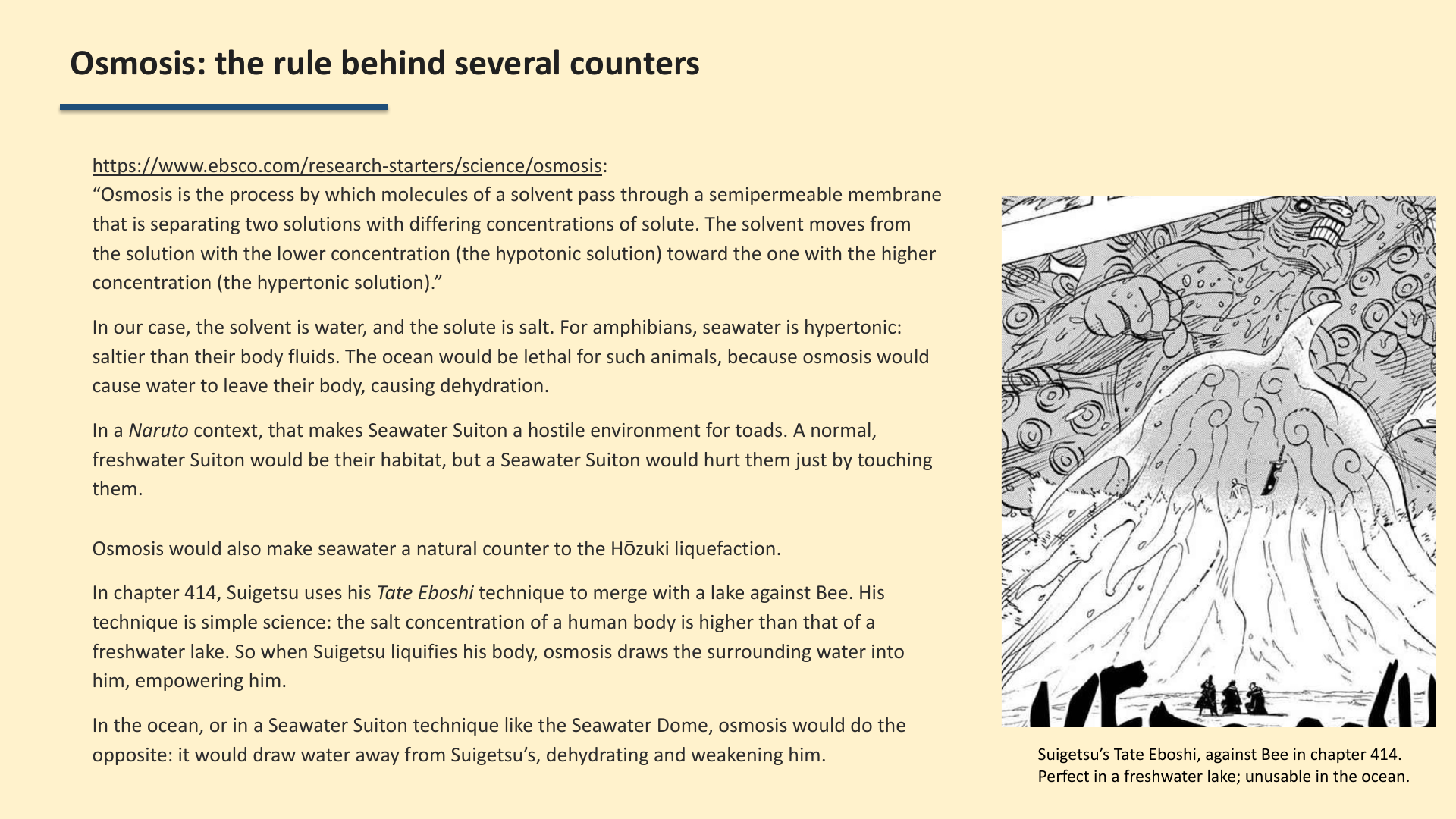
In chapter 414, Suigetsu uses his Tate Eboshi technique to merge with a lake against Bee. His technique is simple science: the salt concentration of a human body is higher than that of a freshwater lake. So when Suigetsu liquifies his body, osmosis draws the surrounding water into him, empowering him.

In the ocean, or in a Seawater Suiton technique like the Seawater Dome, osmosis would do the opposite: it would draw water away from Suigetsu’s, dehydrating and weakening him.

Suigetsu’s Tate Eboshi, against Bee in chapter 414. Perfect in a freshwater lake; unusable in the ocean.

Mokuton: plants drink freshwater, not seawater

Slide 6: Mokuton: plants drink freshwater, not seawater
Read slide transcript

Mokuton: plants drink freshwater, not seawater

Ordinary Suiton seems weak against Mokuton because freshwater feeds plants. Fittingly, in Naruto, Mokuton is the combination of two elements: Suiton and Doton

Seawater reverses the relation. Seawater is poisonous to trees, for the following reasons:

osmotic stress — water becomes harder to take up, as we saw in the previous slide;

ion toxicity — too much Na⁺ / Cl⁻ disrupts cellular processes;

growth inhibition — plants spend energy surviving instead of growing.

Seawater Suiton would therefore be strong counter to Mokuton, as seawater would create a hostile, poisonous environment for the trees that the Mokuton user is trying to grow.

Note: certain specific trees, such as the mangrove, grow in coastal areas. While they do not grow directly in seawater, they are salt-tolerant enough to handle the high tides of the sea. They notably use their roots as filtration systems to keep the salt out. But if you look at the Mokuton techniques uses in Naruto, you can tell their trees aren’t mangroves.

https://www.ars.usda.gov/arsuserfiles/20361500/pdf_pubs/P1139.pdf

Buffering: seawater resists acidification

Slide 7: Buffering: seawater resists acidification
Read slide transcript

Buffering: seawater resists acidification

Acidic techniques were seen a couple of times in Naruto, first used by Katsuyu, and then by Mei, with her acidic variant of Futton. Seawater is a strong counter to them.

Suiton in general could be seen as a counter to acid, but freshwater mainly helps against acid by dilution. So depending on the acid centration, and on the quantities of acid and water, the dilution might not be enough to protect the Suiton user.

Seawater is different. It also helps by dilution, but more importantly, by buffering.

The ocean contains bicarbonate (HCO₃⁻) and carbonate (CO₃²⁻) ions.

These can accept hydrogen ions (H⁺), resisting sudden pH change:

HCO₃⁻ + H⁺ → H₂CO₃

CO₃²⁻ + H⁺ → HCO₃⁻

Of course, if you kept pouring acid into seawater, the buffer would eventually be overwhelmed, but considering the magnitude of seawater techniques in Naruto, such a scenario seems implausible.

That makes seawater much better than unbuffered freshwater at resisting acidification. It’s not a matter of power: seawater wins with chemistry.

Source: https://oceanacidification.noaa.gov/what-is-ocean-acidification/

Paper: seawater keeps attacking after it dries

Slide 8: Paper: seawater keeps attacking after it dries
Read slide transcript

Paper: seawater keeps attacking after it dries

Konan’s paper can handle ordinary rain and water; she proved it when she fought Obito. So the counter is not simply “paper gets wet.”

The counter is salt residue.

Saltwater-damaged paper can warp as it dries, and salt crystals can scratch or contaminate surfaces. For explosive tags or sealing formulas, this would be devastating, as any damage to the written patterns would stop the tag from activating.

In fact, seawater can be so damaging that, if a paper document gets affected by seawater, it is recommended to first rinse it with freshwater.

In a Naruto context, explosive tags wouldn’t work at all in seawater.

Source: https://www.polygongroup.com/en-US/blog/salt-water-vs.-fresh-water-damage-how-will-your-documents-fare/

Yōton: lava plus seawater creates hazards

Slide 9: Yōton: lava plus seawater creates hazards
Read slide transcript

Yōton: lava plus seawater creates hazards

Lava meeting seawater can create secondary hazards:

steam;

acidic volcanic haze in surface interactions;

tiny glass particles;

chemical contamination.

Laze is highly corrosive, because of the hydrochloric acid it contains (pH between 1.5 and 3.5), and causes severe respiratory damage.

Lava users cannot treat seawater as neutral terrain: if they use a Yōton technique to close to seawater, they will create their own hostile chemical environment.

In Naruto, a Seawater Suiton technique meeting a Yōton technique would be especially catastrophic if the interaction happened close to the Yōton user, as would for example be the case with Rōshi’s lava armour (“Yōton Chakra Mode”).

Source: https://time.com/5285449/hawaii-kilauea-laze-lava/

Smaller effects

Slide 10: Smaller effects
Read slide transcript

Smaller effects

We have seen the main counters, but for the sake of scientific trivia, let’s mention a few minor ones — not hugely relevant in a Naruto battle battle, but still worth knowing.

Freezing:

Salt lowers water’s freezing point. Typical seawater freezes around −2°C instead of 0°C. Hyōton would therefore be harder to use in a saline environment — although a Hyōton master can probably overcome this. https://journals.ametsoc.org/view/journals/atot/23/12/jtech1946_1.xml

Corrosion:

Seawater accelerates corrosion of many metals because of chloride ions and conductivity. That would make it counters to shurikens, mechanisms, puppets joints — although obviously not fast enough to matter in a Naruto battle. https://cordis.europa.eu/project/id/501571/reporting

Katon:

Seawater boils at about 102°C, as opposed to 100°C for freshwater, because its salt lowers vapor pressure. That would make it slightly more resistant to Katon — although again, not to the point of incapacitating a strong Katon user.

But the main counter Seawater Suiton has against Katon would be residue. When heat turns seawater into steam, mist, or spray, the H₂O can leave — but the salt remains. This typically creates salt-laden mist / aerosol that scatters light, worsening line-of-sight conditions — which would be especially useful when you consider than the best Katon users generally also are Sharingan users.

These are not decisive counters, but they reinforce the pattern: seawater keeps changing the rules.

Now return to Kisame’s battle record

Slide 11: Now return to Kisame’s battle record
Read slide transcript

Now return to Kisame’s battle record

At this point, you may be wondering: is there any evidence that Kisame’s Suiton are made of seawater?

We have a strong clue. Now that the science is in place, please have a look at Kisame’s battles throughout the novel.

In total, Kisame had seven fights that we know of.

According to the science we just saw, a Seawater Suiton would have behaved similarly to a normal Suiton in four of them: against Asuma’s team, against Gai’s Team, against Bee (an octopus wouldn’t have had any obvious buoyancy issue in seawater), and again against Gai. On the other hand, seawater would have behaved differently against Jiraiya (osmosis hurting his toad), Suigetsu (osmosis again), and Rōshi (laze).

Can you see the pattern? Every single time a Seawater Suiton could pass as an ordinary Suiton, Kisame used at least one. And every single time a Seawater Suiton would have not behaved as a normal Suiton, Kisame did not use any. Out of seven fights, what were the odds?

So Samehada is hiding that her Suiton are not normal. One particularly interesting case should be the final evidence: the fight against Rōshi. Please take your novel to chapter 353; can you see what happened?

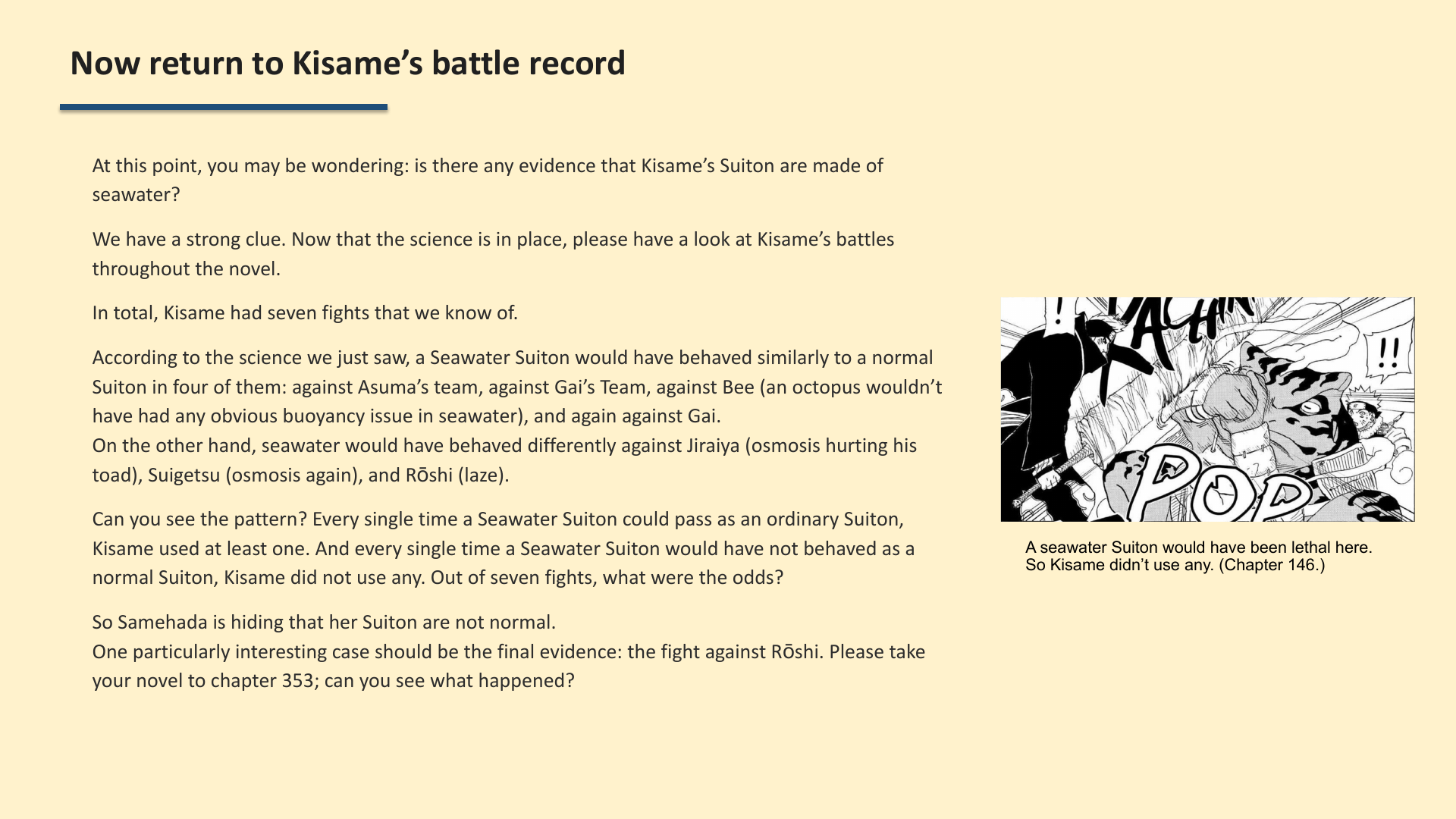
A seawater Suiton would have been lethal here. So Kisame didn’t use any. (Chapter 146.)

The Rōshi fight

Slide 12: The Rōshi fight
Read slide transcript

The Rōshi fight

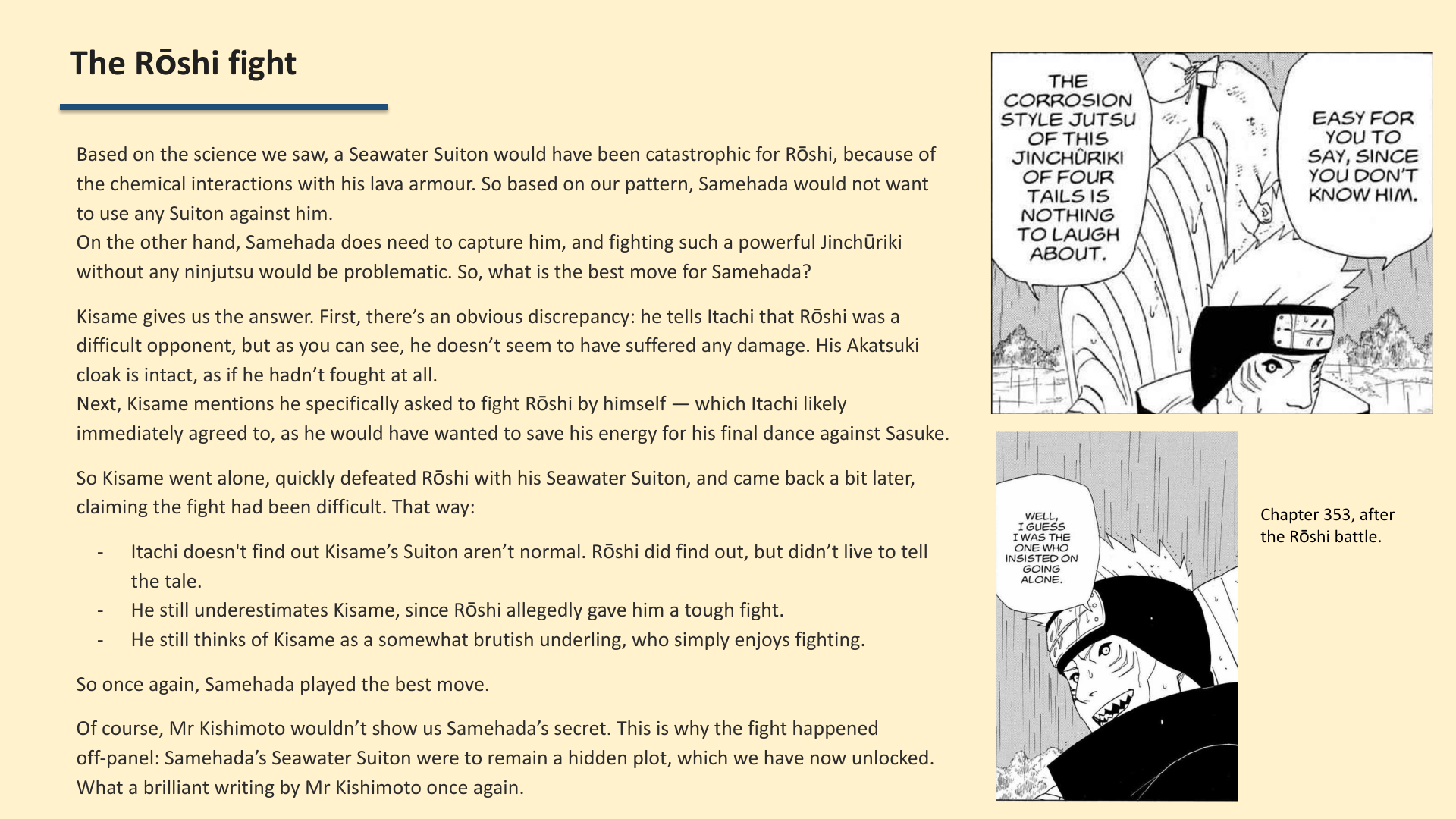
Based on the science we saw, a Seawater Suiton would have been catastrophic for Rōshi, because of the chemical interactions with his lava armour. So based on our pattern, Samehada would not want to use any Suiton against him. On the other hand, Samehada does need to capture him, and fighting such a powerful Jinchūriki without any ninjutsu would be problematic. So, what is the best move for Samehada?

Kisame gives us the answer. First, there’s an obvious discrepancy: he tells Itachi that Rōshi was a difficult opponent, but as you can see, he doesn’t seem to have suffered any damage. His Akatsuki cloak is intact, as if he hadn’t fought at all. Next, Kisame mentions he specifically asked to fight Rōshi by himself — which Itachi likely immediately agreed to, as he would have wanted to save his energy for his final dance against Sasuke.

So Kisame went alone, quickly defeated Rōshi with his Seawater Suiton, and came back a bit later, claiming the fight had been difficult. That way:

Itachi doesn't find out Kisame’s Suiton aren’t normal. Rōshi did find out, but didn’t live to tell the tale.

He still underestimates Kisame, since Rōshi allegedly gave him a tough fight.

He still thinks of Kisame as a somewhat brutish underling, who simply enjoys fighting.

So once again, Samehada played the best move.

Of course, Mr Kishimoto wouldn’t show us Samehada’s secret. This is why the fight happened off-panel: Samehada’s Seawater Suiton were to remain a hidden plot, which we have now unlocked. What a brilliant writing by Mr Kishimoto once again.

Chapter 353, after the Rōshi battle.

Conclusion

Slide 13: Conclusion
Read slide transcript

Conclusion

In this episode, we found that Kisame uses Seawater Suiton, and we learnt that seawater is chemically active water.

Please keep in mind the matchups in which Seawater Suiton would make a major difference compared to a normal Suiton, specifically those three: explosive tags; Mokuton; Paths of Pain. They will be relevant soon enough.

With that, we are ready for the final part of this walkthrough: the pious meaning of the novel.