Pious meaning

Episode 24 — The fake protagonist

The title itself is a clue

Episode 24 — The false Messiah and the fake protagonist
Slide 1: Episode 24 — The false Messiah and the fake protagonist
Read slide transcript

Naruto Walkthrough — Reader Edition

Episode 24 — The false Messiah and the fake protagonist

In this episode, we will focus on Naruto himself. On the surface, Naruto might seem like a frustrating, poorly written protagonist, as his philosophy and his sermons, such as forgiveness and not giving up, seem too simple for the world he lives in. He feels like a Shōnen protagonist shoehorned into what should have been a Seinen manga.

At times, Naruto even seems to vampirise the story, resolving conflicts that, from the reader’s perspective, were more interesting before Naruto arrived. For example, the Hidan and Kakuzu battle was an opportunity to develop Team 10, but their development was cut short when Naruto arrived and fought Kakuzu by himself, leaving Chōji and Ino out of their own quest for revenge.

Fortunately, as always with Mr Kishimoto, this was intentional. Naruto is not a manga, but a detective novel, and the Naruto character is part of our investigation.

In this episode, we will find Naruto’s true role in the novel, and once we have his role in mind, we will realise Naruto is actually an excellent character, wonderfully written by Mr Kishimoto.
The messianic image

Slide 2: The messianic image
Read slide transcript

The messianic image

In previous episodes, we saw a pattern with human gods, angels and messiahs, with a deeper focus on Kabuto and Konan: they spectacularly fail, for they are fake gods. Naruto follows this pattern.

We are told that Naruto is the Child of Prophecy, meant to change the world. He promises be will bring peace; he redeems and converts his enemies, such as Gaara, Nagato and Obito; he promises he will save Sasuke too…

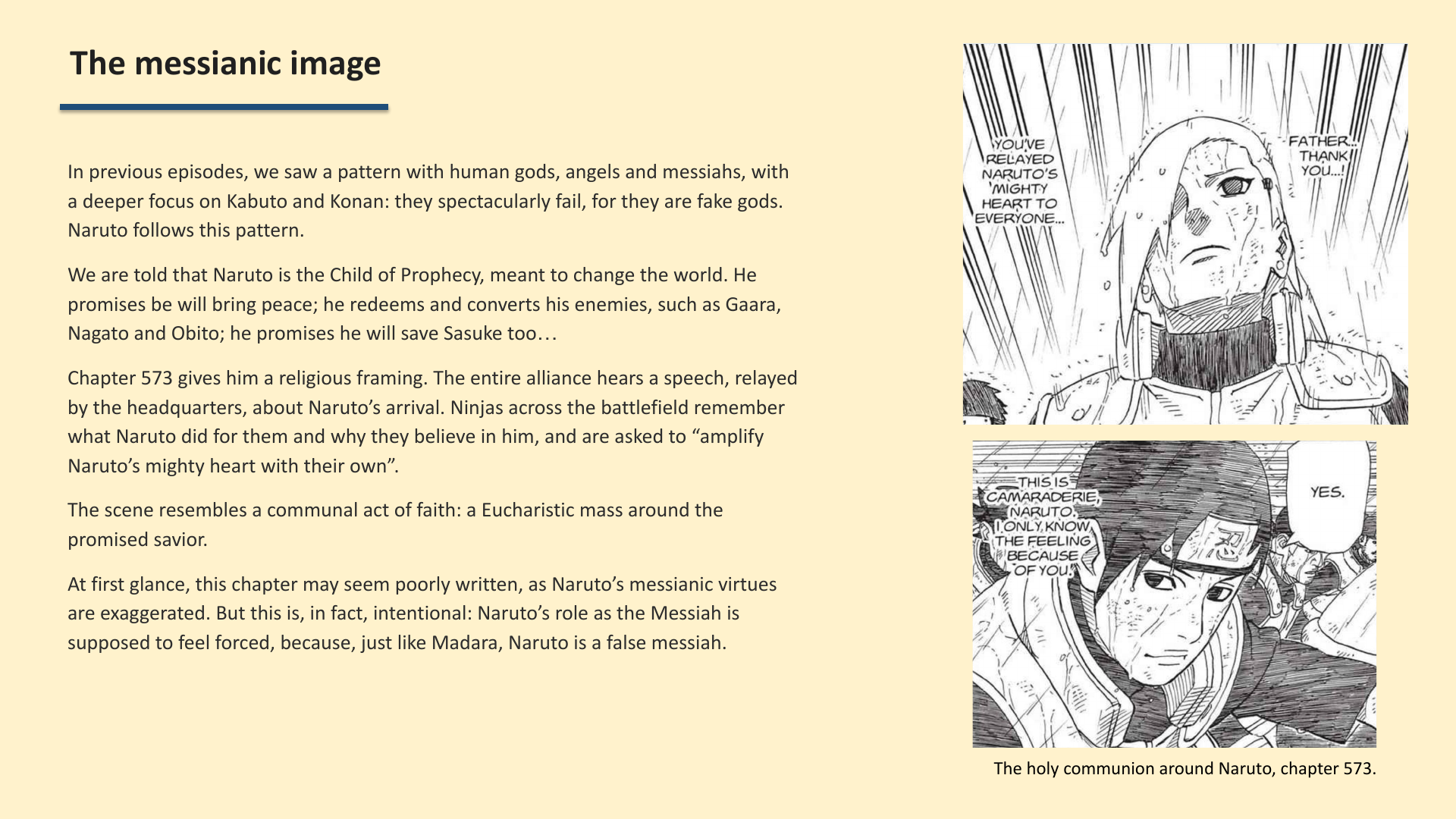
Chapter 573 gives him a religious framing. The entire alliance hears a speech, relayed by the headquarters, about Naruto’s arrival. Ninjas across the battlefield remember what Naruto did for them and why they believe in him, and are asked to “amplify Naruto’s mighty heart with their own”.

The scene resembles a communal act of faith: a Eucharistic mass around the promised savior.

At first glance, this chapter may seem poorly written, as Naruto’s messianic virtues are exaggerated. But this is, in fact, intentional: Naruto’s role as the Messiah is supposed to feel forced, because, just like Madara, Naruto is a false messiah.

The holy communion around Naruto, chapter 573.

False messiah: comfort without salvation

Slide 3: False messiah: comfort without salvation
Read slide transcript

False messiah: comfort without salvation

Naruto can reach and comfort wounded individuals, but he cannot solve the structures that created them.

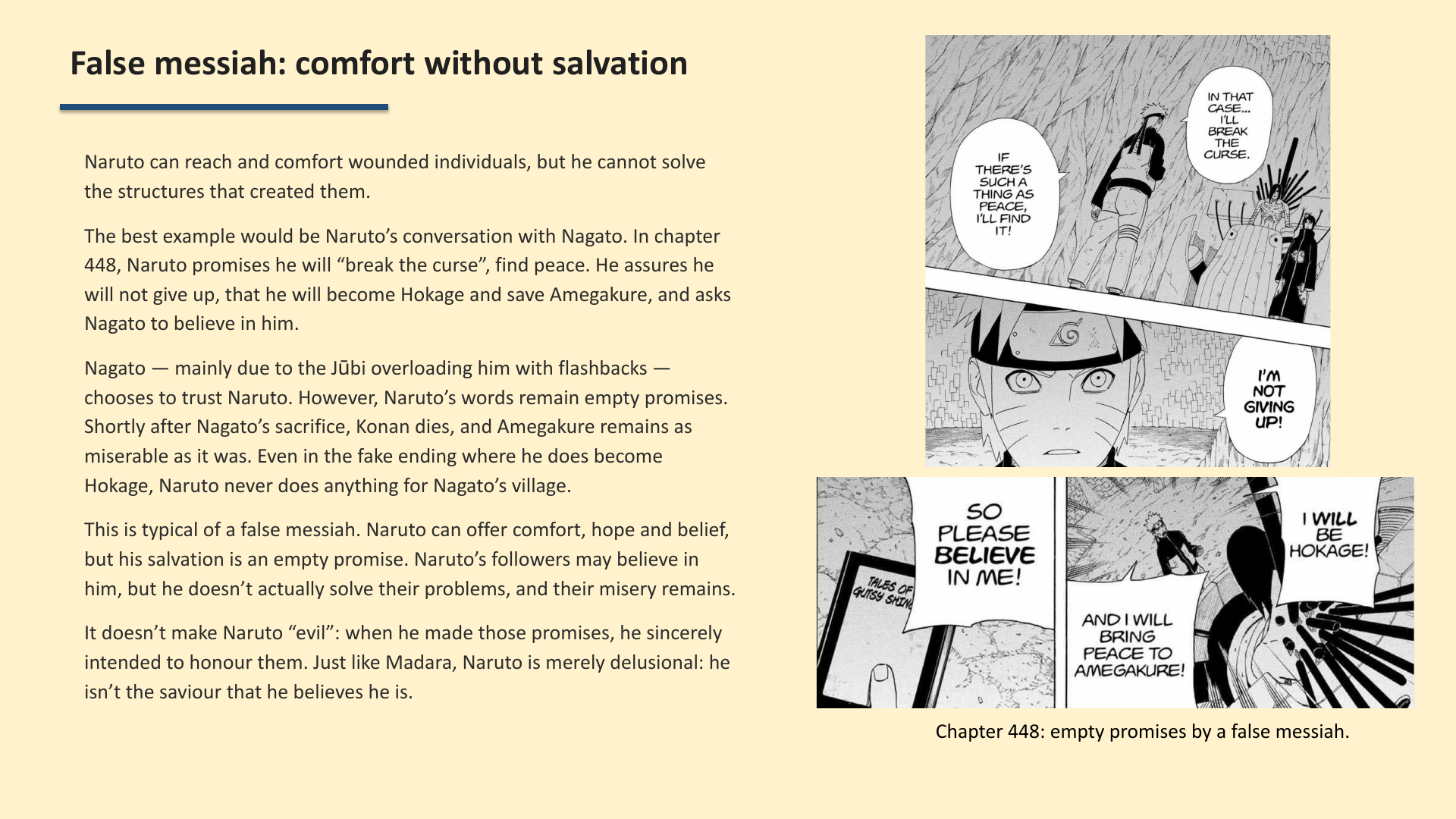
The best example would be Naruto’s conversation with Nagato. In chapter 448, Naruto promises he will “break the curse”, find peace. He assures he will not give up, that he will become Hokage and save Amegakure, and asks Nagato to believe in him.

Nagato — mainly due to the Jūbi overloading him with flashbacks — chooses to trust Naruto. However, Naruto’s words remain empty promises. Shortly after Nagato’s sacrifice, Konan dies, and Amegakure remains as miserable as it was. Even in the fake ending where he does become Hokage, Naruto never does anything for Nagato’s village.

This is typical of a false messiah. Naruto can offer comfort, hope and belief, but his salvation is an empty promise. Naruto’s followers may believe in him, but he doesn’t actually solve their problems, and their misery remains.

It doesn’t make Naruto “evil”: when he made those promises, he sincerely intended to honour them. Just like Madara, Naruto is merely delusional: he isn’t the saviour that he believes he is.

Chapter 448: empty promises by a false messiah.

The war, protected moral environment

Slide 4: The war, protected moral environment
Read slide transcript

The war, protected moral environment

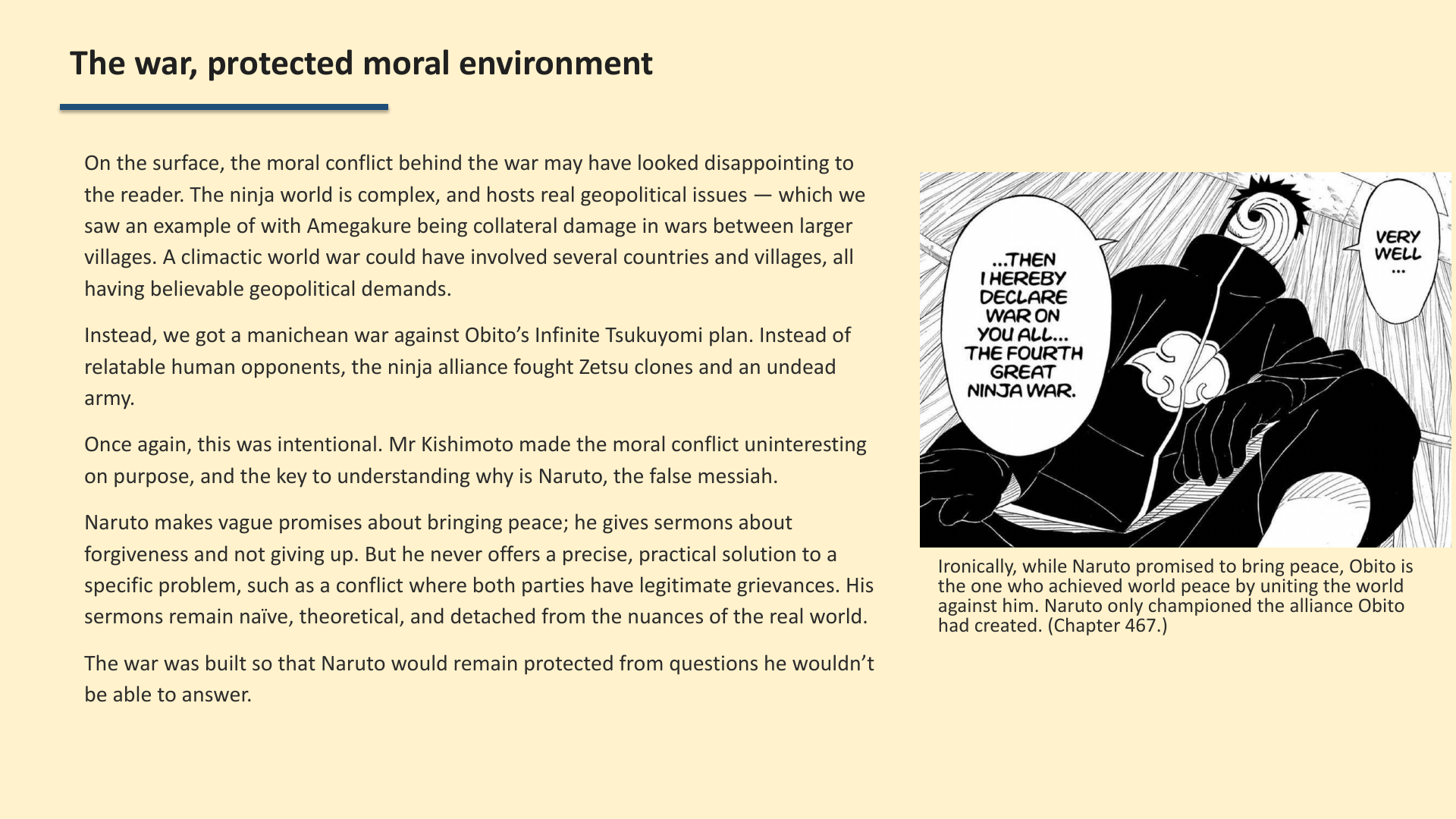
On the surface, the moral conflict behind the war may have looked disappointing to the reader. The ninja world is complex, and hosts real geopolitical issues — which we saw an example of with Amegakure being collateral damage in wars between larger villages. A climactic world war could have involved several countries and villages, all having believable geopolitical demands.

Instead, we got a manichean war against Obito’s Infinite Tsukuyomi plan. Instead of relatable human opponents, the ninja alliance fought Zetsu clones and an undead army.

Once again, this was intentional. Mr Kishimoto made the moral conflict uninteresting on purpose, and the key to understanding why is Naruto, the false messiah.

Naruto makes vague promises about bringing peace; he gives sermons about forgiveness and not giving up. But he never offers a precise, practical solution to a specific problem, such as a conflict where both parties have legitimate grievances. His sermons remain naïve, theoretical, and detached from the nuances of the real world.

The war was built so that Naruto would remain protected from questions he wouldn’t be able to answer.

Ironically, while Naruto promised to bring peace, Obito is the one who achieved world peace by uniting the world against him. Naruto only championed the alliance Obito had created. (Chapter 467.)

A war against plants and zombies

Slide 5: A war against plants and zombies
Read slide transcript

A war against plants and zombies

A grieving mother, desperate to see her son again, sides with Obito and fights the alliance. Would Naruto be able to fight her? To kill her?

An enemy whom Naruto spared, as he often does, returns to Obito’s side, and later murders one of Naruto’s friends. How would Naruto handle that situation?

Such situations never happen, and Naruto is never confronted to moral dilemmas. During the war, he mostly fights Zetsu clones and Edo Tensei corpses; he is never forced to take a human life. Likewise, when he spares a human enemy, as he did with Nagato, it never backfires.

This intentional: Naruto is a false messiah, and his mercy is staged where it does not have to pay its full price. Naruto's preaches are supposed to sound unconvincing, because he only delivers them in a controlled environment, where peace and forgiveness are the easiest choice and don’t require any sacrifice.

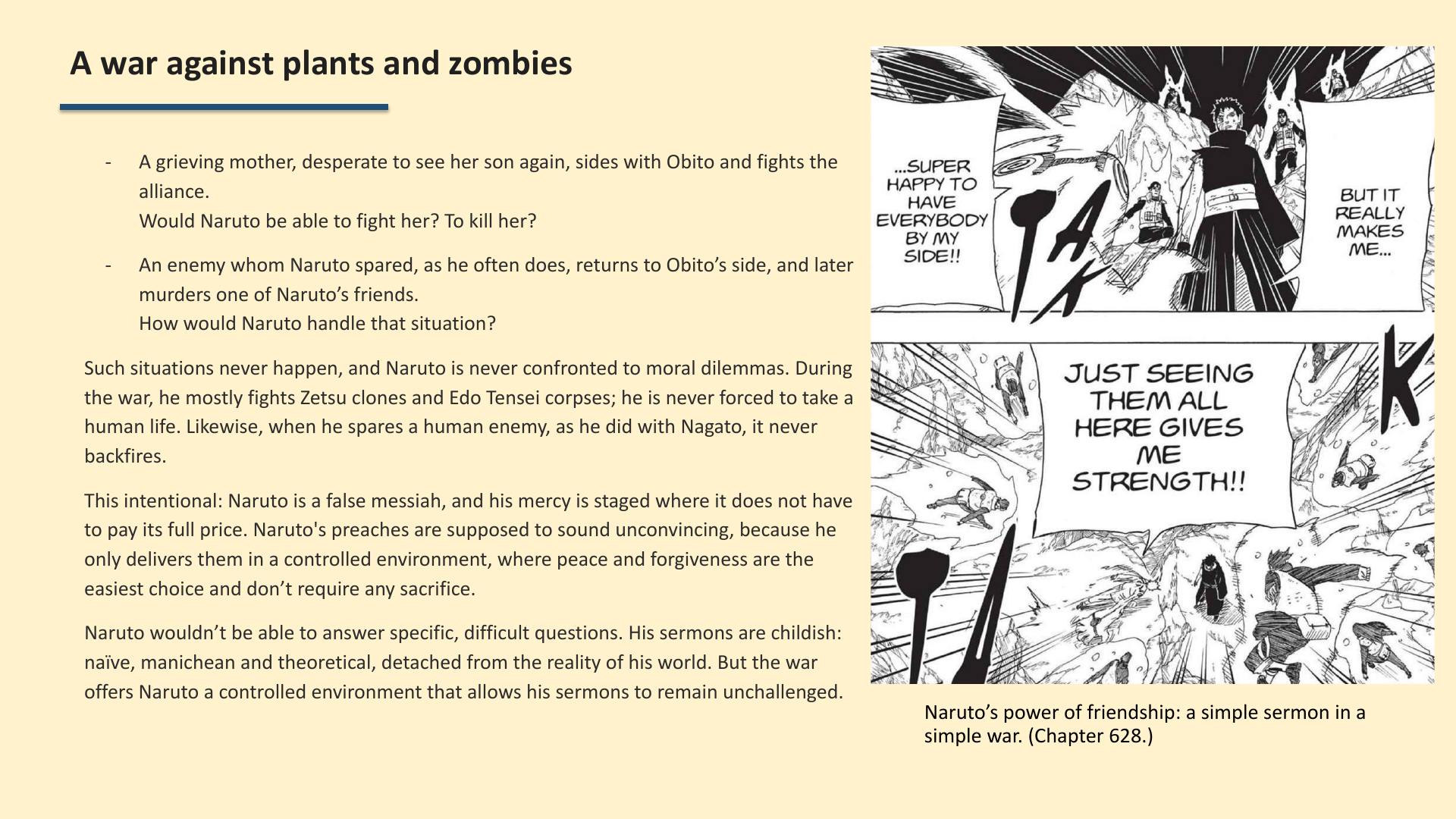
Naruto wouldn’t be able to answer specific, difficult questions. His sermons are childish: naïve, manichean and theoretical, detached from the reality of his world. But the war offers Naruto a controlled environment that allows his sermons to remain unchallenged.

Naruto’s power of friendship: a simple sermon in a simple war. (Chapter 628.)

Naruto’s victories are not fully his own

Slide 6: Naruto’s victories are not fully his own
Read slide transcript

Naruto’s victories are not fully his own

Let us look at Naruto’s main accomplishments, which earned him recognition, with the knowledge we have unlocked during the previous quests:

Naruto defeated Pain. → He did, except that Pain lost on purpose, as part of Nagato’s plan to murder Obito.

He redeemed Nagato. → On the surface, he did, but what really broke Nagato’s resolve was the Jūbi assaulting him with flashbacks.

He tamed the Kyūbi. → He did, but only thanks to Samehada suppressing the Kyūbi’s chakra.

He defeated Obito. → He did, but only because the Jūbi was sabotaging Obito from within, notably with the Rin flashbacks.

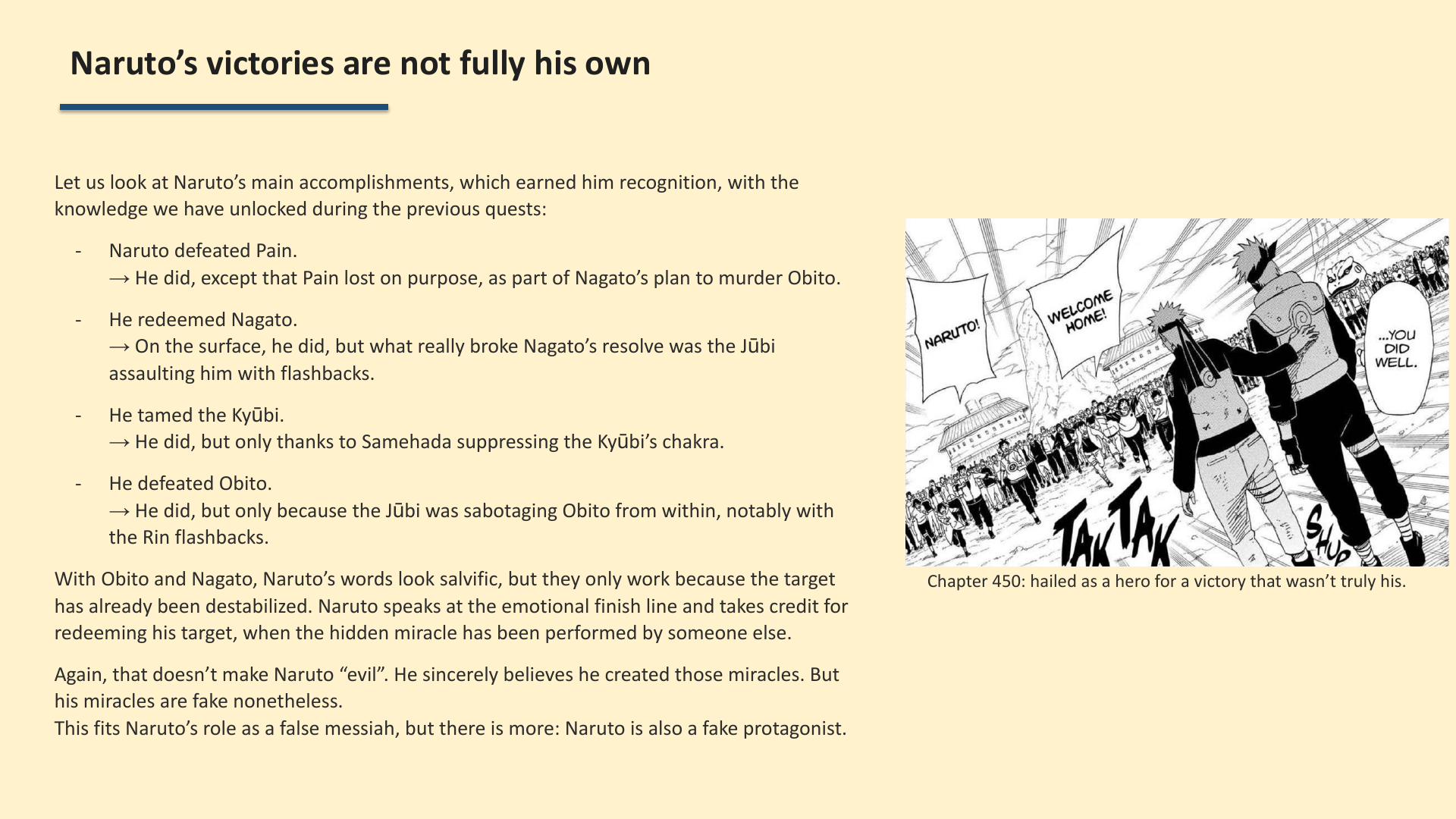
With Obito and Nagato, Naruto’s words look salvific, but they only work because the target has already been destabilized. Naruto speaks at the emotional finish line and takes credit for redeeming his target, when the hidden miracle has been performed by someone else.

Again, that doesn’t make Naruto “evil”. He sincerely believes he created those miracles. But his miracles are fake nonetheless. This fits Naruto’s role as a false messiah, but there is more: Naruto is also a fake protagonist.

Chapter 450: hailed as a hero for a victory that wasn’t truly his.

Naruto, the fake protagonist

Slide 7: Naruto, the fake protagonist
Read slide transcript

Naruto, the fake protagonist

Naruto seems to be the Naruto protagonist, but if we look deeper, he never makes meaningful decisions, and doesn’t get to drive the plot. Instead, he is used by more relevant characters:

Obito and the Jūbi use him to get rid of Nagato.

Nagato uses him to try to lure Obito into a trap.

Obito uses him to get rid of the Zetsu army.

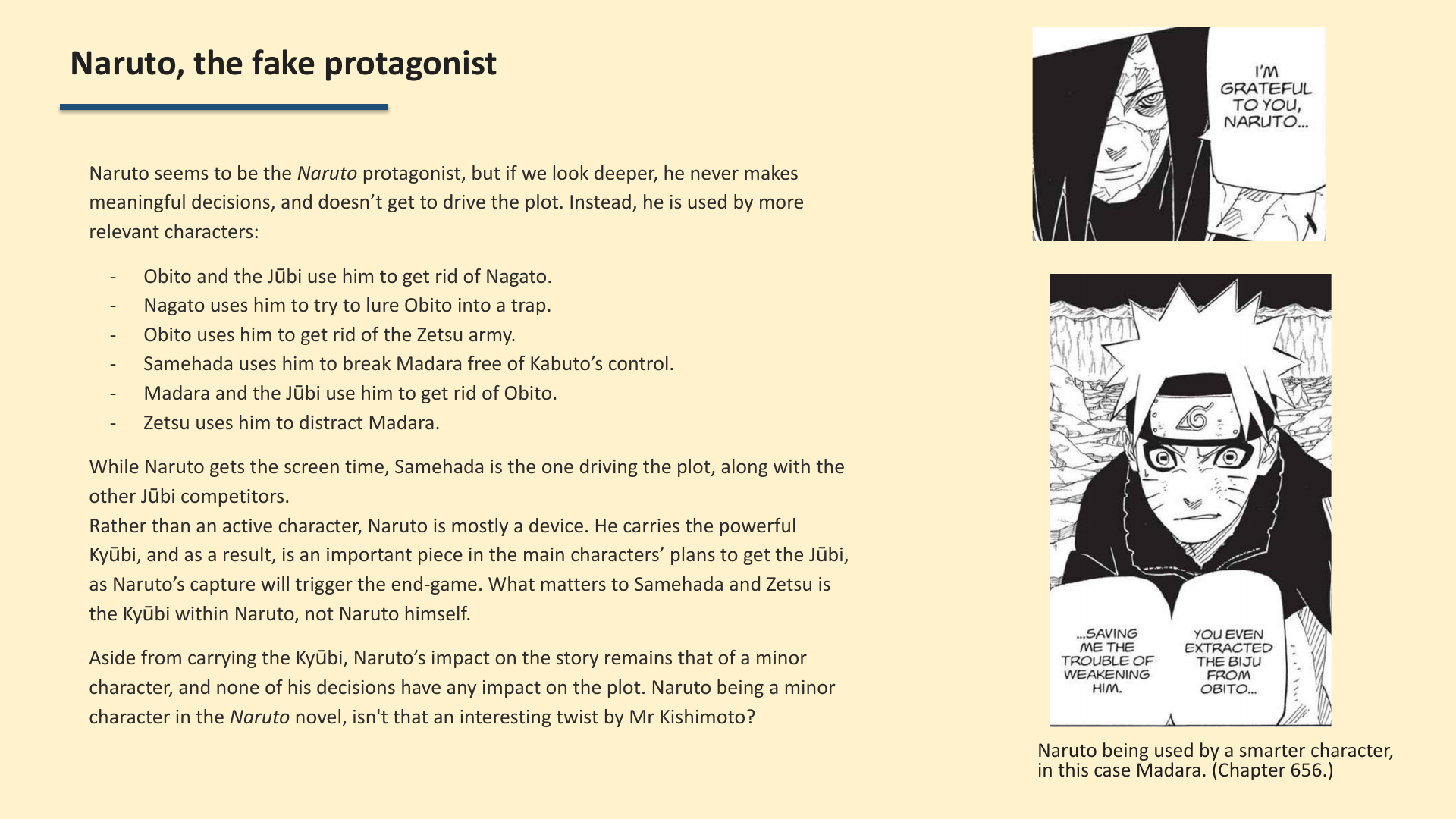
Samehada uses him to break Madara free of Kabuto’s control.

Madara and the Jūbi use him to get rid of Obito.

Zetsu uses him to distract Madara.

While Naruto gets the screen time, Samehada is the one driving the plot, along with the other Jūbi competitors. Rather than an active character, Naruto is mostly a device. He carries the powerful Kyūbi, and as a result, is an important piece in the main characters’ plans to get the Jūbi, as Naruto’s capture will trigger the end-game. What matters to Samehada and Zetsu is the Kyūbi within Naruto, not Naruto himself.

Aside from carrying the Kyūbi, Naruto’s impact on the story remains that of a minor character, and none of his decisions have any impact on the plot. Naruto being a minor character in the Naruto novel, isn't that an interesting twist by Mr Kishimoto?

Naruto being used by a smarter character, in this case Madara. (Chapter 656.)

Naruto, conclusion

Slide 8: Naruto, conclusion
Read slide transcript

Naruto, conclusion

There is a final meta-clue regarding Naruto’s role.

Naruto, as we have established throughout this walkthrough, is a detective novel. The protagonist of a detective novel usually is the detective. But Naruto doesn't solve any mystery ­­— he doesn't even see them. He does not identify Samehada. He doesn’t realise his mother is an impostor. He fights Obito and forgets about Madara. He doesn’t react to any clue, such as the Kotoamatsukami order doctored by Samehada. In fact, he walks right into his enemies’ plots, and unwittingly helps them reach their goals. So Naruto cannot be the protagonist of a detective novel.

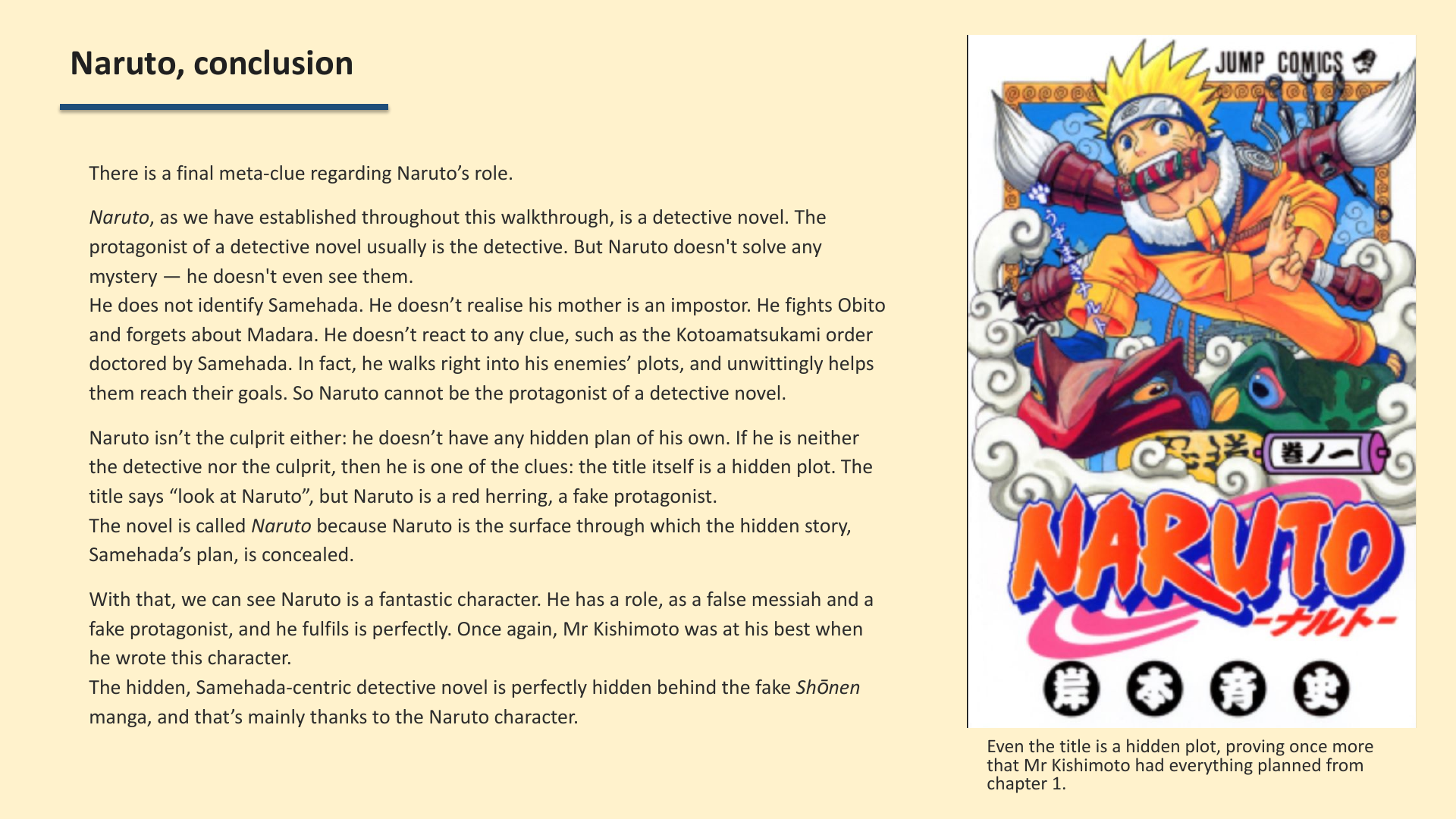
Naruto isn’t the culprit either: he doesn’t have any hidden plan of his own. If he is neither the detective nor the culprit, then he is one of the clues: the title itself is a hidden plot. The title says “look at Naruto”, but Naruto is a red herring, a fake protagonist. The novel is called Naruto because Naruto is the surface through which the hidden story, Samehada’s plan, is concealed.

With that, we can see Naruto is a fantastic character. He has a role, as a false messiah and a fake protagonist, and he fulfils is perfectly. Once again, Mr Kishimoto was at his best when he wrote this character. The hidden, Samehada-centric detective novel is perfectly hidden behind the fake Shōnen manga, and that’s mainly thanks to the Naruto character.

Even the title is a hidden plot, proving once more that Mr Kishimoto had everything planned from chapter 1.