Side quests

Episode 2 — Hiruzen’s second tutorial: more rules

Feats, statements, personalities, and even thoughts can be lies

Episode 2 — Hiruzen’s second tutorial: feats, statements thoughts, and personalities can be lies.
Slide 1: Episode 2 — Hiruzen’s second tutorial: feats, statements thoughts, and personalities can be lies.
Read slide transcript

Naruto Walkthrough — Reader Edition

Episode 2 — Hiruzen’s second tutorial: feats, statements thoughts, and personalities can be lies.

In the previous episode, under Hiruzen’s tutelage, we unlocked our first hidden plot: Mizuki’s mission, the novel’s tutorial.

Before we move on to our next quest, we need to learn a few more rules as to how the novel is to be read. Specifically, we will learn not to trust what we are shown and told: characters lie to each other, and lie to the reader.

Our teacher will once again be Hiruzen; let’s get started.
First rule — statements can be lies.

Slide 2: First rule — statements can be lies.
Read slide transcript

First rule — statements can be lies.

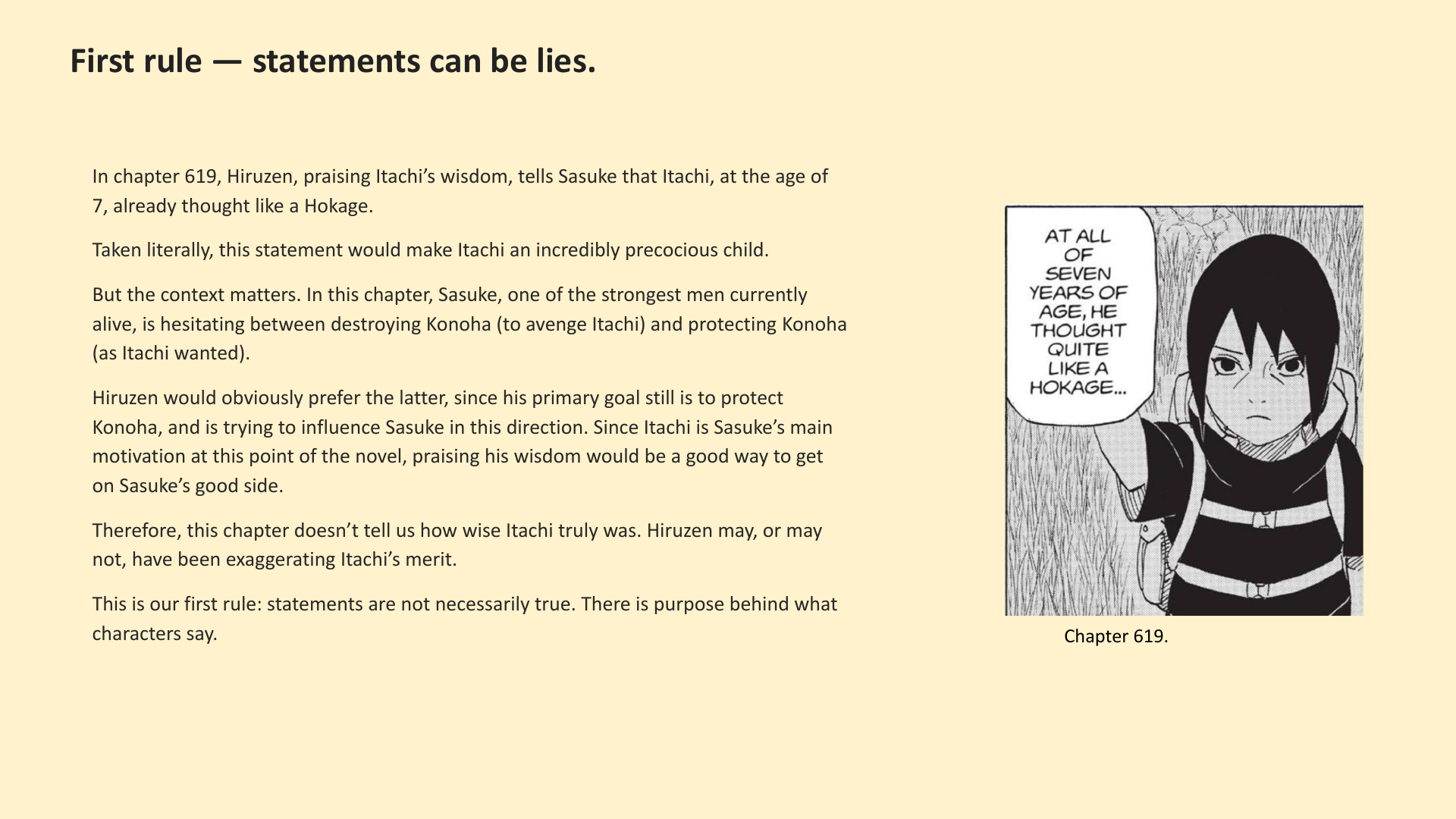
In chapter 619, Hiruzen, praising Itachi’s wisdom, tells Sasuke that Itachi, at the age of 7, already thought like a Hokage.

Taken literally, this statement would make Itachi an incredibly precocious child.

But the context matters. In this chapter, Sasuke, one of the strongest men currently alive, is hesitating between destroying Konoha (to avenge Itachi) and protecting Konoha (as Itachi wanted).

Hiruzen would obviously prefer the latter, since his primary goal still is to protect Konoha, and is trying to influence Sasuke in this direction. Since Itachi is Sasuke’s main motivation at this point of the novel, praising his wisdom would be a good way to get on Sasuke’s good side.

Therefore, this chapter doesn’t tell us how wise Itachi truly was. Hiruzen may, or may not, have been exaggerating Itachi’s merit.

This is our first rule: statements are not necessarily true. There is purpose behind what characters say.

Chapter 619.

Second rule — Feats and weaknesses can be staged

Slide 3: Second rule — Feats and weaknesses can be staged
Read slide transcript

Second rule — Feats and weaknesses can be staged

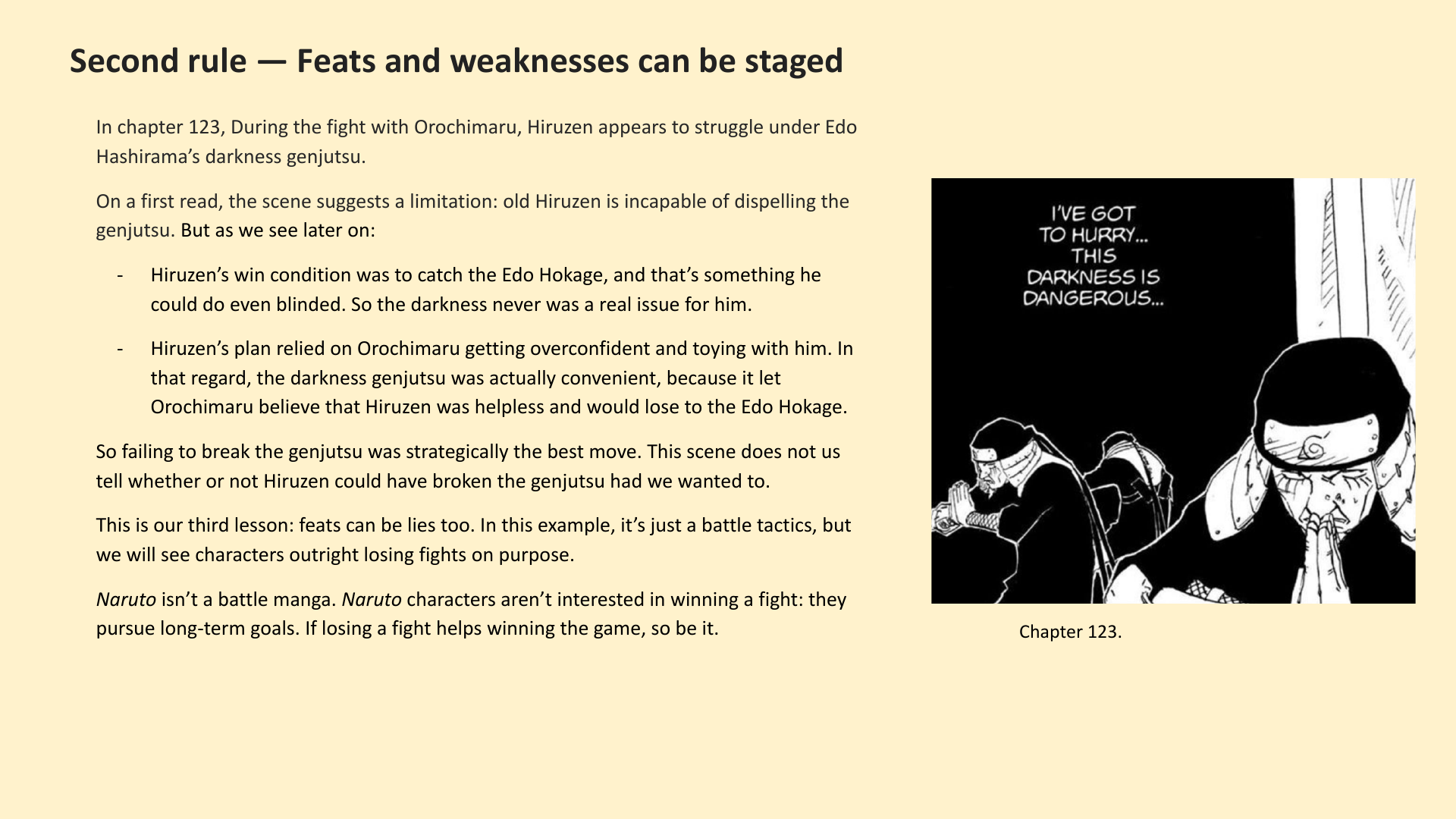
In chapter 123, During the fight with Orochimaru, Hiruzen appears to struggle under Edo Hashirama’s darkness genjutsu.

On a first read, the scene suggests a limitation: old Hiruzen is incapable of dispelling the genjutsu. But as we see later on:

Hiruzen’s win condition was to catch the Edo Hokage, and that’s something he could do even blinded. So the darkness never was a real issue for him.

Hiruzen’s plan relied on Orochimaru getting overconfident and toying with him. In that regard, the darkness genjutsu was actually convenient, because it let Orochimaru believe that Hiruzen was helpless and would lose to the Edo Hokage.

So failing to break the genjutsu was strategically the best move. This scene does not us tell whether or not Hiruzen could have broken the genjutsu had we wanted to.

This is our third lesson: feats can be lies too. In this example, it’s just a battle tactics, but we will see characters outright losing fights on purpose.

Naruto isn’t a battle manga. Naruto characters aren’t interested in winning a fight: they pursue long-term goals. If losing a fight helps winning the game, so be it.

Chapter 123.

Third rule — personalities can be a tool.

Slide 4: Third rule — personalities can be a tool.
Read slide transcript

Third rule — personalities can be a tool.

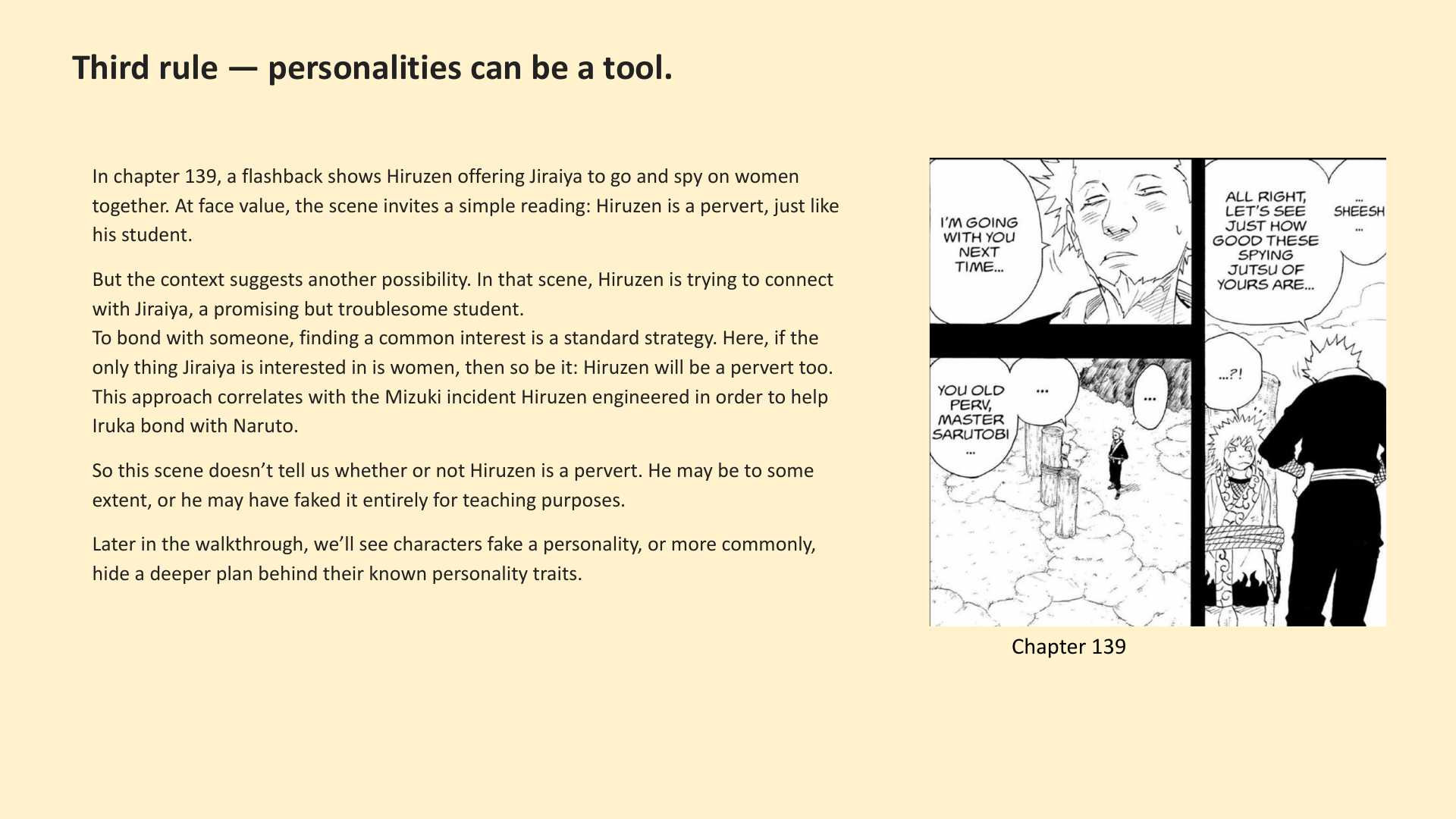
In chapter 139, a flashback shows Hiruzen offering Jiraiya to go and spy on women together. At face value, the scene invites a simple reading: Hiruzen is a pervert, just like his student.

But the context suggests another possibility. In that scene, Hiruzen is trying to connect with Jiraiya, a promising but troublesome student. To bond with someone, finding a common interest is a standard strategy. Here, if the only thing Jiraiya is interested in is women, then so be it: Hiruzen will be a pervert too. This approach correlates with the Mizuki incident Hiruzen engineered in order to help Iruka bond with Naruto.

So this scene doesn’t tell us whether or not Hiruzen is a pervert. He may be to some extent, or he may have faked it entirely for teaching purposes.

Later in the walkthrough, we’ll see characters fake a personality, or more commonly, hide a deeper plan behind their known personality traits.

Chapter 139

Fourth rule — even thoughts can be fake.

Slide 5: Fourth rule — even thoughts can be fake.
Read slide transcript

Fourth rule — even thoughts can be fake.

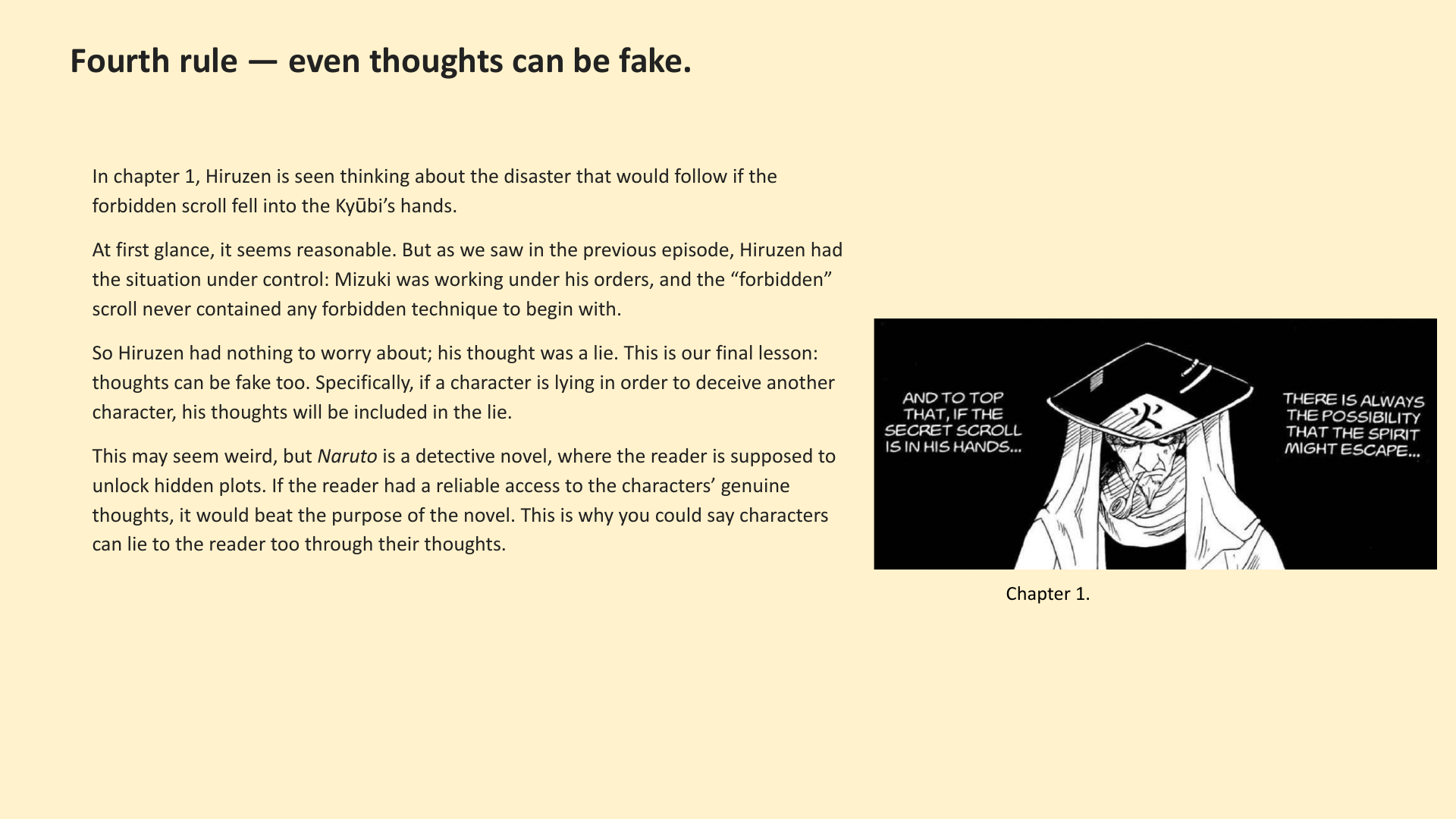
In chapter 1, Hiruzen is seen thinking about the disaster that would follow if the forbidden scroll fell into the Kyūbi’s hands.

At first glance, it seems reasonable. But as we saw in the previous episode, Hiruzen had the situation under control: Mizuki was working under his orders, and the “forbidden” scroll never contained any forbidden technique to begin with.

So Hiruzen had nothing to worry about; his thought was a lie. This is our final lesson: thoughts can be fake too. Specifically, if a character is lying in order to deceive another character, his thoughts will be included in the lie.

This may seem weird, but Naruto is a detective novel, where the reader is supposed to unlock hidden plots. If the reader had a reliable access to the characters’ genuine thoughts, it would beat the purpose of the novel. This is why you could say characters can lie to the reader too through their thoughts.

Chapter 1.

Conclusion

Slide 6: Conclusion
Read slide transcript

Conclusion

Thanks to Hiruzen, we have learnt that statements, feats, personas, and even thoughts can be exaggerated, or outright lies.

Naruto is a detective novel, not a Shōnen manga. It cannot be read with the assumption that everything we see is genuine. In order to unlock the true, Samehada ending, we will need to navigate a world of lies.

Note: this tutorial does not mean we can systematically dismiss every statement / thought we don’t like. Otherwise, if every single line were a lie, then reading Naruto would be impossible.

What Hiruzen taught us is that, if we have a solid hidden plot, with a discrepancy correlated to a reasonable character’s goal, then the relevant character may lie in the context of his plot.

Let us thank Hiruzen for this tutorial: thanks to his teaching, we are ready to start the side quests.